

🫀Interventional cardiology, critically appraised. 🤓Spending nights reading what matters in IC so you don't have to :) 👇🏻Start with the pinned post👇🏻
📍United States
Joined August 2026
- Tweets129
- Following90
- Followers16
- Likes82





Pinned Tweet
New to Cath Lab After Hours🤔? Start here.
Original visual appraisals of interventional cardiology latest evidence: the clinical question, the key result, the limitation that matters, and the source.
Explore three appraisals below, follow for the next one.

Amazing times for medical AI😍

Free tools built by clinicians for learning the many facets of cardiology🫀🩻⚡️🧮📚🕹️
Explore these resources👇🏼:
🩻Echocardiography: intro2echo.com by @David_Ouyang
🩻Angiography Views: angioview.com by @AnnasRahmanMD
⚡️Localize PVCs: learnpvcs.com by @Challa1218
⚡️Localize VTs: simvt.vercel.app by @ArunUMahtani
⚡️LBBAP Simulator: pacingsimulator.com by @jo3_assad
🩻LAA TEE/ICE/CT Simulator: laa.liorjankelson.com by @ExtraStim
🧮Interactive Core Cardiology Tools and Calculators: tools.rueyhu.com by @ruey_hu
📚Latest Trials and Guidelines: cardiolads.com by Jay Gohri, Adhish Beri, and @KochharGunjan
🩻Interactive M Mode: pulmonarypocus.com by @HoosierPocus
🕹️Night Float Simulator: cardsnightfloat.netlify.app by @AbedfromBeirut
🕹️Congenital Heart Disease, Pacemaker, ECG Simulators: cardiorender.com by Dinesh Raja P
This list keeps growing. Know a free, clinician-built tool that belongs here? Drop the link below
#Cardiology #CardioTwitter #MedEd #MedTwitter #FOAMed #VibeCoding #AI #AIinMedicine #LLMs #DigitalHealth
@ACCinTouch @escardio @ASE360 @Heart_SCCT @HRSonline @SCAI @CardioNerds

Cath Lab After Hours retweeted

Free tools built by clinicians for learning the many facets of cardiology🫀🩻⚡️🧮📚🕹️
Explore these resources👇🏼:
🩻Echocardiography: intro2echo.com by @David_Ouyang
🩻Angiography Views: angioview.com by @AnnasRahmanMD
⚡️Localize PVCs: learnpvcs.com by @Challa1218
⚡️Localize VTs: simvt.vercel.app by @ArunUMahtani
⚡️LBBAP Simulator: pacingsimulator.com by @jo3_assad
🩻LAA TEE/ICE/CT Simulator: laa.liorjankelson.com by @ExtraStim
🧮Interactive Core Cardiology Tools and Calculators: tools.rueyhu.com by @ruey_hu
📚Latest Trials and Guidelines: cardiolads.com by Jay Gohri, Adhish Beri, and @KochharGunjan
🩻Interactive M Mode: pulmonarypocus.com by @HoosierPocus
🕹️Night Float Simulator: cardsnightfloat.netlify.app by @AbedfromBeirut
🕹️Congenital Heart Disease, Pacemaker, ECG Simulators: cardiorender.com by Dinesh Raja P
This list keeps growing. Know a free, clinician-built tool that belongs here? Drop the link below
#Cardiology #CardioTwitter #MedEd #MedTwitter #FOAMed #VibeCoding #AI #AIinMedicine #LLMs #DigitalHealth
@ACCinTouch @escardio @ASE360 @Heart_SCCT @HRSonline @SCAI @CardioNerds
Very interesting to understand structural procedures!

Updated intro2echo.com with sections on structural heart echo.
Walks through the steps for TAVR, mTEER, and tTEER. This includes 3D models as well as simulated 2D ultrasound images.
Would appreciate feedback and suggestions for improvement!
intro2echo.com/#mteer
Cath Lab After Hours retweeted

FDA flags Edwards heart-valve delivery system issue after death, injury reuters.com/legal/litigation…

Cath Lab After Hours retweeted

Corelab annotations are a lot of work. Frame after frame, contour after contour, and the software we had made it hard.
So I built our own with @claudeai.
It’s called Coronaut. It was made entirely with Claude Code, to solve a problem we lived with every day. It takes an IVUS pullback and segments the lumen, EEM and stent struts automatically. I think it does a much better job than the software we had available. It also does 3D reconstructions and calculates FFR from the lumen.
Was it fast or easy? No. It’s been more than a year in the making. But it allowed us to overcome a barrier that would otherwise have blocked us forever. I know how to code, but how long would it take me to do this by myself? Years?
When I say AI will revolutionize medicine, this is what I mean. This is where doctors and chips meet, and I think it’s beautiful.
Is it perfect? No. It is not finished or validated yet, and it is for research purposes only at this time. But we are working on it constantly, and it’s coming along.
#CardiologyX #IVUS #AI
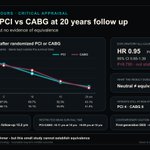
🚨 LEFT MAIN PCI vs CABG trial: 20 years of follow-up produced no survival winner — and no proof of equivalence.
In this paper published simultaneously at #ESC26, no statistically significant difference in all-cause mortality was detected among 201 selected patients suitable for either strategy,
But the confidence interval was broad and the 20-year tail was thin. Absence of a significant difference is not evidence that the strategies are interchangeable. 🧵 1/7

6/7 — TAKE-HOME MESSAGE 🔍
For carefully selected left-main patients judged suitable for either PCI or CABG, this small randomized cohort found no statistically significant difference in all-cause mortality over very long follow-up.
That is reassuring for the durability of both strategies—but it should not be translated into “PCI equals CABG.”
The choice still depends on more than survival:
• Coronary anatomy and disease complexity
• Likelihood of complete revascularization
• Diabetes, surgical risk and comorbidity
• Early procedural risk
• MI, stroke and repeat-revascularization trade-offs
• Patient preference and expected adherence
The practical message is individualized Heart Team selection, not universal interchangeability.
7/7 — WHAT TO KEEP IN MIND ⚠️
• Exploratory extension: confirmatory 20-year mortality testing was not prespecified in the original protocol or analysis plan.
• Small sample: n=201; the wide CI cannot exclude meaningful benefit or harm.
• Only 4 PCI and 8 CABG patients remained at risk at 20 years.
• First-generation DES, universal femoral PCI and no mandated intravascular imaging limit contemporary relevance.
• PCI, CABG and secondary prevention changed substantially over 2 decades.
• Long-term crossover and repeat-revascularization data were unavailable; this is not a comparison of sustained treatment exposure.
• No complete longitudinal nonfatal outcomes, adherence or reliable cause-of-death data.
• Subgroup analyses were exploratory and severely underpowered.
• Four German centers limit generalizability.
📝BOTTOM LINE
Randomized follow-up to 20 years found no statistically significant mortality difference between PCI and CABG for selected left-main disease.
It did not establish equivalence and cannot resolve the contemporary choice between modern image-guided PCI and current CABG.
The authors reported no relevant relationships to disclose.
Evidence appraisal, not patient-specific medical advice.
Original article: Desch S, Pugachova S, de Waha S, et al. All-Cause Mortality Up to 20 Years After PCI or CABG for Left Main Disease. J Am Coll Cardiol. 2026.
doi.org/10.1016/j.jacc.2026.…
#LeftMain #PCI #CABG #CoronaryArteryDisease #InterventionalCardiology #CardiacSurgery #ClinicalTrials #EvidenceBasedMedicine
Cath Lab After Hours retweeted

🫀How do you restore side branch flow after covered stent implantation for coronary perforation?
Diluka Premawardhana et al. present a bailout strategy using covered stent fenestration and TAP stenting.
Read the case: brnw.ch/21x4uvL
#BifurcationPCI #CardioEd

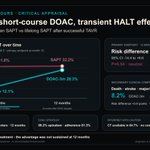
🚨NOTION-4 trial: Does DOAC after TAVR (instead of ASA) reduce HALT?
👉🏻Let's focus on the recently published trial!
3 months of DOAC suppressed HALT after TAVR — but the between-group difference was no longer evident 9 months after treatment stopped.
At 12 months, the primary endpoint was neutral and death, stroke or major/life-threatening bleeding occurred more often with the DOAC strategy.
A short course changed the scan while patients were treated, not the 12-month result. 🧵 1/7

6/7 – TAKE-HOME MESSAGE 🔬
NOTION-4 shows that a 3-month DOAC strategy can reduce CT-detected HALT while treatment is active, but that advantage was not sustained at 12 months.
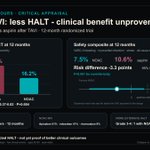
This complements rather than necessarily contradicts ACASA-TAVI, where anticoagulation continued for the full 12 months and HALT was lower at the 12-month scan.
Cross-trial comparisons cannot establish causality, but together the studies suggest that suppression of HALT may be treatment-dependent.
The unresolved question is not simply whether anticoagulation changes valve CT. It is whether doing so improves stroke, valve durability or survival enough to justify bleeding and other clinical risks.
NOTION-4 does not demonstrate that benefit.
7/7 – WHAT TO KEEP IN MIND ⚠️
• HALT on CT was the primary endpoint, not a clinical outcome.
• Only 84.7% had an evaluable 12-month CT; post hoc sensitivity analyses remained neutral.
• Adherence during the first 3 months was 81.3% in the DOAC arm.
• No continued-DOAC arm: the post-treatment increase cannot be attributed definitively to withdrawal.
• Open-label treatment; CT interpretation and clinical-event adjudication were blinded.
• Two Danish centers and a selected population after uncomplicated, single-valve TAVR limit generalizability.
• Chronic anticoagulation, recent DAPT and eGFR <30 mL/min/1.73 m² were excluded.
• Clinical events were secondary, low-count and underpowered.
• Follow-up was 12 months; long-term valve durability remains unknown.
📝BOTTOM LINE
Short-course anticoagulation reduced HALT during treatment, not at 12 months, and did not demonstrate clinical benefit. The findings support avoiding routine DOAC after TAVR without another indication.
Funded by the Novo Nordisk Foundation. Disclosures include industry relationships and one author employed by Abbott.
Evidence appraisal, not patient-specific medical advice.
Original article: Jørgensen TH, Larsen AF, Jensen JM, et al. Short-Term Anticoagulant Therapy and Subclinical Leaflet Thickening in Transcatheter Aortic Valves: The NOTION-4 Trial. J Am Coll Cardiol. 2026. doi.org/10.1016/j.jacc.2026.…
#NOTION4 #TAVR #TAVI #HALT #DOAC #StructuralHeart #InterventionalCardiology #ClinicalTrials #EvidenceBasedMedicine