

Reads. Thinks. Writes. The Witcher (& those little elf guys). Books, games, culture. Niche. Vibes & psychoanalysis. ≽༏≼ https://teapaw.org/t.co/FI5lM2IC2m
United Kingdom & Estonia
Joined March 2019
- Tweets4.9K
- Following199
- Followers477
- Likes13.1K
Pinned Tweet
Ciri and Avallac'h's relationship looks at themes of death and resurrection, sickness and healing. Ciri's journey into the elven Otherworld is undertaken for self-transformation, but as the Grail, she instigates transformation in others as well. She is the Saviour, just not in the way Avallac'h initially is willing to accept.
blathancaerme.com/avallach-c…

i got into fanfics because i could not believe nobody saw the potential in what all would need to go down between those characters ahead of that kiss
eroticism puts the question of what needing a person means on amphetamines

4
107
Elin Ratzinger (or Wilma Wessely if you like) retweeted

been thinking about avallac'h and ciri's relationship and especially how their coping mechanisms interact, so here's some thoughts. some of these things have probably been extensively talked about already, but what harm is that when ao3 is down? let's talk!


Elin Ratzinger (or Wilma Wessely if you like) retweeted

My piece in the latest @Wyrd_Science is out - on the problem of Tolkien's elves. Wonderfully illustrated by Eleanor Piteira! wyrd.science/products/wyrd-s… 🧝♂️


The thing that Elder Scrolls did better for me (than TW games, for example) was to create a feeling that this world is unimaginably old, mysterious, and eldritch. And the music played a huge part in it.


Alright. Having sat down and hammered a blog post out of the earlier burst of delight for this upcoming expansion and its art, I discovered (& was pointed toward) additional potential inspirations for plot of The Witcher 3: Songs of the Past ⬇️God knows how much will be true 😅

See here: blathancaerme.com/who-sings-…

Elin Ratzinger (or Wilma Wessely if you like) retweeted

"A jeśli chodzi o błędy anatomiczne czy inne artystyczne bzdurki, to wynikają one z tego, że nie używam sztucznej inteligencji, tylko jej przeciwieństwa autentycznej, własnej głupoty"


Elin Ratzinger (or Wilma Wessely if you like) retweeted

Hej, jestem Judyta i jestem autorką prac z Yennefer, Triss i Wiedźminem w najnowszej kolekcji Medicine. Prace spod mojej ręki nie wykorzystywały sztucznej intelgencji. Rozumiem wasze zaniepokojenie wszechobecnym AI ale prosze wsztrzymajcie się z niesprawiedliwymi osądami.
Elin Ratzinger (or Wilma Wessely if you like) retweeted

I love this Atwood quote so much because it struck me how deeply the inverse was true for men.
You are a man with a woman inside watching a man.


Elin Ratzinger (or Wilma Wessely if you like) retweeted

plus mały bonus dla niedowiarków: mam cały plik na warstwach!

Elin Ratzinger (or Wilma Wessely if you like) retweeted

The covers I created this year for the French editions of Andrzej Sapkowski’s universe


Merch & spoilers drop for The Witcher 3: Songs of the Past. We'll see Letten & its mirror reflection - Nettel. Lettenhove. Nettelhove. 😀 It recalls the drowned town in Mickiewicz's ballad Świteź: at night, the lake mirrors the sky, showing stars above and stars below, and two moons. But underneath that beautiful reflection lies the truth of the sunken town of Świteź, cast there to save it from the invaders. The townswomen became flowers on the lake shore that kill anyone who picks them (as in Garden of Thorns). The water acts as a barrier between the present and the past, and the fishermen in the ballad have to cast a net to pull the truth out of the lake (in the form of a woman) - thus, one has to look beneath the surface of Letten to see the historical trauma preserved in Nettel.
I also think this concept is, truthfully, the hint at and bridge to Ciri's upcoming trilogy, because it fits perfectly with Sapkowski's idea of the mirror barrier between times and places (that Ciri can cross), but more on that later.
Given Green Man on the merch, I wonder if the concept of Oak & Holly King will make an appearance in Songs of the Past. The Waxing & Waning Year & who(se metaphysical status quo) rules; all that jazz. But we know something even more important from Paula Mejsner, the Lead Writer:
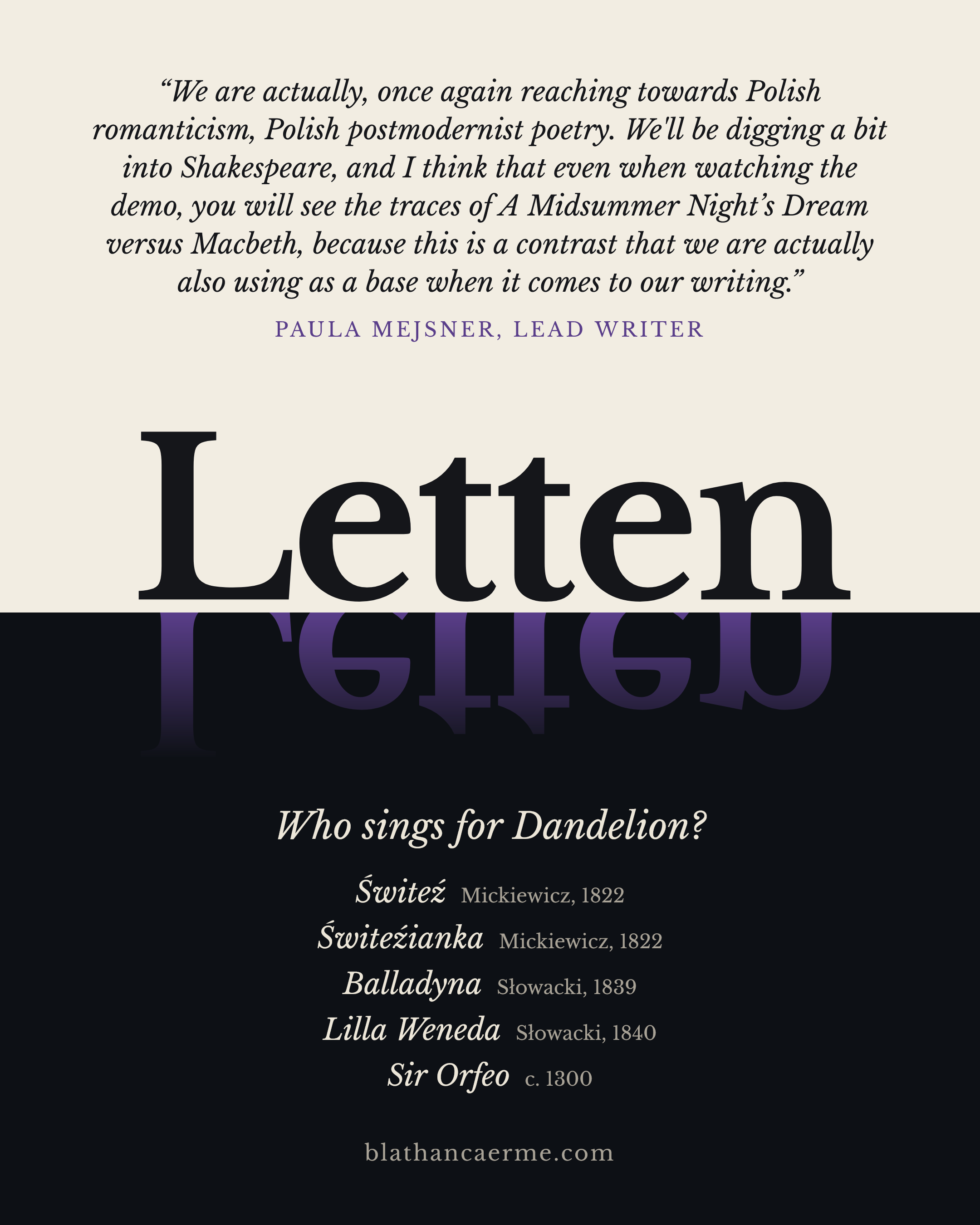
"We are actually, once again reaching towards Polish romanticism, Polish postmodernist poetry. We'll be digging a bit into Shakespeare, and I think that even when watching the demo, you will see the traces of A Midsummer Night’s Dream versus Macbeth, because this is a contrast that we are actually also using as a base when it comes to our writing."
This should be pointing to Słowacki’s Balladyna, which was inspired by both plays.
Around lake Gopło, Prince Kirkor is trying to pick a wife. Goplana, the nymph-queen of the Lake, is in love with Grabiec who's in love with Balladyna. To get rid of the rival, the queen sends her fairy to make Kirkor fall in love with Balladyna, but the fairy botches the spell and makes Kirkor fall in love with both Balladyna and her sister Alina.
The sisters compete for Kirkor by picking raspberries. Upon seeing Alina winning, Balladyna kills her with a knife. The queen Goplana turns the only witness to it, Grabiec, into a weeping willow so he cannot tell. (Draw your conclusions for how they might adapt this 😉 given that the willow we see in Songs of the Past seems to be female.) Balladyna lies about what happened & the crime stays with her as a bloody stain on her forehead that will not come off. Meanwhile, a shepherd-poet searching for an ideal woman, finds Alina's body and falls in love with the dead girl.
Anyway, Kirkor & Balladyna marry, he rides off into battle, Balladyna becomes corrupted with power, locks her poor mother in a tower, takes a lover, tries to remove the stain of her murder, but gets deeper into a cycle of murders to maintain her position, as the natural forces (fairies) remind her of her crimes. At the feast, a sprite sings a song listing Balladyna's crimes, and she sees Alina's ghost. Instead of stopping, more killing follows, more appropriation of symbols of lawful kingship of the land. The lover defeats the husband Kirkor, but Balladyna poisons him too.
Which leads to Balladyna judging the cases in which she had a hand in, and she sentences unknown culprits to death for them - and is then struck down by lightning as God carries out the sentences she passed, in truth, on herself.
So putting this next to what we know of Songs of the Past:


Dandelion vanishes on Belleteyn night in his family's hidden valley, just after his grandfather's death. The trail leads through a thorn garden to a cursed well. Abduction into the underworld, which makes Lilla & Geralt consider the curse of Dandelion's ancestor, the mad Count Humbert de Lettenhove, as they set off into what I presume is Nettel - the dark mirror world of Letten. Its psychic wound, so to say.
The abduction is classic in Irish and Scottish folklore where musicians, alongside brides, new mothers, and children, were the fairies' favourite targets (e.g. Thomas the Rhymer). In the ballad of Tam Lin, the captive can be won back only on Samhain, Beltane's opposite festival. Then the violets: Geralt awakes to a nightmare in which Dandelion is screaming, with images of a well, thorns and the smell of violets. In myth, Persephone was picking violets and other flowers when Hades carried her away. Also, Midsummer's love flower, love-in-idleness, is a wild violet.
But I also hear hints of Sir Orfeo (a retelling of Orpheus and Eurydice), with Geralt as Orfeo & Dandelion as Heurodis, his queen. Heurodis sleeps under a grafted tree and dreams the fairy king will take her. This happens. Orfeo sets off into the wild, follows a fairy troop into a rock, plays music for the fairy king, and wins her back. Except in Songs of the Past, the bard has been taken, so Geralt better make some music with his steel (or at least retrieve Dandelion's lute). In Orfeo's fairy castle, the taken stand frozen and the Slumbering Knight fits this image. He might be Count Humbert himself. At any rate, I expect we'll see many knights bound to sleep under the valley, like the Polish knights under Giewont.
A song probably exposes a hidden crime the Lettenhoves buried. Songs of the Past's EP's longest track is called "What's Done", which harkens to Lady Macbeth's "what's done cannot be undone." And clearly the prosperity of the region is upheld by some kind of sacrifice to the underworld (often renewed at holiday celebrations). Is Dandelion, as the heir, the new generation's payment? Is he caught in a version of his own and his family's past?


