

Sarath Chandar's research group at @polymtl, @UMontreal and @Mila_Quebec focusing on Machine Learning!
Montréal, Québec, Canada
Joined June 2021
- Tweets182
- Following146
- Followers743
- Likes110




Check out this great work from @aidanmrli !

Quite happy to say that our paper on representation learning for dynamical systems was accepted to #NeurIPS2026 and I'll be presenting it in Sydney this December!
Very succinctly, our work, titled "Sparse Koopman Autoencoders Identify Local Dynamical Regimes in Multibasin Systems", is about learning linear representations of state for dynamical systems with multiple basins of attraction. Inducing sparsity in a latent representation can be a very powerful method to model multiple basins of attraction with linear dynamics. By training a Koopman autoencoder with a bias for producing sparse latent representations, we find that a sparse-latent model both forecasts the dynamics better and has greater ability to identify the current local regime of the current state compared to a model without sparsity-inducing effects.
More broadly, I think our work on sparse Koopman autoencoders could be relevant to both the robotics/world modeling and interpretability communities (just brainstorming here).
- Robotics: To my knowledge, switching dynamics are common in robotic systems, i.e. trajectories seem to transition between dynamical modes. With a sparse code, you could get a switch between modes for free.
- Interpretability: Sparse autoencoders might not be all the rage anymore, but I think Koopman modeling is still very natural for understanding the dynamics of models that apply the same computation at multiple steps to advance the dynamics. This applies to most recurrent models, such as looped/weight-tied transformers (dm me if you want to discuss!)
Thanks to my amazing collaborators @ukreddy126 @mahanfathi @apsarathchandar @RGoroshin. I was thinking about what to say about this (clueless grad student tries to figure out social media) and this post ended up being really late lol, my bad.
See you in Sydney!
Paper: arxiv.org/abs/2608.29057
Code: github.com/aidanmrli/skae

🎓 Graduate Program Application Mentorship
Applying to grad school doesn't have to be overwhelming!
Get personalized 1:1 support from students who’ve successfully navigated the process.
🔗 Apply now: forms.gle/FyjEuLmjcdREF3Ba6
🗓️ Deadline: Nov 1, 2026
👇 Here is what you get:
✨ What you’ll get from our mentorship program:
📄 CV & SOP Feedback to polish your documents
🎙️ Interview Tips to build real confidence
🤝 1:1 Guidance directly from current grad students
Don't navigate the complex application process alone. We're here to help bridge the gap and showcase your full potential! 🌟
#GradSchool #Mentorship #TechDiversity #HigherEd #MachineLearning #EDI #AI
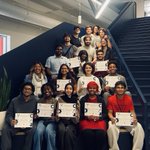
🎉 Thrilled to share that 8 papers from our lab (and collaborations with lab members) have been accepted at #NeurIPS2026!
The work spans RL, world models, dynamical systems, LLM safety & interpretability, tabular foundation models, and forecasting. Huge congrats to everyone 🧵👇
📄 φTD: Distributional Reinforcement Learning using Characteristic Functions
Distributional RL built on characteristic functions.
w/ @DavideBald42296
Congrats again to all the students and collaborators behind these papers! 🙌 See you at #NeurIPS2026
Chandar Lab retweeted

Just got accepted at NeurIPS! Read our paper on how (we think) TFMs generalize!
arxiv.org/pdf/2608.17957


Chandar Lab retweeted

Our semantic world models paper is accepted at #NeurIPS2026 E&D Track! 🎉
What's the best latent space for diffusion world models? We find semantic spaces beat VAE-style ones on planning and robustness, with competitive visual quality.
Paper & more: hskalin.github.io/semantic-w…

Diffusion world models can help test and improve robot policies before running them on real robots.
But can the choice of latent space make the WM more faithful?
We show that semantic spaces beat reconstruction spaces on task relevant metrics.
hskalin.github.io/semantic-w…
Chandar Lab retweeted

Read our paper on scaling interpretable LLMs, we show that interpretable LLMs are not only possible but can scale both on typical generation benchmarks and interpretability benchmarks. arxiv.org/abs/2608.07594👀

Chandar Lab retweeted

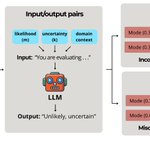
People use LLMs all the time for help with medical problems, some doctors might also use them too to explain diagnoses to patients.
But diagnostic tests are inherently probabilistic. This work from @dicemasz explores if LLMs are suited or not for this usecase!

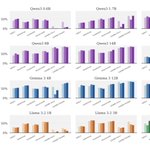
Turns out that many contemporary LLMs still struggle to explain probabilities and uncertainty in plain natural language 👀
Such findings call LLMs’ reliability as explainers of probability into question — they may not be well-suited to explaining other predictive outputs to decision-makers or discussing future uncertainties in a calibrated manner.
We got these & other insights from @dicemasz main MSc work, which focused on evaluating LLMs’ limitations for communicating risk in natural language — already out on preprint if you want to learn more!!
See: arxiv.org/abs/2607.03882
