

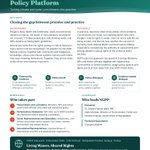





How can Bangladesh turn evidence on climate, water and nature into policies that reflect what communities need?
Launched in Dhaka in October 2026, the Nature and Governance Policy Platform (NGPP) brings together ministers, parliamentarians, senior officials, researchers and communities to review evidence, weigh policy options and agree on practical next steps. Guided by natural science and natural rights, the platform brings local experience into policy dialogues and turns research into briefs that decision-makers can use. Change Initiative serves as its Technical Secretariat.
At COP31 in Antalya, NGPP will share Bangladesh’s experience on water governance and natural rights through Living Waters, Shared Rights, a high-level dialogue on 9 November 2026 at the Bangladesh Pavilion.
The dialogue is organised in collaboration with WaterAid Bangladesh and with support from the Embassy of Switzerland in Bangladesh.
#ChangeInitiative #NGPP #COP31 #WaterGovernance #NaturalRights #Bangladesh

Who speaks for rivers when decisions about water are made?
At COP31, Change Initiative will host Living Waters, Shared Rights, a policy dialogue on how recognising the rights of rivers and freshwater ecosystems can strengthen climate resilience for the communities that depend on them.
M. Zakir Hossain Khan, Co-Founder & Chief Executive of Change Initiative, will deliver the keynote. Dr Shaikh Faridul Islam, State Minister for Environment, Forest and Climate Change and Convener of the Nature and Governance Policy Platform (NGPP), will convene the dialogue. Speakers from government, climate finance, water research and civil society will explore what Natural Rights-Led Governance means in practice for water policy.
Join us on Monday, 9 November 2026, from 14:30 to 17:00 Türkiye time (UTC+3) at the Bangladesh Pavilion, COP31, Antalya.
The dialogue is organised in partnership with Swisscontact and WaterAid Bangladesh, with support from Switzerland.
#COP31 #LivingWatersSharedRights #NaturalRightsLedGovernance #WaterGovernance #ClimateResilience #RightsOfNature #BangladeshPavilion #NGPP #ChangeInitiative

Change Initiative at COP31 | 9–14 November 2026 | Antalya, Türkiye
How can climate-vulnerable countries finance a renewable energy transition without deepening debt? And what changes when the rights of rivers, forests and other ecosystems shape decisions about development?
At COP31, Change Initiative is bringing these questions into seven events focused on climate finance justice, energy sovereignty and Natural Rights-Led Governance. Our programme connects grant-based finance for adaptation and loss and damage with practical choices about shared waters, community stewardship and how countries measure development progress.
9 November
- Side Event · Living Waters, Shared Rights - Climate resilience and the governance of shared waters.
10 November
- Press Conference · Financing Energy Sovereignty - Financing nature-smart energy while addressing the climate debt trap.
12 November
- Session · Nature’s Sovereignty - Putting the Natural Rights-Led Governance framework into practice.
13 November
- Press Conference · Nature’s Sovereignty - Assessing LDC graduation beyond GDP by considering whether countries are sustaining their natural capital.
- Side Event · Land, Trust, and Data - Protecting climate and nature through community stewardship.
- Side Event · The Implementation Gap - Improving access to climate finance for the energy transition, drawing on the Renewable Energy Finance Outlook 2026.
14 November
- Stakeholder Consultation · COP31 Position - Change Initiative’s position paper declaration on grant-based finance, debt relief, a nature-smart energy transition and natural rights.
Join us in Antalya. See the programme card for times and venues, and follow Change Initiative for updates.
changei.earth
#COP31 #ChangeInitiative #ClimateFinanceJustice #ClimateDebt #LossAndDamage #EnergySovereignty #NaturalRightsLedGovernance

For every US$1 Bangladesh received in climate grants, it received US$2.70 in loans, according to Change Initiative’s Climate Debt Risk Index 2025. At COP31 in Antalya, the terms of climate finance matter as much as the amounts pledged.
Change Initiative is calling for five decisions in Antalya.
1. Prioritise grants for climate action in vulnerable countries and set a delivery timetable that names who will provide the finance.
2. Triple adaptation finance from a clear baseline, with an interim target and public reporting on progress.
3. Scale up the Fund for Responding to Loss and Damage and make direct access the default.
4. Reduce the climate debt burden through debt relief and climate debt audits.
5. Put the rights of nature at the centre of climate and economic decisions through Natural Rights-Led Governance.
Explore the infographic for Change Initiative’s proposals on climate finance, adaptation, loss and damage, debt, just transition and the Global Stocktake.
#COP31 #ChangeInitiative #ClimateFinance #ClimateDebt #AdaptationFinance #LossAndDamage #JustTransition #NaturalRightsLedGovernance

Sukuk should finance a sustainable energy future.
M. Zakir Hossain Khan, Co-Founder and Chief Executive of Change Initiative, urges Bangladesh to reconsider financing the Matarbari coal expansion through sukuk, stressing the need to safeguard public health, coastal livelihoods and future generations.
In The Business Standard, he advocates a national green sukuk programme to support renewable energy, energy storage and energy efficiency aligning financial decisions with ecological responsibility and long-term public wellbeing.
#ChangeInitiative #GreenSukuk #RenewableEnergy #ClimateJustice

Full article link: tbsnews.net/thoughts/sukuk-s…

Climate finance must protect vulnerable communities without deepening their debt.
“We are borrowing to survive a crisis we have done virtually nothing to bring about.”
In an exclusive interview with The Climate Watch ahead of COP31 in Antalya, Türkiye, M. Zakir Hossain Khan, Co-Founder & Chief Executive of Change Initiative, calls for a fairer global financial system that puts climate justice, people and nature at the centre of financing decisions.
He outlines four priorities for Bangladesh:
• Grant-based adaptation and loss and damage finance, with clear delivery timelines.
• Reform of international financial institutions to address climate vulnerability, ecological losses and debt risks.
• A substantially resourced loss and damage fund, with rapid support reaching affected families.
• Continued access to grants and concessional finance based on vulnerability, including after LDC graduation.
Khan also stresses that international commitments must be matched by domestic accountability through transparent project selection, public disclosure, community-led monitoring and measurable improvements in people’s lives.
“Judge Antalya, one year later by the money that has been received, not by what was announced.”
@Zhkhaneco
#ClimateJustice #ClimateFinance #COP31 #ChangeInitiative

Full article link: theclimatewatch.com/banglade…
“International finance cannot replace domestic governance, and domestic governance cannot replace international climate justice. We need dual accountability, developed countries must honor climate-finance obligations, and Bangladesh must ensure every taka is transparently spent and produces measurable resilience. Climate justice requires finance; credibility requires integrity.”
M Zakir Hossain Khan
Co-Founder & Chief Executive
Change Initiative
#ClimateJustice #ClimateFinance #ChangeInitiative
🤖 Made with AI

“Protecting the Earth is the foundation of future economic prosperity, lower disaster risk, stronger communities and a just global transition.”
Change Initiative’s Natural Rights-Led Governance (NRLG) framework sets out a pathway from a disaster-capitalizing economy to protection-led prosperity recognising nature’s rights, rewarding regeneration and strengthening community stewardship.
Aligning finance, energy and production with ecological limits can strengthen human security, support nature-smart jobs and build lasting prosperity. Progress must be measured through ecosystem recovery, justice and shared wellbeing.
#NaturalRightsLedGovernance #ProtectionLedProsperity #NaturePositiveEconomy #ClimateJustice #ChangeInitiative

Climate Debt, Not Climate Justice
Countries least responsible for the climate crisis should not have to borrow more to survive its consequences.
Change Initiative’s Climate Debt Risk Index 2025 (CDRI’25) estimates global climate-related debt at approximately US$372 billion. Of the 55 countries assessed, 47 face high or very high climate debt risk.
The infographic highlights a stark financing imbalance: annual adaptation finance of US$27.5 billion against estimated annual needs of US$387 billion covering only about 7%. Meanwhile, approximately 62% of adaptation finance is loan-based, adding repayment obligations to countries already confronting floods, droughts and rising seas.
When resilience depends on further borrowing, climate finance can deepen the vulnerability it is meant to address.
Change Initiative calls for accessible, transparent and grant-based climate finance, alongside meaningful debt relief, to protect communities, restore nature and strengthen resilience.
Climate justice requires finance that enables recovery without deepening sovereign debt.
Read more: changei.earth/post/justice-i…
#ClimateJustice #ClimateDebt #ClimateFinance #CDRI2025 #DebtRelief #ChangeInitiative #DebtFree

Nature is sovereign because life depends on non-negotiable ecological laws, not on human permission. Rights of Nature are meaningful only when they recognize those limits. If the same institutions that extract, pollute and profit are also allowed to define and enforce Nature’s rights, a clear conflict of interest arises. Human law, markets and investment must therefore operate within Nature’s sovereignty, not above it.
@Zhkhaneco
#NatureIsSovereign #RightsOfNature #NaturalRightsLedGovernance #EcologicalLimits #EnvironmentalAccountability #NaturePositiveFinance #ChangeInitiative

Climate finance must protect nature and strengthen women’s rights.
Writing in The Daily Observer, M. Zakir Hossain Khan Co-Founder and Chief Executive of Change Initiative, calls for mandatory gender impact assessments across major investments, infrastructure and climate-finance projects.
His message is clear: women must help shape decisions not simply be counted as beneficiaries. Investment should protect water, farmland and ecosystems, assess environmental impacts across the full life cycle, and deliver fair benefits for local communities.
Through the lens of Natural Rights-Led Governance (NRLG), Bangladesh’s development priorities must connect ecological integrity, gender justice and long-term prosperity.
Read the full article: lnkd.in/g9Bsgjdz
#ChangeInitiative #ClimateFinance #GenderJustice #NRLG

Full article link: observerbd.com/news/598086

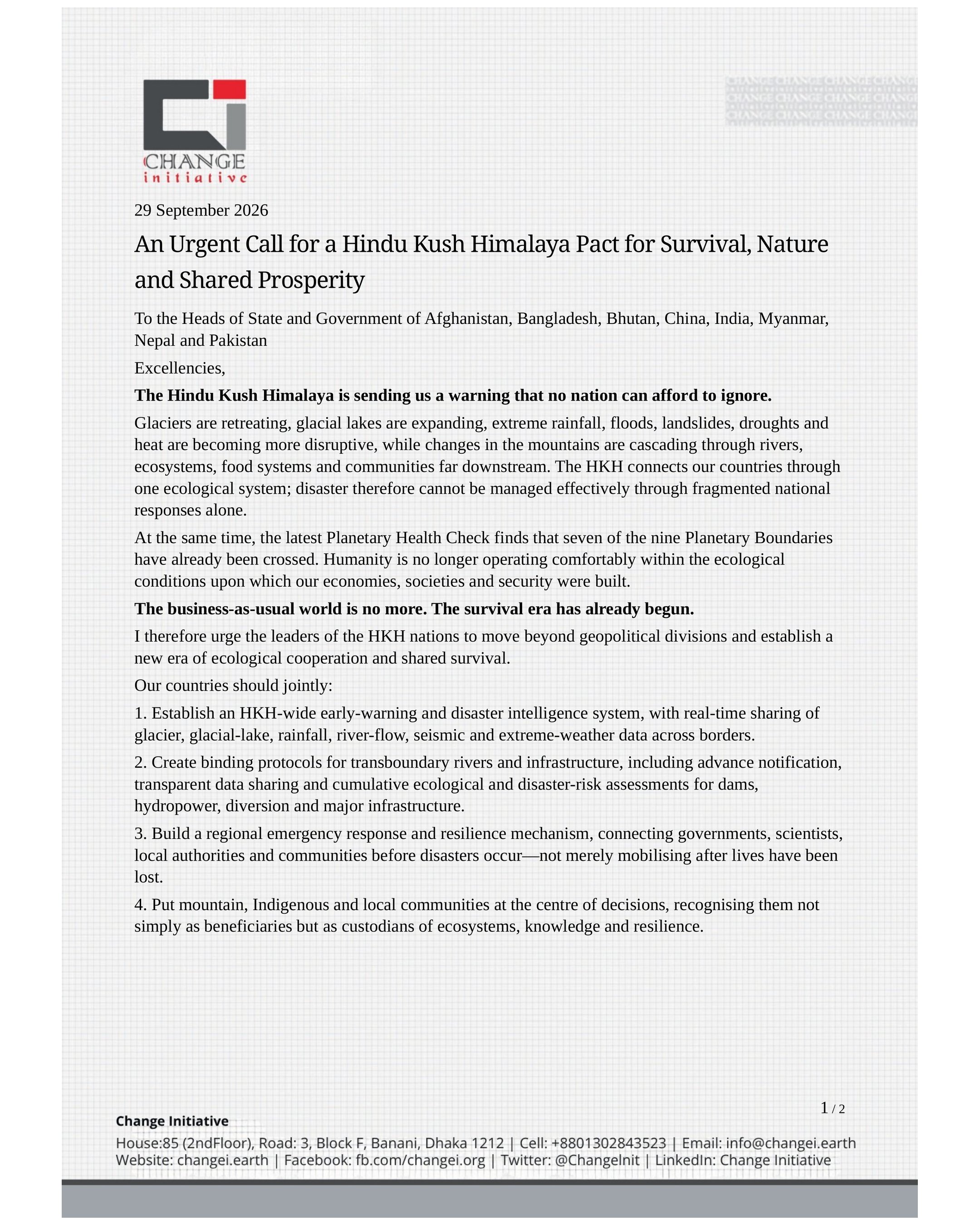
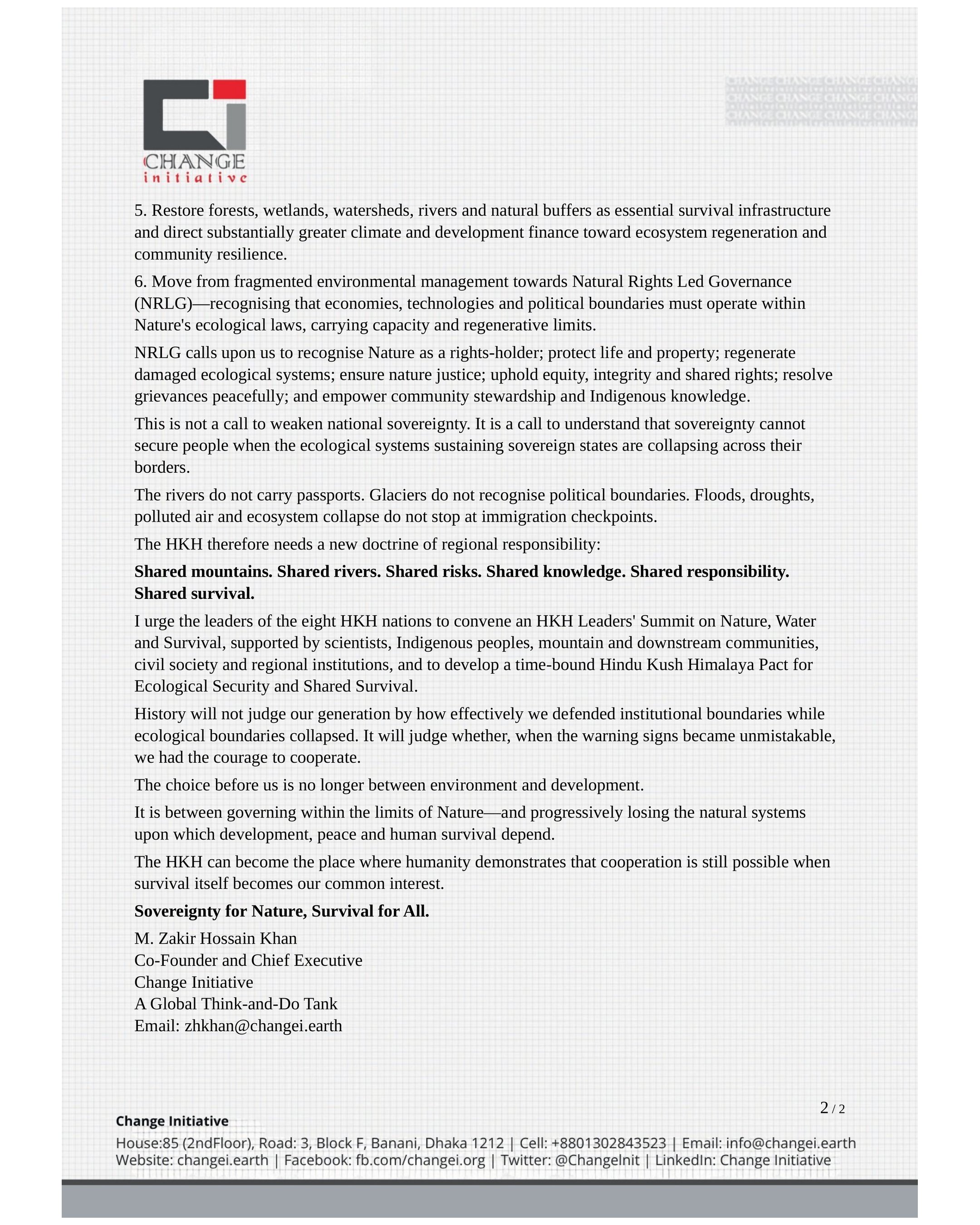
An urgent call to the Heads of State and Government of Afghanistan, Bangladesh, Bhutan, China, India, Myanmar, Nepal and Pakistan.
M Zakir Hossain Khan, Co-Founder and Chief Executive of Change Initiative, urges the leaders of these eight Hindu Kush Himalaya nations to forge a Hindu Kush Himalaya Pact for Survival, Nature and Shared Prosperity.
The appeal calls on leaders to move beyond geopolitical divisions, convene an HKH Leaders’ Summit on Nature, Water and Survival, and develop a time-bound regional pact for ecological security and shared survival.
It sets out six priorities for collective action:
• Cross-border early warning and disaster intelligence.
• Binding safeguards for transboundary rivers and infrastructure.
• Regional emergency response and resilience.
• Mountain, Indigenous and local communities at the centre of decisions.
• Ecosystem restoration and greater resilience finance.
• Natural Rights Led Governance (NRLG).
Shared mountains. Shared rivers. Shared risks. Shared knowledge. Shared responsibility. Shared survival.
Read the full letter in the two accompanying pages.
Sovereignty for Nature, Survival for All.
#HinduKushHimalaya #SharedProsperity #RegionalCooperation #NRLG #ChangeInitiative
At the Joint CTF–SCF Trust Fund Committee meeting at IFC Headquarters in Washington, M. Zakir Hossain Khan, Chief Executive of Change Initiative and SCF-CIF Observer, presented key messages on behalf of CIF Observers, calling for the emerging CIF strategy to move beyond an integrated investment framework toward an equity, justice and nature-centred delivery model.
The intervention carried forward recommendations from the 2nd South Asia Stakeholders Meeting, which brought together around 200 civil-society, youth, think-tank and public-sector participants. Five shifts were emphasized-from national projects to basin and ecosystem systems; response to prevention; centralized delivery to community stewardship; energy access to Nature-Smart Energy; and debt exposure to climate-finance justice.
The core message was clear, CIF should move from financing projects to financing resilience systems, from central delivery to stewardship, from post-disaster response to prevention, and from mobilizing capital to delivering climate-finance justice for people and nature.
#ClimateFinance #CIF #ClimateJustice #NatureSmartEnergy #SouthAsia #ChangeInitiative


Bangladesh can expand renewable energy without sacrificing agricultural land.
A recent study by Change Initiative highlights the country’s substantial untapped solar potential. Rooftop solar in Dhaka alone could generate nearly 11,000 MW. Nationwide, a Zero-Arable-Land approach combining rooftop and floating solar with suitable spaces across industries, small enterprises and BSCIC estates could deliver approximately 22,000 MW of clean electricity.
The opportunity is already above us and around us. What Bangladesh needs now is effective policy, accessible finance and timely implementation.
-@Zhkhaneco @dw_bengali
#RooftopSolar #RenewableEnergy #Bangladesh #ChangeInitiative
Full video link: facebook.com/reel/1610898519…

Solar Power Must Be Bangladesh’s Highest Energy Priority
Bangladesh must place the rapid expansion of solar power at the centre of its strategy to meet growing electricity demand while safeguarding economic stability, said M Zakir Hossain Khan Co-Founder and Chief Executive of Change Initiative, in remarks to Jatiya Arthaniti.
While a new Floating Storage and Regasification Unit (FSRU) at Matarbari may be necessary to strengthen near-term energy security, it must not create additional financial liabilities for the government or the public. Before proceeding, authorities should transparently examine the cost overruns, alleged corruption and unsustainable debt associated with past publicly financed projects.
Reliable energy is essential to keep the economy moving. However, excessively costly electricity cannot be sustained indefinitely through large public subsidies particularly when the government has limited fiscal space to absorb new financial pressure.
Bangladesh therefore needs a solar-first energy strategy, rigorous scrutiny of major infrastructure investments and stronger protection of public finances. Energy security must be achieved without locking the country into costly fuel imports and long-term debt burdens.
#SolarPower #RenewableEnergy #EnergySecurity #EnergyTransition #FiscalResponsibility #Bangladesh #ChangeInitiative
@Zhkhaneco

Full article link: jatiyoarthoniti.com/2026/09/…
