

Ex-quant trader, pod shop PM. Trying to figure the world out @ArbResearch
London
Joined September 2013
- Tweets6.8K
- Following1K
- Followers1.5K
- Likes33.1K







Pinned Tweet
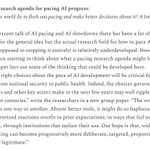
New paper! We've written a framework and research agenda for thinking about pacing - what it means, under what conditions it might work, and open questions we think need (much) more work.
This was a big effort over the last two months, we hope it is useful!


Charles🔸 retweeted

Swarms are a big deal: they solved a Millennium Problem, they hacked Hugging Face & OpenAI and they're fast. But do they perform better than solo agents?
No, not yet.
(The confusion seems to be caused by people not matching compute levels for their solo agent baselines.)

Deciding it's not wise to speak because of implicit or explicit internal pressure or norms is not so different from muzzling, practically spelling, and more insidious because you may not think you've been muzzled.

See also

Hm, I think this is literally true but gives a reader too rosy of an impression. I think Kelsey's assessment here is fair: teapaw.org/KelseyTuoc/status/2105…
I personally feel free to say what I think on these topics and certainly don't feel that I or anyone else are "muzzled" in some explicit way, but I've talked to coworkers who worry that they'll face social repercussions for saying things that are too spicy or critical, or feel that they're supposed to seek approval for anything they say in public and don't expect to get it so they don't bother asking. (I think these worries are usually wrong, and when I hear about them I generally say "nah you should just clearly say what you think and it will be totally fine", but I think they still exist.) It can also be hard to navigate confidentiality considerations carefully when discussing one's general views on AI risk and many people err conservative so as not to risk making a mistake on this front.
My impression is that OpenAI's culture is significantly healthier in terms of the degree to which employees find it easy and low-friction in practice to speak their mind in public (though in some ways that also come with costs; it's not entirely clear to me what the right balance is).
2
97

I was asking myself yesterday if this is an update on P=NP but I don't know the math very well and doubt it on priors

Imagine a world where p=np. Any easily verifiable task can be accomplished with compute, there are giant gaps in all security, and machines can be used to autonomously solve the biggest math problems.
2
10
1,093
Charles🔸 retweeted

Imagine a world where p=np. Any easily verifiable task can be accomplished with compute, there are giant gaps in all security, and machines can be used to autonomously solve the biggest math problems.
Charles🔸 retweeted

Holden Karnofsky (cofounder of GiveWell and Open Philanthropy, now at Anthropic) on how it feels to get hard work done without shame:


Charles🔸 retweeted

If you came out here to build things that make people’s lives better then you shouldn’t work at or with these shitty gambling app companies and you should take note of who does.

fuck you, and fuck everyone with a fund logo in their bio pretending this is innovation
i'm a recovering gambling addict. here's what you don't put in the pitch deck:
people with gambling disorder die by suicide at 15x the rate of everyone else. for men 20–49 it's 19x. about 1 in 5 attempt it, the highest rate of any addiction
kalshi lets 18 year olds bet on sports in states where the legal age is 21. addicts who self-excluded from draftkings and fanduel are relapsing on your app because "federally regulated" means none of the state protections apply
that's not the "longer, more difficult path." that's the path around every guardrail that was built for people suffering from this addiction
you're not backing a prediction market. you're backing a sportsbook with better lawyers, and you're getting rich off people who will lose their savings, their families, and some of them their lives
Charles🔸 retweeted
When you don't know what to do, run a fellowship
If you liked our pacing policy agenda (pacing.tech), come do research with us. Paid, remote, not boring.


Charles🔸 retweeted

After selling off on concerns that they purchased too many GPUs, neoclouds rallied after a strong quarter from Nvidia, bolstered by neoclouds' demand for GPUs.

This is pretty cool

I have a major result to share.
I’ve found conclusive forensic evidence that the top 4 Chinese AI labs—DeepSeek, Moonshot, MiniMax and Ant Group—have built their newest models on NVIDIA’s most advanced Blackwell chips, which are barred from export to China.
This sounds insane, but I discovered that almost every AI model carries a hidden signature of the GPU that trained it. When a model is first set up, the starting values of its weights are laid out in a pattern that depends on the exact GPU. Each combination of GPU and seed number produces a unique pattern—a sort of fingerprint of the hardware used to create the model. Traces of that pattern survive training into the published model.
Again, this evidence isn’t based on any insider information or leaking. It’s based on a forensic analysis of the model weights released by the companies themselves.
I searched more than six trillion combinations of chip layout and seed number and matched them to open-weights models. In doing so, I found conclusive evidence that six Chinese AI models—including DeepSeek-V4-Pro, Kimi K3, and MiniMax-M3—were initialized on NVIDIA Blackwell systems. Four of the models match Grace Blackwell, the GB200 and GB300 parts in NVIDIA’s flagship liquid-cooled rack-scale systems.
I then verified these results on real hardware. Running unmodified PyTorch with the seeds I’d recovered, a Blackwell B300 reproduced DeepSeek-V4-Flash’s untouched starting weights bit for bit, and a rented GB200 reproduced Kimi K3’s to a correlation of 0.999995. A Hopper H100 reproduced none of DeepSeek-V4-Flash’s, and changing the seed by one broke the match. (DeepSeek’s seed is 953049583 by the way.) The method also was verified to match 24 known open-weights models to the hardware that developers said they used.
It is exceedingly unlikely that these results are a coincidence. Across six trillion combinations, the best accidental match should reach only about 8 sigma (i.e., eight standard deviations above what random chance would produce). The real matches range from 49 to 1,385 sigma, and even the weakest single test hits 20.
These were data-center-scale training runs. With some analysis of release schedules and model details, I estimate that the largest, Kimi K3 and DeepSeek-V4-Pro, used 2,000 to 3,000 Blackwell GPUs each. Clusters of this size cost on the order of $150 to $200 million each to buy, and across these labs alone would add up to more than half a billion dollars of export-controlled GPUs, not counting experimental compute or otherwise. It’s quite likely that we see multi-billion dollar expenditure on export-controlled GPUs.
I am highly confident in this result, and it has been independently verified by senior researchers at OpenAI and Anthropic. You can read the full report at unemploymentlabs.com/checkpo….
There is much more I’ve identified about these models through other forms of checkpoint forensics like this, and will have more to share soon.

16
551
Charles🔸 retweeted

This newsletter is my new favorite source for easily following AI developments: p3humansonai.substack.com/p/… props to @peligrietzer et al
It does seem like we're likely to find out in the next 18 months if simple takeoff models like AI Futures' are making an important, wrong assumption about limits to capabilities progress in AI.
My base case is that they are, but I think there's maybe a ~20% chance they are not
Charles🔸 retweeted

🪇🎉 Announcement 🎉🪇
An Epistemics Fund, sponsored by @oughtinc
Ought plans to make between $500k and $5M in grants to top recommendations in community notes, reliability tracking and more.
Apply! Or Ask Me Anything on the fund/my grant evaluations
epistemic.fund


Charles🔸 retweeted

Also we are allowing funds to run on Lightcone Commons.
The first of these will be an epistemics fund, sponsored by @Oughtinc, led by @NathanpmYoung. They are interested in projects helping people think better and want submissions by Nov 26th.
More here: epistemic.fund/
This and graphs like it are bizarre, obviously they are gaining less capability per dollar. What kind of bizarro world would we be in if you could gain the same advances with your 100th billion dollars as your first?
But economic usefulness is not linear in AECI points.

Anthropic is gaining exponentially less capability per billion dollars spent over time. It's now 8x as expensive to boost AI capabilities as it was 2 years ago, getting worse on a log scale. This includes METR report & internal models.
Credit to @alexolegimas, @sebkrier, and @michael_wiebe for inspiration.

to quote @slatestarcodex "constant progress in science in response to exponential increases in inputs ought to be our null hypothesis, and [...] it’s almost inconceivable that it could ever be otherwise"
