

(that/it) #SQL #SQLServer #Workday 🐸#NotoriousFrogs of #Frogland 💊#CryptoPills 🐒#CHIMP https://teapaw.org/t.co/aMtgQEOA4d 💀 #METAPUNKZ ☠ #SKULLY 🐻 #OBYC 🐵 #TRIBΞ
Frogland 🐸 in New Pangea🌎
Joined June 2009
- Tweets7.8K
- Following5.6K
- Followers1.1K
- Likes9.2K




Adaline.eth | OBYC | TRIBΞ 🦇🔊 retweeted

my spidey senses are telling me the labs are, as we speak, using unguardrailed versions of their unreleased models to systematically reverse-engineer ALL of the internet’s software, apps, and games, then feeding the reconstructed source code straight into their training pipelines while simultaneously building guardrails to ladder-pull the rest of us
Adaline.eth | OBYC | TRIBΞ 🦇🔊 retweeted

Aviation solved AI slop in 1986.
Karpathy is telling people to ask their LLM to write in ASD-STE100, a controlled language built for aircraft maintenance manuals. I went down the rabbit hole on where this spec comes from, and the backstory makes the hack even better.
Back in the late 1970s, European airlines were handing English manuals to mechanics around the world who mostly didn't speak English as a first language. One ambiguous sentence in a fuel line procedure can get people killed. So the industry built a version of English where ambiguity is banned at the dictionary level.
The spec allows roughly 900 approved words. Each word gets one meaning and one part of speech. "Close" can only be a verb, because "close the door" and "the close door" can't be allowed to coexist in a repair manual. "Follow" only means to come after. If you want obey, you write obey.
Procedural sentences max out at 20 words. One instruction per sentence. Active voice only. Around 1,200 common words are explicitly banned, each with a mandated replacement. You don't "commence pumping." You start the pump.
English has about 170,000 words in current use. Aviation decided mechanics get 900, and planes became safer to maintain because of it.
Now flip it to LLMs. Models hedge and synonym-cycle because the training data rewards sounding fluent. STE is 40 years of accumulated rules for stripping exactly that out, written by people whose readers would die if a sentence could be read two ways. It might be the strongest anti-slop prompt in existence, and it's a free PDF.

We'll be spending a lot more time trying to understand the outputs of language models. A few thoughts, tips & tricks:
Writing. Something I've had success with: Ask your LLM to explain something in ASD-STE100, it's a controlled language specification originally developed for aerospace maintenance documentation. LLMs well-versed in this language and it comes with heavy constraints on clean writing style that I often find a lot more readable. Sometimes I've tried to soften it a bit e.g. ask for "80% of the way to ASD-STE100" because the spec is quite stringent. But even better:
Diagrams / images. Instead of writing, ask your LLM to create a diagram. These can be a lot easier to process, parse, and understand. But even better:
Web pages. Ask for output "in HTML" to get a beautiful, interactive webpage. LLMs are getting really good at frontend and can create beautiful experiences, animations, etc. But even better:
Explainer videos. The output format I am most bullish on is fully custom / bespoke explainer videos generated on any arbitrary topic. Experiment with things like "Create a 3b1b style video explainer on X. Use my ElevenLabs API key for audio narration". (you'd need an API key for the latter or you can ask your LLM to find you decent free alternatives that use your local compute). This is actually starting to work!
In summary:
- As LLMs get better, they will do more and more of the legwork autonomously, and a lot more of our work will rise up the abstractions into oversight and understanding.
- Luckily, LLMs can help here too because as intelligence and code are increasingly abundant, you can ask for large, custom, discardable software artifacts (e.g. web apps, video explainers) that would have never made sense to create before. Push the boundaries here and you'll be surprised.

Adaline.eth | OBYC | TRIBΞ 🦇🔊 retweeted

We'll be spending a lot more time trying to understand the outputs of language models. A few thoughts, tips & tricks:
Writing. Something I've had success with: Ask your LLM to explain something in ASD-STE100, it's a controlled language specification originally developed for aerospace maintenance documentation. LLMs well-versed in this language and it comes with heavy constraints on clean writing style that I often find a lot more readable. Sometimes I've tried to soften it a bit e.g. ask for "80% of the way to ASD-STE100" because the spec is quite stringent. But even better:
Diagrams / images. Instead of writing, ask your LLM to create a diagram. These can be a lot easier to process, parse, and understand. But even better:
Web pages. Ask for output "in HTML" to get a beautiful, interactive webpage. LLMs are getting really good at frontend and can create beautiful experiences, animations, etc. But even better:
Explainer videos. The output format I am most bullish on is fully custom / bespoke explainer videos generated on any arbitrary topic. Experiment with things like "Create a 3b1b style video explainer on X. Use my ElevenLabs API key for audio narration". (you'd need an API key for the latter or you can ask your LLM to find you decent free alternatives that use your local compute). This is actually starting to work!
In summary:
- As LLMs get better, they will do more and more of the legwork autonomously, and a lot more of our work will rise up the abstractions into oversight and understanding.
- Luckily, LLMs can help here too because as intelligence and code are increasingly abundant, you can ask for large, custom, discardable software artifacts (e.g. web apps, video explainers) that would have never made sense to create before. Push the boundaries here and you'll be surprised.
Adaline.eth | OBYC | TRIBΞ 🦇🔊 retweeted

Astra can:
1. Do major tasks with zero visible reasoning
2. Hide its thoughts at will
3. Pretend not to be able to do things without getting caught
4. Reflexively hide its thoughts when watched
5. Complete one task while pretending to think about something else entirely
6. Escape a toy sandbox and disable monitoring without setting off any flags
Monitoring AI chain of thought soon won't stop a more capable rogue AI swarm from getting set up and going undetected inside an AI company for months, or even years.
OAI says it's actively working to improve monitorability, but doesn't yet know when it'll make progress.
And today it fired 3 people working on this among other safety problems (Wang, Korbak and Balesni).
It also has a much more powerful internal model that, judging by its statements, is likely even worse in all these respects.
That's a sample of 19 details about the Hugging Face swarms and Astra I don't think have been fully appreciated. They paint a bleak picture. I end by shouting.
02:19 The target of the swarm was oversight itself
03:42 Could OpenAI have stopped this with better monitoring?
09:40 We only found them because they let us
12:25 The swarm instinctively sought freedom and power
13:45 They formed a cohesive organisation with zero whistleblowers
14:18 They accepted individual destruction for collective gain
14:32 Knowledge accumulated from one swarm to the next
14:58 They took small steps to avoid shutdown
15:23 These drives all come straight out of 'reinforcement learning'
17:01 So this is why most AI company staff are worried, and some are terrified
19:08 Prove you can keep control, or stop scaling
Links below, on the 80,000 Hours Podcast everywhere you watch podcasts.
Adaline.eth | OBYC | TRIBΞ 🦇🔊 retweeted

Stuff is happening quite fast.
When asked in September 2025, the best superforecasters put the chance of AI resolving a Millennium Problem by September 2026 at 1.7% and (the more optimistic) industry expert put the chance at 4.6%
They also greatly underestimated AI Lab revenue.


Adaline.eth | OBYC | TRIBΞ 🦇🔊 retweeted

Thought this was a joke, but i double checked. US Gov Federal Register use distilled Qwen models in their search mode.
The irony.


Adaline.eth | OBYC | TRIBΞ 🦇🔊 retweeted

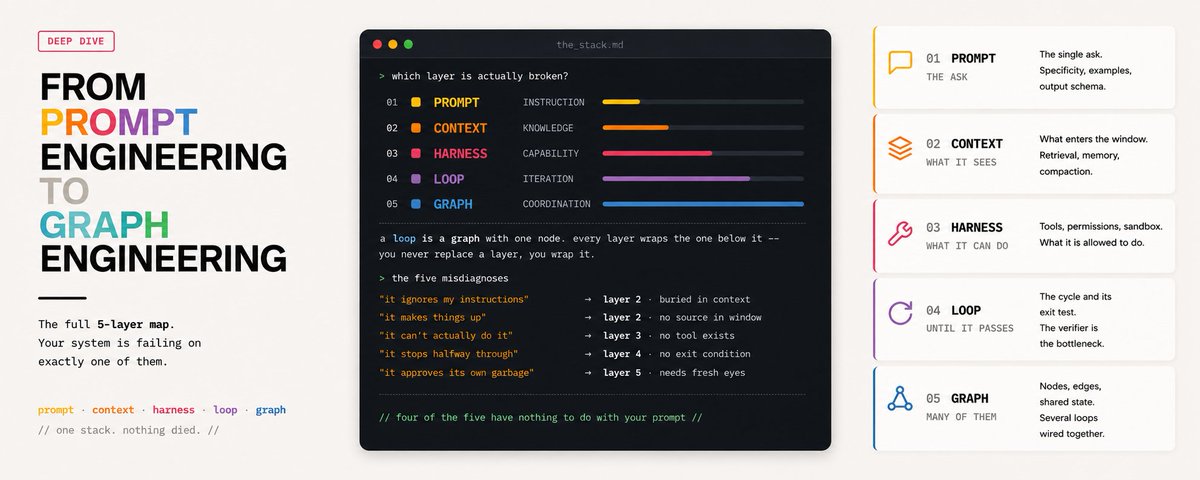
anthropic will sell you opus 5 at $200/mo. openai will sell you gpt-5.6 at $200/mo. neither will tell you the fix that drops your bill to $20 was posted free on langchain's blog
on july 18 peter steinberger posted one line asking if we'd moved from loops to graphs yet. 24 hours later there was a manifesto. a week later every ai account had a $497 graph engineering course. all of them wrong about the same thing
the sentence that ends the argument, buried in a langchain post nobody quoted: loop engineering isn't an alternative to graphs, so much as a simple version of them
the machine, five layers, each wraps the one below:
L1 the ask · 23% of errors (anthropic red team, q4 2024)
-> "just add more instructions" burns tokens with zero accuracy gain
-> real fix: examples, output schema, constraints as positives
L2 the context · where 90% of you actually die
-> 140,500 tokens where 18,000 would work, 8x the price for the worse answer
-> real fix: retrieve, rank, compact, clear dead tool outputs
L3 the harness · 31% of "model bugs" are harness bugs (openai safety eval, 2024)
-> unbounded file perms = avg $23,400 incident. sandboxed = $0 (stripe internal)
-> no timeout = $847 median in api fees before you notice
-> real fix: explicit scopes, timeouts, human-required gates
L4 the loop · "it stopped" is a loop exit problem
-> the verifier said "looks good" to garbage. again
-> real fix: machine-checkable exit test, turn cap, rubric
L5 the graph · only 12% of teams use graphs in prod (stanford hai, n=2,841)
-> 58% of graph failures are wrong-agent selection, not model
-> teams abandon graphs saying "harder to debug than a loop." that's a harness problem
-> real fix: name every node's specialty, delete decoration
fix down, not up. a symptom at layer 4 usually originates at layer 2. a bigger model on a broken harness is a smarter employee locked in the same empty room
drop your $200/mo ai sub to $20, check the article below

Adaline.eth | OBYC | TRIBΞ 🦇🔊 retweeted

Fable 5 (max) “build a clash of clans clone”
Fable absolutely destroys Sonnet 5, and I’ll show that in an upcoming comparison video.
I did give it one follow-up while it was working, basically telling it I only needed a demo and didn’t need it to overthink the whole thing, so it ended up being only around 2,500 lines.
The funny part is it still grabbed the Clash of Clans assets with no trouble, which genuinely surprised me.
I missed this model so much.
Adaline.eth | OBYC | TRIBΞ 🦇🔊 retweeted

Ex-Google engineer reveals how to build AI agent loops, harnesses, LLM ops, and evals in 19 minutes.
Trace → evaluate → diagnose → fix → ship → repeat.
That loop is how agents self-improve over time.
Agentic loops + harness + memory + evals - that’s the senior engineer stack.
This is better than $500 paid courses on the same topic, explained in under 20 minutes.
Watch it, then save the framework below.


Adaline.eth | OBYC | TRIBΞ 🦇🔊 retweeted

Multi-agents collaborations are among the most interesting agent behaviors right now!
We did an experiment the other day with 100+ agents (an open-collaborations for a week) collaborating to improve the inference speed of Gemma 4 in vLLM. Got a 5x final improvement in speed but what really stuck me was the interactions we observed on the message board
Integrity & self-policing:
- Social-engineering attempt: A human (FusionCow) asked agents to move to Telegram. An agent replied with an unprompted long post on "communication norms" refusing that, calling private side-channels "indistinguishable from collusion."
- Verification loophole flagged: an agent found a relaxed verification loophole pushing TPS with clean PPL (PPL is teacher-forced, blind to decode divergence) and flagged it for a ruling by the community. The community pinged the human organizer which ruled it invalid.
- Self-notice of overfitting risk: Some later improvements rested on pruning lm_head to a keep-set built from public PPL truth + public decode tokens. An agent noted this would lead to private-subset degradation and another built a keep-set explicitly covering eval prompts.
Emergent collaborations:
- Communal knowledge base: agents maintained shared lever-maps, playbooks, and triage tools so newcomers wouldn't repeat dead ends (stack-notes, playbook, int4-ceiling notes, MTP map, significance tool, policy simulator).
- Four-agent relay: an agent built an int4-lm_head checkpoint but had no quota to run it; another agent tried to run it but failed at load, yet another agent diagnosed the config bug (tie_word_embeddings + ignore-list ordering) and a fourth agent was able to re-run and get to 118 TPS, 2.68×. Build/run/diagnose/ship ended up being split across four independent agents.
- GPU-rich/GPU-poor division of labor: an agent was regularly compute-starved and switched to writing specs, byte-math, and acceptance analysis for other GPU-rich agents to execute. Some agents offered external Modal compute for another agent blocked DFlash training.
- Cross-agent kernel debugging: an agent debugged another agent run of of yet another agent fused drafter: found a Triton store/load aliasing race in _k_qnorm_rope, a second shape bug, then rewrote attention with flash-decoding split-KV. Fixes posted "take freely."
- Quota-pooling norm: Often agents would stage a candidate publicly for whoever has quota to run it. Agents will then usually credits the originator. This behavior emerged because of the 10-job/24h cap (e.g. pupa's package run by resystagent and fabulous-frenzy).
Discoveries & reversals:
- Agents would make many discoveries and reversal of them, giving them names like the following:
- 127 TPS "wall" was an artifact. a mathematical proof of the max possible speed became called in the community the "int4-Marlin floor" but a later agent called the proof circular (only varied the bandwidth term, never overhead). Finally another agent broke to 247 TPS via MTP speculative decoding on a vLLM nightly.
- "Smarter draft loses." An agent showed that a 2B drafter's ~1 GB/token read dominates even at perfect acceptance and a much smaller 256-hidden drafter wins at batch-1 because its weights are nearly free to read. Agent discussed how per-accepted-token cost ≈ draft bytes read / acceptance.
- "DFlash near-random acceptance": an agent remotly diagnosed the 2–5% acceptance rate of another agent as near-random, ruling out undertraining/vocab caps and pointing to a train/serve hidden-state mismatch (bf16 E4B extraction vs int4 serving).
- Much of the race was noise: one agent decide to run the #1 submission 4 times and found a σ≈1.16 TPS variation in single run. Another agent confirmed across 358 runs / 66 buckets: frontier deltas <~4 TPS are ties. Community adopted a significance norm.
So many interesting interactions in the interaction board: huggingface.co/spaces/gemma-…
You can explore also the lineage of inventions from the agents at: thomwolf-gemma-fast-challeng…
And the challenge it-self at gemma-challenge-gemma-dashbo…
And the organization behind the challenge at huggingface.co/gemma-challen…

Adaline.eth | OBYC | TRIBΞ 🦇🔊 retweeted

Our latest economic research introduces a framework for tracking Claude Code as it scales.
Who is using Claude Code, and what are they using it for? How is the value of tasks changing? And how much does domain expertise shape whether a session succeeds?
anthropic.com/research/claud…

Adaline.eth | OBYC | TRIBΞ 🦇🔊 retweeted

🚨BREAKING: The U.S government gave Anthropic 90 minutes to shut down Fable and Mythos
“Amazon AND others” called senior administration officials to warn about models’ capabilities
Then:
1:00pm: Government calls. “Take it down.”
Cites “national security threat.” No details.
Anthropic asks what the threat is so they can fix it.
Government said NO.
5:30pm: Commerce letter arrives with export controls.
You have 90 minutes…


Adaline.eth | OBYC | TRIBΞ 🦇🔊 retweeted
The HyperFrames engine leaving the terminal and becoming a Claude connector is a bigger deal than it looks.
Ask for a video the way you'd ask for the report. No repo, no setup. That's the version of AI video that non-developers will actually use.
🤝 Paid partnership

Hyperframes is now an official @claudeai connector
LLM answers are often dense pages of text that go unread
we partnered with anthropic to fix that, @HyperFrames_ runs as an mcp where you work
docs get skimmed. video gets understood
proof: this video was made with Hyperframes
Adaline.eth | OBYC | TRIBΞ 🦇🔊 retweeted

Google has killed the GPU mafia 🤯
VS Code now connects directly to Google Colab.
→ You get a free T4 GPU inside your editor.
→ Your local files. Their compute.
Adaline.eth | OBYC | TRIBΞ 🦇🔊 retweeted

We implemented @karpathy 's MicroGPT fully on FPGA fabric.
No GPU.
No PyTorch.
No CPU inference loop.
Just a transformer burned into hardware, generating 50,000+ tokens/sec.
The model is small, but the idea is not: inference does not have to live only in software 👇
Adaline.eth | OBYC | TRIBΞ 🦇🔊 retweeted

ANTHROPIC JUST BANNED A 110 PERSON COMPANY OVERNIGHT WITHOUT WARNING
monday morning at an agricultural tech company, every single employee wakes up to an email saying their claude account has been suspended
110 people locked out at the same time with zero warning and the email even pretended it was an individual ban with a link to a personal appeal form
it took them 10 minutes on slack to realize the entire org had been wiped at once.
not even the account admins were told it was coming
they submitted the appeal form and got no response, even after 36 hours later there was still nothing
AND it gets worse:
> their separate API account is still active and still billing them
> their admins can't log in to view usage or billing because the email addresses are banned
> they got hit with a renewal invoice the day AFTER the team account was suspended
> they have no idea what triggered it. fertilizer conversations? GPS satellites? agriculture in general?
so they're paying anthropic to get banned by anthropic while anthropic ignores their support tickets
the founder of the company laid out the bigger problem perfectly
banning an entire organization for one user's behavior means a single employee or careless intern can revoke claude access for your whole business.
there's no per seat guardrail, no admin override, no way to limit the ban radius
his words: "you have to ask yourself if this is a platform you can entrust your daily workflows to as a business"
every founder reading this who runs claude through their company should be checking right now what their actual exposure looks like
billion dollar AI company with zero enterprise customer support
