

Investigating what doesn't quite fit. Esotericism, psychology, health, consciousness and unconventional ideas. Host of Orion's Arrow.
Bournemouth, England
Joined February 2009
- Tweets2.5K
- Following3.1K
- Followers1K
- Likes604






Pinned Tweet
For most of my life, I thought the world worked roughly as I'd been told it did.
Then things stopped fitting.
During nearly two decades in real estate finance, and increasingly since, I kept coming across things that didn't fit how I thought the world worked.
So I started investigating them.
Esotericism. Psychology. Health. Consciousness. Economics. Persuasion. Symbolism. Cycles. And plenty that doesn't fit neatly into any category.
I'm not interested in telling you what to believe.
I'm interested in asking better questions, testing ideas and seeing where they lead.
Right now I'm writing 33 Essays in 33 Days and hosting conversations on Orion's Arrow.
The subjects might change. The underlying question probably won't:
What doesn't quite fit?
Don't pay rent on borrowed thoughts.
Are We Drowning in Information but Starving for Insight?
33 essays in 33 days. Quite a journey.
And it's made me question something I've spent much of my life doing: collecting information.
What the hell am I going to do with it all now?
For nearly two decades, I worked in commercial finance, where information was part of what I traded in.
Outside work, I was collecting a very different sort of information. Books, research, unusual ideas, forgotten knowledge and connections between seemingly unrelated subjects.
But what was I actually doing with it? Typically, just constant musing…
Having stepped away from finance a year ago, I've been exploring whether I could build something around my own thinking and perspectives, rather than simply providing information as a commodity.
These 33 essays have been part of that experiment.
Astrology, education, persuasion, decentralisation, practical magic, AI and plenty more.
Not exactly a neatly fitting niche!
So what's the common thread across 32 seemingly unrelated subjects?
I think it's the search for information that's genuinely worth knowing.
Like a treasure hunter searching for gold.
Finding something remarkable is exciting. But what then?
What's it worth? Why does it matter? And could it change something?
Take Edward Bernays, for example. Discovering how he helped develop techniques of mass persuasion, and why he's not better known outside PR, is interesting on its own.
But recognising how those techniques might still influence what we believe are our own opinions? That's something worth sitting with.
Or John Taylor Gatto, whose work challenges the very structure of schooling.
If bells, constant interruptions and institutional routines can shape how children learn and think, what might that mean for the adults we become?
These aren't simply interesting facts to collect. They're questions that could change how we understand our own lives.
Perhaps that's what's missing in our increasingly overwhelming Information Age.
We're surrounded by more information than we could ever consume, but how much of it actually makes us think differently?
How often do we come across an idea that makes us stop and recognise that perhaps we've been looking at something the wrong way all along?
That recognition interests me enormously.
One unexpected benefit of the sprint has been AI as a strategic thinking partner.
Not to tell me what to think. I push back constantly.
But to chew over my ideas, explore connections and help me find the narrative I actually want to convey.
The hardest part hasn't been writing every day. It's been working out why a particular discovery matters, what I really want to communicate and how to communicate it.
Perhaps that's the real difference between information and insight.
33 essays later, I'm less interested in collecting information and more interested in sharing something worth knowing.
33 Essays: No. 33
The 33 essays may be finished, but the investigations certainly aren't.
I'm exploring many of these questions in greater depth through Orion's Arrow, my podcast featuring conversations with people challenging conventional thinking.
If that's your kind of curiosity, you can listen here:
redcircle.com/shows/e3373bb9…
33 Essays – Your Turn
Of the 33 subjects I've explored, I'm curious which resonated most with you.
And more broadly, what's something you've discovered that genuinely changed the way you see the world?
What If Magic Is More Practical Than We Think?
Essay 32 – What If We Could Remember the Future?
As part of my journey into influence and persuasion, like many I came across the Hermetic principles, the Law of Attraction and the popular book The Secret.
Except for one issue: it didn't seem to work for me.
Indeed, whilst doing some more psychometric testing, there seemed to be people with talents for manifesting more easily than others.
How disappointing.
Perhaps it wasn't meant to be.
Having written it off for many years, I then came across Donna Laine and her intriguing Remembering Technique.
I found the premise encouraging: rather than visualising a future you want to create, you remember it as though it has already happened.
Not future tense, not even present tense, but past tense.
Something opened up for me.
I tried her exercises.
I planned a driving trip to be almost magical in its execution. It was.
I tried for a notoriously difficult parking space and got it.
The lady I needed to meet was waiting for me outside, just as I had remembered.
Coincidence? Maybe.
I then had a sudden shock: my bank accounts were closed with 60 days' notice, no justification given.
I remembered that a better solution was out there, and I'm currently exploring an entirely new marketplace of banking alternatives I would never otherwise have discovered.
The bigger goals are more challenging, but doable. I've seen a relative manifest a highly unlikely career move, and others find their dream homes.
Which begs the question:
What if we have more influence over our lives than we've been taught to believe?
Neville Goddard discusses the wish already fulfilled. You just have to put the right emotion into it.
How would you feel if it had already happened?
Perhaps it's all coincidence and the world is really a very boring place.
Or perhaps we can mess around with time and memory, like magicians, after all.
You decide.
33 Essays: No. 32
I recently interviewed Donna Laine on Orion's Arrow about her Remembering Technique, practical magic and the intriguing possibility of remembering your future.
If you're curious about how it works, here's our conversation: youtube.com/watch?v=2Oj3ceuI…
If AI Does the Work, What Will Humans Do?
In 2019 I met a fascinating chap, Dr Jag Kundi. A polymath, UK property developer based in Hong Kong, fluent in Mandarin Chinese and a professor specialising in future technology and AI.
Whilst we met to discuss development finance, I came away blown away by AI. In 2019.
His prediction? My career as a finance broker would be taken over by AI fairly soon.
I found it hard to disagree.
Afterwards, I remember asking various lenders about their views on AI, and the standard response was, “It won't replace lending to humans...”
Whilst that hasn't yet come to pass, I think many see it coming sooner rather than later.
Which brings me to my own career.
I was already losing interest and meaning in my work. So if AI takes it, what next? And what does that mean?
Meaning.
I kept coming back to that.
A career isn't just income. It provides identity, social interaction and personal development. So much more.
Raoul Pal, the macroeconomist, describes AI as reducing the cost of intelligence to nearly zero. Huge deflation, and potentially the end of GDP as a meaningful measure.
As I write in late 2026, AI is already taking a machete to corporate jobs, with no end in sight.
And if the cost of intelligence approaches zero, what incentive do the young have to learn a skill or trade if there is no income at the end of it?
Which begs the question: if the Luddites are right this time, and 80% of jobs really do go, what will humans do for work, purpose, meaning, identity and fulfilment?
Worryingly, Yuval Noah Harari, when discussing what might happen to economically redundant humans, suggested drugs and computer games.
Not very inspiring.
Many interesting thinkers are tackling the subject, from Daniel Susskind to David Shapiro. Jordan Peterson to David Graeber. Theodore Kaczynski to José Argüelles.
Have we conflated employment with meaning as part of an accepted social contract during the Industrial Age?
And now that age is nearly over, do we need to rethink what meaning actually is?
And will we have a choice?
Autonomy plays an important part in meaning for me, but might not for you.
Perhaps going back to those psychometric tests might help.
Know thyself first.
It might help later.
33 Essays: No. 31
What If There's More Hidden in Our Words Than We Realise?
While writing yesterday's essay on debating, I stumbled across something interesting.
The word “debate” comes from the Old French debatre, meaning to fight or contend, ultimately connected to batre, to beat.
Rather appropriate given what I was writing about today.
I've been fascinated by etymology, the origins and hidden history of words, for a few years now.
Working in property & finance, one of the first phrases that got my attention was...
Mortgage.
It comes from the Old French mort gage.
Death pledge.
Not quite how the banks advertise them.
Then there is Companion.
From Latin meaning, essentially, someone you share bread with.
Suddenly ordinary words start looking rather less ordinary.
And money opens another rabbit hole.
Currency traces back to the idea of running or flowing.
Which is interesting when you consider how many water metaphors we use around money.
Cash flow. Liquidity. Liquid assets. Banks. Frozen assets. Floating currencies.
Coincidence perhaps, but quite the watery collection.
Neptunian or Piscean almost.
Then things started getting considerably stranger as I delved more into the esoteric world.
Why do we “spell” a word?
A spell is also a combination of words supposedly capable of producing an effect.
Throughout history, mystical traditions around the world have attributed enormous significance to words, sounds, mantras, prayers, incantations and sacred names.
Were words once understood as something more powerful than simply a means of communication?
And then there are the more esoteric interpretations.
Government, for example.
Govern traces back to the Latin gubernare, to steer or direct.
Mens in Latin means mind.
Government.
Steering the mind?
Or entertainment.
Break it apart esoterically and you find “enter”, “contain” and again the association with mens, or mind.
Entering and containing the mind?
Conventional etymology gives different explanations for these constructions.
But esoterically, they are quite the coincidences.
Especially when you begin finding similar examples elsewhere.
We spend an extraordinary amount of our lives thinking in words, speaking in words and interpreting reality through words.
Yet most of us have little idea where those words came from, what they originally meant, or whether they might contain other layers of meaning.
There seems to be a strange composite nature to our words, involving Latin roots alongside mystical traditions worldwide that have ascribed real power to words and sounds.
Perhaps there is rather more hidden in our everyday language than we realise.
Now there's a rabbit hole...
33 Essays: No. 30
Have We Forgotten Why We Debate?
As my parents will testify, I was enthralled with the news and politics from a ridiculously young age.
I was captivated and bemused by Parliament and UK Prime Minister's Questions, this seemingly pantomime-style, highly scripted performance for the masses. A slanging match seemingly achieving very little.
Can't say my opinion has changed much since...
But why this very aggressive style of arguing at the supposed top of our societal tree?
Surely we're all trying to get to a much better outcome for everyone?
Like the truth?
Maybe not.
A-Level History and Politics had done little to satisfy my bemusement.
It was much later, while looking into influence and persuasion, that I stumbled across a 19th-century philosopher I'd never heard of called Arthur Schopenhauer.
In The Art of Being Right, he describes debate as a form of “intellectual fencing”.
The idea of holding your own in an argument whether you're right or wrong.
Which leads to an interesting problem.
If the purpose is to win, then changing your mind means you've lost.
Interesting then that the origin of the word “debate”, known as its etymology, takes us back to the Old French debatre, meaning to fight, contend or quarrel, itself connected to batre, “to beat”.
Combat.
So why do we debate?
To get closer to the truth, whether we turn out to be right or wrong?
Or simply to win, regardless?
Increasingly, it feels like the latter.
And if we can't be seen to lose, perhaps it's no wonder we've retreated into our social media echo chambers, safely surrounded by others “who think like us”.
Which leads to an interesting reflection on who actually wins and loses.
Maybe the real winner of a debate isn't the person who successfully defends their position.
Maybe it's the person who discovers they were wrong.
Because they've walked away knowing something they didn't know before.
What if changing your mind means you won the argument?
Depends, I suppose, whether you care more about winning and losing, or seeking the truth.
Now there's a thought...
33 Essays: No. 29
What If We're Not Supposed to Feel the Same Every Day?
Isn't it odd how some days we're absolutely on it, in the zone, and other days feel like trudging through treacle?
We often put this down to a bad night's sleep, and clearly that's a factor.
But sometimes we sleep great and wake up knackered.
Could there be something much larger going on?
The idea of cycles and their accompanying energies is a fascinating one, whether that's on a daily basis or over much longer periods of time.
It's interesting that in astrology, whether you believe in it or not, the traditional planetary rulerships marry up remarkably well with the days of the week.
Monday, the Moon. Reflective, perhaps a bit lower energy after the weekend.
Tuesday, Mars. Most of us seem much more lively, ready to get going and start things.
Wednesday, Mercury. Communication, commerce and deals seem to fit rather nicely here.
Thursday, Jupiter. Expansion, optimism, the bigger picture. Where are we going?
Friday, Venus. Pleasure, relationships, enjoyment. Conveniently sitting at the end of the working week.
Saturday, Saturn. Structure, responsibility, getting things in order.
Sunday, the Sun. Vitality, self-expression and, traditionally at least, the day of rest.
Coincidence? Maybe.
But there are much bigger cyclical energies at play too, and not just from an astrological standpoint.
Take the amazing work of William Strauss and Neil Howe.
They proposed that four different generational archetypes repeatedly follow one another, with broadly recurring drives, attitudes and behaviours.
In their follow-up book, The Fourth Turning, they described a larger Societal cycle of roughly 80–90 years, divided into four turnings resembling Spring, Summer, Autumn and Winter.
Interestingly, Uranus takes around 84 years to orbit the Sun.
Spookily close to the Strauss-Howe cycle.
So are we exposed to varying types of energy that we actually know very little about?
We tend to assume that when our energy changes, the explanation must be somewhere inside us.
Bad sleep. Bad mood. Lack of motivation. Something we ate.
But what if we're not always malfunctioning?
What if sometimes we're responding?
And could that partly explain why we feel differently from day to day, year to year, or even generation to generation?
Perhaps we're simply not supposed to feel the same every day.
Food for thought…
33 Essays: No. 28
I Used to Find History Boring. Then I Started Questioning It.
I found history monumentally boring at school, despite strangely choosing it for A-Level, where a very interactive teacher finally brought the subject to life.
History always seemed so dark. Conflict, loss of life, empires rising and falling. The major events were rarely happy ones.
But one phrase had a profound effect on me:
“History is written by the winners.”
Why would the winners need to write history? Surely what happened was obvious, whether you were on the winning or losing side?
How naïve of me.
One of those winners was the British Empire, whose greatness we celebrated at school.
But as I learnt more about the lives of people in the countries Britain had occupied, a rather different picture emerged. Communities devastated, lives destroyed and enormous loss of life.
My subsequent travels around the world suggested the British weren't universally held in quite the esteem I'd been led to believe.
At University between 1996 and 2000, I became friendly with two Northern Irish lads, one Protestant and one Catholic.
The Troubles were approaching a historic turning point, and these two seemed to represent a younger generation that simply wanted to get along.
One evening, after a pint, I rather ill-advisedly challenged them to settle the issue for me.
Instead, they described a recent event that had appeared on television. Astonishingly, they explained how differently it had been presented by British and Irish broadcasters. You could have been watching accounts of two completely different events.
Enlightening, if somewhat disturbing.
What was going on here, then?
The Iraq War raised even more questions. Reports of connections between the Bush and bin Laden families seemed extraordinary in the context of everything we were being told.
And through the work of investigative journalists, I began looking more closely at the economics of war.
War, it seemed, could be extraordinarily profitable.
Destroy with weapons, rebuild with real estate. Two enormous industries potentially benefiting from the same conflict.
That couldn't be right. Surely?
The more I investigated, the less straightforward history appeared.
And the further back you go, the more questions emerge, some considerably wilder than others.
Did Shakespeare really write his plays, or was someone connected to Elizabeth I's court responsible?
Are major financial crashes entirely organic, or are some deliberately engineered?
Have wars been initiated on false premises, including false-flag operations, to advance particular objectives?
And how much of what we accept as historical fact depends on which accounts survived, who controlled the narrative and whose version we were taught?
I started out thinking history was a record of what happened.
Now I increasingly see it as an investigation into what happened, what we're told happened and why those accounts might differ.
It turns out that, with history at least, the more you know, the less you know.
33 Essays: No. 27
My Love/Hate Relationship With Money and Its Design
My relationship with the workings of money has always been intense, complex and fascinating.
I was exposed to some of its architecture at an early age. My father was a retail banker, and my hilariously early interest in the news and newspapers meant money was never far away.
A couple of weeks into my first Economics class, aged 14, we witnessed Black Wednesday on 16 September 1992, when the British pound came under attack and Chancellor Norman Lamont was suddenly front and centre.
I can still hear our teacher excitedly turning on the television and announcing, “You're watching history, boys…”
My own relationship with money yo-yoed. Sometimes I was a saver, sometimes a heavy spender. Student loans and credit card debt hampered my twenties and pushed me towards conventional employment because there seemed little alternative.
I still remember the credit card offers arriving when I was just 18. Crazy, really.
Eventually, my career took me into overseas property investment and property development finance. I even wrote a macroeconomic newsletter for eight years.
Money was never very far away.
But throughout my twenties and thirties, I increasingly questioned the system and its architecture. Something always seemed off, although I couldn't quite put my finger on it.
Money clearly enabled great success in some lives, but I'd also seen its colder side.
A best friend's parents lost their house during the recession around 1989. I witnessed two waves of corporate redundancies, with targeted employees receiving old-fashioned brown envelopes on their desks before tearfully collecting their belongings and leaving.
There was a very cold and unemotional side to money and its design that I couldn't shake.
In my experience, money attracted the very people who shared similar traits with Profit. Cold and unemotional types. I saw some of the worst of this in the property game, too.
Money seemed very controlling, a kingmaker, if you will. Some flourished, while others sank without a trace.
Supply can be artificially made scarce to increase prices. Who decides that?
That seemed to be it. A cold and controlling system that everyone quietly agreed to participate in, provided that working hard, earning money and serving the system eventually delivered a healthy pension, a debt-free home and, hopefully, a pleasant retirement.
A social contract of sorts.
But it doesn't play out that way for many.
Pensions have been stolen. Property markets can collapse at precisely the wrong moment. Retirement pots diminish, and some people find themselves working well into retirement.
It can feel like a roll of the dice, where personal choices and the larger system can both have an enormous effect on the individual's outcome.
After a lifetime of fascination with money, and 18 years working in finance, I'm left with three questions I still can't quite reconcile.
Does the system expand the individual's capacity to think and act independently, or make the individual increasingly dependent upon it?
Does money serve the individual, or does it ultimately serve the system designers?
And is money, for all its uses, another outdated concept?
33 Essays: No. 26
I've Spent Most of My Life Being Told to Slow Down.
Doing things quickly had always felt good.
As a kid, once I'd got the hang of something, I wanted to do it quicker and quicker. Not necessarily the right idea, though!
Strangely, this seemed to contradict my Deliberative strength, identified through psychometric testing. But perhaps the two weren't so incompatible. I could spend ages thinking something through while still feeling the need to get everything done as quickly as possible.
As the Information Age expanded through my teens and into my twenties, a funny thing happened. I started to feel as though I didn't have enough time to do anything.
Essentially, I couldn't cope.
Time management became something of an obsession. How could I get more done in less time? How could I squeeze even more into an already packed day?
But it never worked.
If anything, it reinforced the feeling that everything was urgent, and that no matter how much I accomplished, there would always be more to do.
Over the years, plenty of people told me, "You need to slow down."
But it didn't really hit home until recently.
I've since read some fascinating books, including Four Thousand Weeks, In Praise of Slow and The Calm Life, all exploring, in different ways, the costs of our obsession with speed.
Mistakes, accidents, scattered attention and spending so much time on the urgent that we neglect what's actually important.
In some spiritual circles, there's a concept called the Sacred Pause.
I might simply call it Giving Yourself Permission to Stop.
Instead of the endless internal dialogue of "I have to do this, I have to do that, there's too much to do, how am I going to cope?", it's actually OK to say enough.
Stop.
The slowing-down process can bring you back to what's happening right now, in front of you, rather than the endless thoughts racing through your head. Many of which, incidentally, might not even be true.
Of course, pausing can bring its own sense of guilt. Why am I stopping when I've got so much to do?
But perhaps that's precisely when we need it most.
You're not escaping life. You're giving yourself the space to experience it rather than constantly reacting to it.
And there's something else I've come to appreciate about the pause.
It gives you a choice.
You're not a slave to your daily tasks. Yes, responsibilities matter, and there are things that genuinely need doing.
But even for a minute, you can choose to stop.
To sit in silence. To let the urgency subside. To give yourself permission not to be doing something.
It might make a world of difference.
33 Essays: No. 24
Has Education Outgrown Its Original Design?
I thrived at school until I was about 13. Then something changed.
Throughout my teenage years, I increasingly struggled with formal education. My A-level results were particularly disappointing.
I was bored, often struggled to keep up and found little enthusiasm for the subjects I was studying. At times, I wondered whether I simply wasn't that clever.
Yet I was curious about the world. I subsequently gravitated towards self-help courses, independent study and practical skills such as negotiation.
Why had a system that worked so well for some children seemingly failed to work for me?
Studying history, economics and politics eventually offered a possible explanation.
Mass schooling expanded during the nineteenth century, alongside the Industrial Revolution. An industrial society needed an organised workforce, and education increasingly reflected the demands of that world.
Around the same time, I discovered John Taylor Gatto, an award-winning American teacher who spent 30 years working within the education system before becoming one of its most outspoken critics.
Gatto argued that the structure of schooling teaches children lessons that have little to do with the official curriculum.
Consider the school bell.
A child might be halfway through writing a poem, completely absorbed in the creative process. Then the bell rings. The poem must be abandoned, the books packed away and attention redirected to the next subject.
What does that teach a child about the importance of their own thoughts?
It is a structure that makes considerable sense in a factory, where workers must operate according to an externally imposed timetable. But is it the best way to develop an independent mind?
And the bell is only one example.
The state determines the curriculum. Grades measure achievement against prescribed standards and can have a profound effect on self-esteem. Children spend much of their best years grouped with others of almost exactly the same age, rather than learning through participation in the wider community.
There is a recurring theme: someone else decides what you learn, when you learn it and how your progress is judged.
Perhaps that model served the needs of an industrial society. But we now live in a very different world.
If we were designing an education system from scratch today, would we recreate the nineteenth-century classroom?
Or would we build something that placed greater value on curiosity, independent thinking and the ability to direct our own learning?
33 Essays: No. 23
Are We Surrounded by a Language We Can’t Read?
As someone who researches and investigates constantly, I’ve ended up down plenty of rabbit holes over the years, ranging from the conspiratorial to the esoteric and the occult.
Across all of those areas, and more, there was something that struck me.
I kept coming across the same symbols, regardless of the change of subject, or whether I agreed with the material or not.
The idea was that there could be far more meaning contained within a symbol than its surface appearance suggests.
That took on even more significance as I dived into work on the subconscious, where I kept encountering the idea that the subconscious communicates through symbols and metaphor.
What’s going on here then?
Language itself is, of course, a set of symbols, brought together to change meaning. All there in plain sight.
And then you discover that in Hebrew the letters themselves have numerical values: Aleph = 1, Bet = 2, Gimel = 3 and so on. Jewish mystical traditions went further, attaching deeper symbolic significance to both letters and their numerical values.
A letter wasn’t necessarily just a letter, and a number wasn’t necessarily just a number.
Take zero.
In some symbolic traditions, the circle or zero can represent cycles, death and rebirth, even reincarnation. Round and round we go.
Then I came across the work of Laird Scranton and his investigations into the Dogon tribe of Africa.
His interpretation goes somewhere completely different.
Scranton argues that some Dogon symbols encode sophisticated ideas about the formation of matter and the nature of the universe. He interprets zero or nothingness as representing a non-material, unmanifest state before physical matter.
Same basic symbol. Very different meaning.
And that fascinated me.
What if some ancient symbols weren’t simply pictures, but ways of encoding knowledge?
Then I discovered one of the great names in esoterica, Manly P. Hall.
Not heard of him?
Can’t say I’m surprised. Neither had I until relatively recently.
Yet Hall became a major American writer and lecturer on occultism and esoteric philosophy in the 20th century, producing an enormous body of work exploring symbolism across ancient philosophy, religion and the mystery traditions.
And once you start looking, symbols really are everywhere.
Obelisks. Logos. Triangles. Circles. Numbers. Letters.
The Eye of Horus. The serpent. The Tree of Life. Pentagrams used in magical ritual. Runes. Even the Masonic Square and Compasses.
We see these things constantly and largely take their meaning as read.
But what if there’s more to the story?
Do symbols communicate with our subconscious in ways we don’t consciously pick up?
Could that be used for good?
And for bad?
Perhaps symbolism represents a kind of lost literacy.
Have we forgotten how to read?
What if we’re looking straight at these symbols without understanding what they’re saying?
Hmm.
The pondering goes on.
33 Essays: No. 23
I Thought Sound Was Something You Heard. Then I Saw It.
Sound and light have always fascinated me.
I'd spent a lot of time experimenting with binaural beats, trying to alter my brainwave state to increase focus or bring some calm during stressful and mentally scattered periods.
Such as every day of the week!
Then, through various email lists I was on, I kept coming across Dr John Stuart Reid, an acoustic researcher teaching a course on the ancient science of sound and cymatics.
Eventually, I dived in.
I wasn't disappointed.
Sound covers such a huge array of subjects, from the Bible's “In the beginning was the Word” to the extraordinary geometric patterns created when sound vibrations interact with matter on a Chladni plate.
That was one of the things that really caught my attention.
Sound wasn't simply something I could hear.
I could see it.
The course then went much further, exploring research and theories around how sound interacts with the human body, including blood cells, glands and the vagus nerve.
Then came one of the most intriguing ideas of all.
Our cells might, in a sense, “sing”.
There's even a field called sonocytology exploring the vibrations and sounds produced by cells.
Suddenly, sound started looking rather different.
And apparently our ancestors may have thought so too.
The course explored ancient uses of sound in places such as Egypt and India, including instruments such as the sistrum, lyre and harp, alongside more modern approaches involving tuning forks and particular frequencies.
Then there's the human voice itself.
Humming. Chanting. Toning.
Something I explored much more recently with James D'Angelo on Orion's Arrow.
Different traditions, different explanations, different eras.
But the same underlying phenomenon kept appearing.
Vibration.
Perhaps that's what fascinates me most about cymatics.
Our senses give us a particular experience of reality. We hear a sound and assume that what we're hearing is the phenomenon.
But put that vibration through matter and suddenly something previously invisible can produce a visible pattern.
Which leaves me wondering how often we make the same mistake elsewhere.
How much of reality do we assume isn't there simply because we can't perceive it directly?
33 Essays: No. 22
Why Do I Make a Pros and Cons List When I Already Know the Answer?
Whenever I've got a significant decision to make, my go-to was always a piece of paper, a pencil and the tried-and-tested pros and cons list.
Never fails...
Except, I often knew the answer before I started.
Or more intriguingly, if I was deciding on a purchase, I could spend forever analysing, only to suddenly decide at the drop of a hat.
Intuition?
In sales training we were taught that people buy with emotion and justify with logic. Emotion arrives quickly, while the rational explanation often comes afterwards.
So why did I need the pros and cons list?
Perhaps this was an issue with trusting myself. If I already knew, or was going to suddenly know the answer, was the logical part of the process pointless?
I'd discovered through psychometric testing that Deliberative was one of my strengths. I needed time to think things through.
Perhaps that's why I liked the pros and cons list. It bought me time, despite the sudden quickening of the decision at the end.
Or perhaps it was a way of verifying my intuition, a kind of checks and balances.
Maybe it helped justify an emotional decision I'd already made in a way my rational brain could understand.
But that brings us to pattern recognition.
Is the decision made quickly simply because we've seen something like this before?
In property finance, sometimes I could just feel that a deal was wrong, but I'd still need to work through it logically.
Sometimes my intuition turned out to be right and I'd discover why later, when a skeleton eventually came tumbling out of a borrower's closet.
Was that intuition?
Or had nearly two decades of looking at property deals trained me to recognise tiny warning signs without consciously knowing I was doing it?
Perhaps what we call intuition is sometimes experience working faster than conscious thought.
But does that explain all of it?
Some people would call it subconscious pattern recognition. Others might talk about gut instinct. In more esoteric circles, you might hear about an etheric field of intelligence that we somehow tap into.
I don't know.
But perhaps logic and intuition aren't competing systems after all.
Maybe intuition tells us where to look, and logic helps us check what we find.
Which means my old pros and cons list might not have been pointless after all.
Maybe I just didn't understand what I was using it for.
33 Essays: No. 21
I Knew What I Did. But Did I Know Who I Was?
By early 2020, quite a lot was going on internally for me, despite being pretty settled as a real estate finance broker.
Astrology had already helped me move from feeling like parts of me “needed fixing” towards greater acceptance of who I was.
But now I was approaching what astrologers call the Uranus Opposition, more commonly known in the material world as the “midlife crisis”.
And the timing was pretty good.
My career progression had stagnated. Partly because of a sudden health issue, and partly because I'd hit that “is this all there is?” moment.
I still enjoyed brokering deals between people, but the subject itself had lost its edge. Land and property purchases can be miserable affairs. Everyone often seems relieved when they're finally over.
And that was my day job, not an occasional occurrence.
Brokering also comes with an inherent lack of control. Add money and property into the equation and, in my experience at least, they didn't always bring out the best in people.
So in January 2020, nearly 20 years after first discovering the book Now, Discover Your Strengths, I embarked on another journey of self-discovery.
And I went at it obsessively.
Myers-Briggs. StrengthsFinder. MCore. VIA. Process Communication Model. Reiss Motivation Profile.
Test after test.
I didn't just want to know myself as a property finance broker.
I hoped there was more to me than that.
And these tests became a springboard.
“Know Thyself” has since become a core tenet of my philosophy.
Because the deeper I looked into myself, the more I also realised just how different everyone else is.
StrengthsFinder alone identifies 34 different talent themes. That's a hell of a lot of possible combinations before we've even considered everything else that makes us different.
Perhaps that's what I'd been missing.
For years, when someone asked what I did, I had an easy answer:
Property finance broker.
But that's what I did.
Was it really who I was?
Taking all those tests didn't give me a neat answer to that question.
What they did was help me start separating my identity from my occupation.
And I'm very glad I did.
Because perhaps one of the most important things we can investigate isn't what's happening in the world around us.
It's who's doing the investigating.
Know Thyself.
33 Essays: No. 20
What If Efficiency Is Making Us More Fragile?
I've been fascinated for years by how centralisation dominates the way we build many of our major structures: politics, corporations, media, banking, money and more.
It seemed obvious to me that centralisation had weaknesses, particularly its vulnerability to potential abuses of power. The more responsibility we outsource to the centre, the less control we retain at the edges.
It was one of the things that fascinated me about Bitcoin.
And strangely, it wasn't really the Bitcoin part.
It was the underlying, almost hidden idea that Bitcoin was an attempt to decentralise money.
I sometimes wonder whether people struggle with Bitcoin because they haven't first been exposed to the idea of decentralisation.
And why should they have been?
Most of the organisations we work for are centralised. Our banks are centralised. Much of our food production and distribution is centralised.
Surely we've organised things this way because it works?
Well, yes.
Centralisation clearly has benefits. Economies of scale, coordinated strategy, concentrated decision-making and, particularly, efficiency.
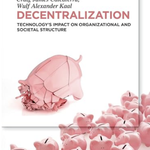
But I've recently been digging much deeper into decentralisation, including Kaal and Calcaterra's excellent book Decentralization, and there's another side to this.
The pursuit of efficiency can remove some of the very flexibility that helps a system survive when things go wrong.
Decision-making can become concentrated. Information has further to travel from the edges to the people making the decisions.
And when too much depends upon the centre, what happens when the centre gets it wrong?
That's when something clicked for me.
Resilience.
I've written before about mental resilience before. What matters is your ability to navigate through the storms that inevitably arise.
Perhaps systems aren't so different.
Many natural systems have multiple routes and different ways of responding to change. What can look inefficient may actually help the whole system absorb disruption.
Decentralisation applies a similar principle. Responsibility moves outwards, hierarchy can flatten and individual parts of the system gain greater autonomy.
But there are trade-offs.
Efficiency versus resilience.
Concentrated power versus autonomy.
Control versus adaptability.
Perhaps the interesting question isn't whether centralisation or decentralisation is “better”.
It's how much resilience we're prepared to sacrifice in pursuit of efficiency.
33 Essays: No. 19