

Postdoc at Cornell University. Human-water systems modeler, exploring the co-evolution in human-water systems + smart control.
Ithaca, NY, USA
Joined April 2018
- Tweets138
- Following174
- Followers156
- Likes424







The LINS Lab @ Clemson University is recruiting two PhD students - Fall 2026, (Spring start possible)
Full details: linkedin.com/posts/chungyi-l…
I’ll be at AGU later this year — come say hi!
#PhD #Clemson #SCEEES #Water #CivilEngineering

109
I’m excited to share that I’ll be joining Clemson University as a tenure-track Assistant Professor in the School of Civil and Environmental Engineering and Earth Sciences (SCEEES) this August 2025!
See the LinkedIn post for more details: linkedin.com/posts/chungyi-l…

2
8
269
I will be presenting on Friday, 13 Dec 2024, 13:40 to 17:30, at poster H53P-1319. Let’s chat!
"Assessing the Transferability and Effectiveness of Groundwater Conservation Policy Under Environmental Heterogeneity"
Or, on Wednesday, 11 Dec, 8:30 - 12:20, at poster GC31U-0090!

The 2024 AGU is happening in less than a week!
Be sure to check out the Water & Society sessions. Follow us on X (@aguwater) and LinkedIn(linkedin.com/in/aguwater/), and don’t forget to tag us for reposts!
See you soon!

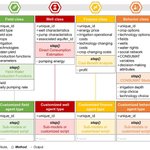
🚨Groundwater management is vital for sustainable agriculture. What if you could model human-nature interactions to better inform policy? We developed PyCHAMP, a Python package, to help you do just that! 1/5
🔗Paper: authors.elsevier.com/a/1jba6…
🔗Model: github.com/philip928lin/PyCH…

Ready for 2024 #EWRI Congress at Milwaukee!
Stop by my talk on Tuesday at 4:45 pm to 5:00 pm, room S 102 E, to learn CHAMP: A Modeling Platform for Sustainable Groundwater Management Through Human- environmental Interaction!
Looking forward to meeting great people!

Come to check out our new United States Groundwater Well Database!

We introduce the United States Groundwater Well Database (USGWD), which contains 14.2+ million use and monitoring wells across the US. 1/9
Paper: rdcu.be/dDGDY
Data: hydroshare.org/resource/8b02…

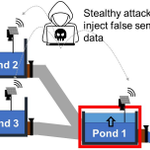
🚨 Exciting News! Our latest research on the "Flood Risks of Cyber‐Physical Attacks in Smart Stormwater Systems" is now published in Water Resources Research. 🌊💻
Paper Link: doi.org/10.1029/2023WR034827
#WaterSecurity #CyberPhysicalSystems

In this groundbreaking study, we delve into how cyber-physical attacks, specifically false data injection, can dramatically change flood risks. 🌧️🔒 #CyberSecurity #FloodRisk
1
28
🌟 First time at UCDavis Pre-AGU Fall Meeting! 🌟 Dive into the world of sustainable groundwater management with my latest work. Don't miss out: Catch me at H24B-05 on Tue, Dec 12, from 4-5:30pm. #AGU23 🌍
👀 Sneak Peek at My iPoster: [shorturl.at/qsyLP]
@_malena_

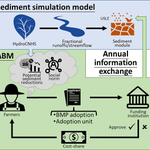
Our study "Pay-for-practice or Pay-for-performance? A coupled agent-based evaluation tool for assessing sediment management incentive policies" is now published in the Journal of Hydrology!
The 50 days' free access is here! authors.elsevier.com/c/1hSX8…
@CAWSLehigh1 @aguwater

Thank you, CUAHSI, for supporting the proposed study!
We aim to develop the United States Groundwater Wells Database to facilitate research on improving our understanding of human-water systems.

CUAHSI would like to extend a big congratulations to all of the 2023 Hydroinformatics Innovation Fellowship awardees! Way to go!! 🏆

1
10
993

Ready for #AGU22! I will present on Wednesday with the title H32L-05: Analyzing the Role of Socioeconomic Factors in Water Quality Management through Agent-Based Modeling.
Looking forward to any coffee/lunch chats. Feel free to DM me~
@aguwater @CAWSLehigh1


Today, I passed my Phd dissertation defense on the topic of "Co-evolution in complex adaptive water systems from long-term planning to short-term responses." Many thanks to all people that help me to go through this PhD journey!

New paper released!
Python package: HydroCNHS (Hydrological Model for Coupled Natural–Human Systems)
A semi-distributed hydrological model for integrating the human system! Check it out!
Paper: doi.org/10.1061/(ASCE)WR.194…
User manual: hydrocnhs.readthedocs.io/en/…

Also, I will introduce the package in CUASHI's cyberseminar series on Nov 15 at 12pm ET.
Register: us06web.zoom.us/webinar/regi…
@CUAHSI
Come join us! I will share a newly developed HydroCNHS that targeting model coupled human water system on Nov 15~
hydrocnhs.readthedocs.io/en/…
Announcing a new cyberseminar series beginning November 1st! Join us Tuesday's at 12pm ET for a series of lightning talks with speakers who are actively working to create open source tools across a wide spectrum of use cases! Register us06web.zoom.us/webinar/regi…


A new study explores the coevolution mechanism (i.e., bidirectional interactions) in coupled natural human systems (CNHS)!
authors.elsevier.com/c/1fJF5…
Results show that coupled models can better capture the historical irrigation diversion (human) and streamflow (nature) dynamics.

It is always hard and time-consuming to translate multidimensional thoughts into one-dimensional writing. Haha
Paper got published in Earth's Future!
Studies have recently focused on using coupled natural-human systems (CNHS) to inform policymaking. However, model uncertainty can increase with model complexity and affect the variance of the model outcomes. [1/5]
dx.doi.org/10.1029/2021EF002…
