

Analysing Football. Studying the game, one phase at a time. Professionally unbothered. For business inquiries and collaborations: [email protected]
Joined October 2021
- Tweets55K
- Following1.8K
- Followers6.1K
- Likes22.6K




CitySide retweeted

Hey @HKane, you just won the #BallonDor 😭🏆
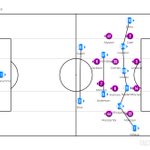
Once Spurs gained control of the ball, after the build-up phase, it was an example of the "De Zerbi-ball". It was a beautiful sequence of play, if you notice the fine details in this move.
Spurs have grown slowly into the season as it was a big change with the appointment of De Zerbi.
Chelsea had a clear plan to disrupt Spurs' build-up, even with the latter deploying a double pivot to create additional passing options in the first phase. We saw Spurs struggle to properly build-up play owing to the same.
The approach revolved around aggressive man-oriented marking in midfield, denying Spurs' double pivot the space and time to receive, turn and progress possession.
Meanwhile, Palmer and Rogers positioned themselves to press either the goalkeeper or the centre-backs, depending on where the ball travelled, restricting Spurs' ability to circulate possession comfortably across their back line.
The objective was simple: deny central progression and force Spurs to play long (or wide).
Once Spurs were forced into direct deliveries, Chelsea could engage Marmoush and the wide players in aerial or physical duels, with supporting midfielders positioned to contest the second balls and initiate attacking transitions.
Marmoush is more effective attacking space through explosive runs than operating as a traditional target man, receiving under physical pressure and securing long deliveries with his back to goal.
Consequently, Spurs struggled to establish controlled possession beyond Chelsea's initial pressing line in the first-half.
Ideally, a replacement should be a right-sided centre-back who could play right-back too.

🚨 𝗥𝗘𝗣𝗢𝗥𝗧𝗦: Manchester City left-back Rayan Ait Nouri looks set for an exit, after falling down the pecking order since Enzo Maresca’s arrival.
A move could possibly be in January.
📰 via @ManCityMEN


CitySide retweeted

Sources have stated @etihad are poised to proceed with an action against @premierleague following recent consultations with their legal representatives.
Khusanov and Gvardiol, O'Reilly and Nunes as full-backs.
Then, the midfield, depends upon who we are facing but if we need more control, then:
Anderson, Bouaddi, Fernandez/Cherki
If we want to attack freely:
Anderson, Fernandez, Bouaddi
Simple and sound.

Chelsea's interesting approach to defending corners: prioritising space over numbers.
- Rather than dropping almost everyone into their own penalty area, Chelsea position four players higher up the pitch, reducing the number of bodies around the six-yard box.
- The underlying principle is to reduce congestion in the goalkeeper's operating space while forcing the opposition to reconsider how many players they commit forward.
How does the mechanism work?
1. By leaving four players higher, Chelsea create a potential numerical threat in attacking transition. The opposition must either retain additional players in their rest-defence structure or risk being exposed if Chelsea win the first contact and launch a counter-attack.
2. This can indirectly reduce the number of attackers occupying Chelsea's penalty area.
3. Meanwhile, the reduced congestion around the six-yard box provides the goalkeeper with clearer sightlines to track the delivery and greater freedom to attack the ball.
4. The remaining defenders are responsible for protecting the most dangerous zones, engaging opposition runners and winning the first aerial contact.
However, there are clear vulnerabilities.
1. With fewer players defending the box, Chelsea become increasingly dependent on the quality of their individual duels and the goalkeeper's ability to command his area.
2. Opponents can exploit this by overloading the far-post zone, using blocking movements to isolate defenders or attacking second balls before Chelsea's advanced players can recover.
3. Another important consideration is the delivery itself. Inswinging corners towards the six-yard box may favour an aggressive goalkeeper, but deliveries targeting areas outside his effective claiming range can force Chelsea's reduced defensive unit into difficult aerial contests.
The tactical trade-off is interesting.
- Chelsea are effectively attempting to defend corners by influencing the opposition's attacking structure, rather than simply matching their numbers inside the penalty area.
- The objective isn't just to clear the initial delivery, but to create favourable conditions for the goalkeeper, preserve defensive access to key zones and maintain an immediate threat in transition.
- However, the effectiveness of this approach ultimately depends on whether the opposition respects the counter-attacking threat or chooses to overload the penalty area regardless.


