

AI Automation, AI , Developer Influencer, Ambassador, Moderator, Content Creator
Web3
Joined June 2022
- Tweets4.8K
- Following836
- Followers2.1K
- Likes19.6K







Read an article about how companies are cutting their AI agent bills by 90%, and there's an idea in it that completely changed how I think about agents.
Open any agent log and count how many times the model actually created something - wrote text, code, a plan - versus how many times it just picked: which tool next, is this source relevant, did the test pass, is this command safe.
In most logs, the second kind wins by a landslide. And every single one of those "picks" gets billed as a full generation from a frontier model.
The fix they describe isn't "use a cheaper model." It's a model that can't write a single word. It only answers multiple-choice questions and returns a probability. About 100ms per answer, pennies per million tokens.
Here's the clever part: whatever it's confident about gets handled instantly. Whatever it's unsure about gets escalated to a stronger model. You end up with a cascade where the expensive model only touches the genuinely hard cases.
Real example from the article: 100 emails, half fraud, half legit - classified in 16 seconds for 7 cents, 96 out of 100 correct.
And at scale, the numbers get wild: processing a million support tickets with a frontier model alone costs around $30,400 a month. The same workload through the cascade costs around $6,480.
This isn't a "save 10%" kind of fix. It's "you're paying for a Ferrari where a calculator would do"

Sounds awesome! I'm curious to see what benefits the Slippy Club members will get.

The Slippy Club NFT whitelist is now open. 🐍
SLIPPY holder benefits will be revealed soon.
Follow the steps. No arms required.
nft.slippy.club
He wrote a comprehensive history of AI-from Turing's question in 1950 to ChatGPT. It's worth reading if you're interested in the topic.

Found a setup people are actually using to make money with AI right now, wanted to share.
The idea is simple: take a product photo, drop it into ChatGPT, ask it to write a script like a regular person reviewing it on their phone - short, casual, natural pauses, no salesy tone.
Then you feed that photo + script into Sora 2 or Veo 3 (or use something like HeyGen or PolloAI if you don't want to touch an API). What comes out is a video of a "person" holding the product, talking, lips synced, camera shaking a bit like it was actually shot on a phone.
Then you sell that video to brands as UGC ads.
The numbers are real:
- one video: $200-500
- a 3-pack of variations: $500+
- on retainer (fresh videos every week): agency-level income
Why it works: brands were already paying for this kind of content, the only bottleneck was needing an actual person with a camera. That bottleneck's gone now, but the demand didn't go anywhere.
If you know even basic prompting, you could realistically set this up in an evening

The more I explore @0xhazels, the more interesting the idea behind it becomes.
It’s not just another platform where you farm points by posting about projects.
Hazels is trying to turn social attention into something measurable - your content, activity and Social Score all become part of the system.
I’m still figuring out how the ranking and rewards play out in practice, but that’s actually what makes this interesting to me.
I’d rather test it myself than just read the docs.
Let’s see what happens 👀

Been growing my account around AI tips lately, and honestly I could use more momentum 😄
If you're building your own thing too - let's follow each other.
Drop a comment, I'll follow back within the day.
Support > competition

1/7🧵One ordinary photo. One short command in ChatGPT. Pro-level visuals in seconds.
Magazine covers, exploded product views, ad creatives, 3D illustrations, lifestyle shots.
5 commands worth saving 👇
#ChatGPT #AI #AIPrompts #PromptEngineering #AIimages

6/7🧵If your original photo feels boring, use this.
Upload the photo, then type:
/lifestyle-shot
It places your object in a realistic advertising context. The demo put a suitcase in an airport at sunset.
7/7🧵Recap:
/magazine-cover → cover
/product-explosion → parts breakdown
/ad-creative → ad
/3d-soft → 3D illustration
/lifestyle-shot → real-life scene
Save this thread and follow for more AI tricks like these.
#AITools #AIGenerated #ProductDesign #AIart #Midjourney #Marketing

Just joined @0xhazels and started exploring Hazels Studio.
What caught my attention is how it combines creator content, social scores and on-chain rewards into one system.
The idea is pretty simple: discover campaigns, create original content and earn YORAI based on your activity.
I'm starting with The Eighth Rise and will be sharing what I discover along the way.
Let's see where this goes 👀

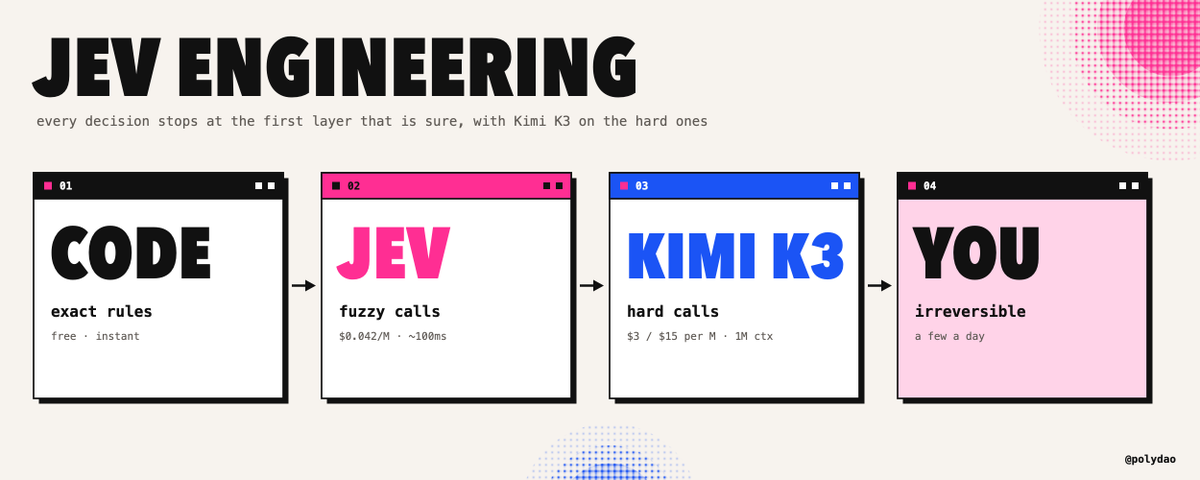
Institutional research desks on Wall Street cost $2-5 million a year. AI pipelines are now doing similar work for $450 a day.
The setup:
code filters thousands of stocks → Kimi K3, with its massive context window (over 1M tokens), scans quarters of financial data for inconsistencies → GPT-6 Astra (OpenAI's model, launched in early September) delivers sourced bull-vs-bear reasoning.
The key detail: the human doesn't disappear from this loop. They review the output, focusing on real changes and contradictions - but deliberately keep the model away from risky buy/sell calls. AI cuts through the information overload; the final decision stays human.
Users praise exactly this combination: cost savings, smart orchestration between two different models built for different jobs, and human oversight exactly where the stakes are highest.
Fittingly, this is happening the same week @OpenAI rolled out a separate #ChatGPT for Financial Services for banks. While the corporate world sells "AI for Wall Street" as an enterprise line item, someone's already assembling a working equivalent from open models for $450 a day.

🏹 $GOLDENARROW: 2 hours in, +5800%, then -51% on a single candle
Started quiet, then rocketed from zero to a $1.56M cap. A few minutes later - a red candle, retrace down to $761K.
But here's the interesting part: buy volume ($740K) is almost equal to sell volume ($713K). 2,638 buyers today vs. 1,487 sellers.
This isn't "a whale dumped and everyone panicked" -people are entering and exiting at roughly equal rates. Looks more like natural turbulence after a vertical pump than a classic rug.
Whether anyone chases a second leg up - the next hour will tell 👀

🐈 $CAT (Clarity Cat) - anatomy of an hour of hype
Launched on Pump.fun and hit a market cap near $970K within minutes - an insane number for a fresh meme coin.
Then it played out like a textbook case: someone started offloading their position, the candle broke down, and the cap dropped back to ~$225K. Sell volume was 560K+ tokens over 8 bars.
The classic question in moments like this - "will it get bought back or not" - barely matters. The real question is: how many holders got in BEFORE the dump, and how many bought in during the panic afterward?
Who can guess which candle most of the buyers actually entered on? 👇

1/3🧵I started digging deeper into @RareFriendsNFT and at first I thought it was just another free-mint NFT project. But the mechanics here are actually much more interesting.
The project is backed by Poopie, co-founder of @doodles. The Genesis collection has only 1,024 NFTs.
What really caught my attention is the current market valuation. The OpenSea floor is around $1,050, while recent sales have been happening around $950–$1,420+.
And all of this started with a free mint.

2/3🧵But the price isn’t even the most interesting part.
Each Genesis can be converted into 1,000,000 $RAREFRIEND. Once converted, the NFT is burned forever and can never be recovered.
That creates a pretty unusual deflationary mechanic: the Genesis supply can only go down.
At the same time, Genesis has a 2.0x reward weight, while Generations have a maximum of 1.75x.
So Genesis isn’t just a collectible NFT - it’s the most powerful asset within the system.

3/3🧵$RAREFRIEND can then be used to create Generations - the next layer of the ecosystem.
So the model looks like this:
- Genesis → $RAREFRIEND → Generations → rewards
Right now, the collection has only 263 unique owners, with just 23 NFTs listed for sale, and around $46K in 24h volume.
With a floor around $1,050, the supply is what makes this particularly interesting: there are only 1,024 Genesis, and every Genesis that gets converted is permanently removed from the collection.
So for me, the real question isn’t whether a Genesis is “expensive” at $1K.
It’s what happens to Genesis if Rare Friends actually builds a working economy and the supply starts shrinking.
