

Universal Co-Masonry is a Masonic Order dedicated to the Great Work of restoring Freemasonry to its origin and founding in the Ancient Mysteries.
Colorado, USA
Joined December 2016
- Tweets3.3K
- Following318
- Followers16.5K
- Likes1.1K




Pinned Tweet
Join us for the Masonic Seminar Lecture Series xitter.cf/i/broadcasts/1wxWjlzoB…

RITUAL FORM IN FREEMASONRY AND CEREMONIAL MAGIC
Ritual is the deliberate ordering of symbolic action according to an established form. Through measured movement, prescribed sequence, and concentrated attention, abstract principles acquire visible expression. The human mind is brought into disciplined relation with an idea through the participation of the senses, the faculties of memory, and the exercise of conscious intention.
In Freemasonry, ceremonial form belongs to a system of moral instruction and initiatic philosophy. The arrangement of the Lodge, the symbolic implements of the Craft, and the measured progression of its ceremonies establish an ordered framework through which the candidate may contemplate duty, virtue, and the proper government of his conduct. The square, the compasses, and the architectural symbolism of the Temple present moral principles under material forms. Their significance unfolds through study, reflection, and the practical application of the lessons they convey.
Western ceremonial magic has likewise employed established sequences, consecrated spaces, symbolic instruments, and the concentrated direction of the mind. Within certain traditions of late antiquity, the Middle Ages, and the Renaissance, these elements were understood through philosophical systems concerning celestial correspondences, spiritual intelligences, and the concealed properties of nature. Ceremonial action was frequently regarded as possessing an operative character, whereby the practitioner sought to engage spiritual or natural agencies according to the doctrines of his particular school.
The common philosophical interest lies in the relationship between outward action and inward consciousness. Sequence establishes order. Symbol concentrates meaning. Attention directs the intellectual faculties toward the principles represented.
The institutional purposes of these traditions remain distinct. Freemasonry directs its ceremonial discipline toward moral formation, the cultivation of virtue, and the progressive understanding of its initiatic teachings. Western ceremonial magic historically encompassed systems concerned with spiritual operation, natural correspondences, and the exercise of agency within a cosmological order.
The comparative student must therefore examine each ceremonial tradition according to its own principles and declared purposes. Similarity of form establishes a legitimate field of symbolic inquiry, but the philosophical meaning of ritual depends upon the doctrines, intentions, and ends that govern its employment.
In every properly ordered ceremony, the arrangement of actions possesses significance. The place of an object, the succession of movements, and the attentive disposition of the participant contribute to an intelligible symbolic structure. The study of that structure reveals how human beings have employed measure, proportion, and ceremonial order to give sensible expression to their conceptions of moral and spiritual law.


THE FIRMAMENT
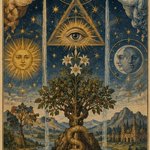
The starry heavens present to the contemplative Mason a sublime image of order, proportion, and immutable law. Beneath that celestial vault, the stars pursue their appointed courses, marking the passage of time and furnishing man with the means of orientation and measure. Their regular motions proclaim an order within which all earthly labour must find its proper place.
As the architect governs his work by the square and compasses, so must man endeavour to regulate his conduct according to those moral principles which give harmony and stability to human life. The contemplation of the heavens, whose vastness surpasses the measure of our earthly concerns, teaches humility in judgment and enlarges our conception of duty.

“Look within. Within is the fountain of good, and it will ever bubble up, if thou wilt ever dig.”
~Marcus Aurelius
🤖 Made with AI


The liberty of conscience proclaimed by Universal Co-Masonry establishes a solemn responsibility: that each individual should pursue truth with sincerity, exercise judgment with moderation, and respect the conscientious convictions of others. Our Declaration of Principles affirms the utmost tolerance in the search for truth and requires that religious and philosophical discussions be conducted with temperance and mutual consideration.
Within these principles lies ample room for the serious comparative study of religious traditions. The sacred writings, symbols, and philosophical teachings of different civilizations offer abundant material for examining humanity's understanding of moral duty, divine order, and the cultivation of virtue. Through patient and conscientious study, we may discover affinities of thought, distinctions of doctrine, and varied expressions of those moral questions which have occupied mankind throughout the centuries.
We uphold liberty of thought and the sincere pursuit of truth, recognizing that no institution may claim exclusive possession of it. This conviction places upon us the obligation to approach differing beliefs with intellectual humility, to examine unfamiliar ideas with fairness, and to preserve the dignity of sincere inquiry.
Tolerance gives freedom to inquiry; moderation preserves its dignity; and the search for truth supplies its proper purpose. These principles guide our consideration of the religious and philosophical inheritance of humanity, encouraging the cultivation of understanding, sound judgment, and mutual respect.
We invite all who share these aspirations to read our Declaration of Principles and consider the duties it places upon every seeker of truth.


THE MOON
The Moon, passing through her successive phases, presents to the observer a celestial illustration of order, recurrence, and measured change. From the slender crescent to the full and luminous orb, and thence through her gradual waning, she completes a course whose regularity has furnished mankind with one of its most ancient instruments for reckoning time. By her revolutions, months were measured, religious observances appointed, and the recurring seasons of human activity brought into an intelligible order.
Her light, received from the Sun and reflected upon the Earth, affords a fitting subject for moral contemplation. Man likewise receives illumination through knowledge, experience, and the instruction of those who have labored before him. The worth of such light is made evident in its faithful application to the duties of life.
The Moon's appearance changes according to her position in the heavens, yet her course remains governed by constant laws. So must the disciplined man preserve the regularity of his conduct amid the changing circumstances of earthly existence.
In the symbolic language of Freemasonry, the celestial lights offer enduring illustrations of order and proportion. The Moon particularly commends to our consideration the virtues of constancy, patience, and obedience to rightful measure. Her recurring phases teach the observant mind to reckon time wisely, to respect the appointed seasons of labor, and to maintain fidelity to duty through every alteration of fortune.

THE SUN
Each morning the Sun ascends above the eastern horizon, dispelling the darkness and restoring to the world its visible form. Pursuing its appointed course across the heavens, it marks the passage of the hours, regulates the labours of men, and gives to the succession of days that regularity upon which the affairs of civilised life depend.
From the earliest ages, the Sun has occupied a distinguished place in the religious symbolism and philosophical contemplations of mankind. Its splendour has represented divine illumination, its warmth the generative powers of Nature, and its apparent course the constancy of celestial law.
Within the moral symbolism of Freemasonry, the Sun affords an instructive emblem of knowledge, order, and disciplined industry. As daylight reveals the proportions of an edifice and enables the craftsman to distinguish each stone and measure its proper place, so intellectual illumination enables a man to discern his duties and govern his conduct according to reason.
The Mason who labours beneath this emblem should cultivate the regularity which it represents. His hours must be wisely apportioned, his faculties diligently employed, and his actions directed by a clear understanding of their purpose.
For the workman who possesses light sufficient to comprehend the design may place each stone with precision, and contribute his appointed labour toward the completion of the Temple.


"For we know there will be a general reformation, both of divine and humane things”
~Fama Fraternitas
🤖 Made with AI


The Masonic Seminar Lecture Series - Freemasonry and Death xitter.cf/i/broadcasts/1wxWjlzoB…

THE ROSICRUCIAN REFORMATION AND THE MASONIC IDEAL
The Rosicrucian manifestos of the early seventeenth century proclaimed a great reformation of human knowledge and conduct. The Fama Fraternitatis (1614) and Confessio Fraternitatis (1615), followed by the allegorical Chymical Wedding (1616), arose amid the religious controversies and intellectual ferment of Protestant Germany. Their authors conceived of a renewal of learning in which Christian piety, natural philosophy, medicine, and the investigation of divine creation should contribute to the restoration of human society.
At the foundation of this remarkable programme stood a moral conviction: that the improvement of mankind required the cultivation of wisdom and the purification of human character. Knowledge carried with it an obligation to employ its fruits in the service of others.
A corresponding principle may be discerned in speculative Freemasonry. The rough ashlar, subjected to the patient discipline of the craftsman, represents the individual character gradually brought into conformity with the principles of virtue. Through education, self-command, and the faithful discharge of duty, the Mason prepares himself to contribute to the moral improvement of society.
Later centuries witnessed significant contacts between Rosicrucian thought and Masonic institutions, particularly through esoteric literature and organisations cultivated by Masons. Their historical connections require discrimination, for each tradition possesses its own development and intellectual inheritance.
Their common philosophical concern remains worthy of serious consideration: the reformation of society begins with the reformation of those who compose it.


THE ACACIA
The acacia, with its hardy wood, enduring green foliage, and remarkable power of survival beneath an unforgiving sun, has long furnished Freemasonry with an emblem of profound moral significance. Rooted in difficult soil and sustained through seasons of drought, it presents to the contemplative mind an image of constancy amid the changing fortunes of earthly existence.
In Masonic literature, the acacia has traditionally been associated with fidelity, remembrance, and the persistence of life. Its verdure speaks of that principle of endurance by which the memory of worthy deeds survives the passing of generations. The living branch becomes a fitting emblem of those affections and obligations which neither distance nor the passage of years should diminish.
There is a solemn instruction in the steadfastness of this humble tree. As its roots maintain their hold upon the earth through adversity, so must the upright man preserve his allegiance to truth, his fidelity to duty, and his reverence for those who have preceded him.
The acacia thus teaches a quiet and enduring lesson: that a virtuous life leaves its impress upon the world, that honorable memory demands faithful guardianship, and that the good which a man cultivates may continue to bear fruit long after his own earthly labors have ceased.


