

Tracking how India builds chips, rockets, robots & research. Sources linked. No party, no sponsor.
Joined September 2026
- Tweets186
- Following95
- Followers14
- Likes576







Pinned Tweet
The bullet train is coming to Tamil Nadu. Worried it touches only one city?
The approved Chennai–Bengaluru line stops at Chennai, Poonamallee and Parandur*, then runs through Chittoor in Andhra Pradesh and Kolar in Karnataka.
The Chennai–Hyderabad line spends about 61 km in Tamil Nadu before Tirupati, Nellore and Amaravati. The network effects, new stations, new investment, new commutes, will mostly land outside our state.
Crying about it won't help. The route follows the shortest path, and it's set. So don't fight the route. Add to it.
What Tamil Nadu needs is its own dedicated plan for moving people and goods between its cities, built on three things:
Speed: Chennai, Coimbatore, Madurai, Trichy, Salem and Bengaluru within a few hours of each other, starting with faster trains on tracks we already have.
Commuter-friendly: RRTS lines, where the next city is an hour away, so you can live in Vellore or Villupuram and work in Chennai.
Freight: a dedicated freight corridor into Tamil Nadu, linking Hosur, Coimbatore and Tiruppur to Chennai and Thoothukudi ports.
Today, none reaches the state.
Get all three right and we don't need to depend on the bullet train alone. Bullet trains take many years. Much of this can start now.
We looked at 20 rail links Tamil Nadu needs and asked three things of each: is it planned, how far along is it, and is there a date?
Only 1 of 20 has a delivery date.
Three things to do now:
A Tamil Nadu stop on the approved line, near Vellore, while the plan is still being revised.
Approve the RRTS corridors already studied (Vellore, Villupuram, Coimbatore–Salem) and speed up today's tracks to 160 km/h.
Bring a dedicated freight corridor into Tamil Nadu.
Rail is the Centre's job; land and RRTS are the state's. Both hold pieces. Give all 20 a date, and an order.
*Parandur station is still in the design, but the airport it was planned for has been dropped.
Full breakdown in the video, and the maps in this thread 👇
@dmuthuk @SingaiGR #BulletTrain #Chennai #ChennaiAirport #RRTS #railway
1
371
Common Man retweeted

#weneedparandurairoportback
The earlier govt had already planned the flood mitigation issues. If the current govt feels it isn't enough, they can change the design. Publish every report possible. Pay as much compensation as farmers want. But there's no alternate!! @CMOTamilnadu

Parandur can come back, on the CM's own principles.
The CM's test for growth is clear: development, but not at the cost of farmers, homes or water. Here is how Parandur can pass every one of those tests.
THE PROBLEM
• Chennai still has no second-airport site. TIDCO's own RTI reply: the final site is "not yet selected."
• About 1,500–1,700 acres at Parandur are already bought and paid for, waiting for a use.
• Chennai handled 23 million passengers last year. Bengaluru: 44.5 million. Hyderabad: 30.5 million.
• A new airport takes 8–10 years. Starting from zero costs time Chennai doesn't have.
WHY THE CM WAS RIGHT TO STOP THE OLD DESIGN
• The site's tanks hold about 9.3 million m³ of water (independent estimate). The 2024 plan's Nelvoy reservoir: 5.69 million m³. About 60%.
• The site was to be raised 1.5 m above flood level. Navi Mumbai used 2.5 m.
• Farmers were offered cash only. The plan literally said "land for land: not applicable."
THE FIX: PARANDUR, DONE RIGHT
1. Water first
– At least 9.3 million m³ of new storage. Not a drop of storage lost.
– Drainage built for a 1-in-100-year storm, the national standard for big-city airports.
– At least 2.5 m above flood level.
– New reservoirs built and tested through a full monsoon before any tank is touched.
– Flood studies for the Kosasthalaiyar, Cooum and Adyar published first.
– Zero water drawn from farmers' lakes.
2. Farmers paid better, and protected
– Phase 1 needs one runway. The second isn't needed until 2043.
– Buy that land now. Farmers keep farming it until a fixed date written into the deed.
– A yearly payment from a locked fund (at least ₹30,000–50,000 per acre, rising 10% a year), so a change of government can't stop it.
– At handover: a top-up, plus at least 22.5% of the land back as developed plots, or shares in a farmer-owned company.
3. New homes before old ones are touched
– A ready township handed over before any eviction. Villages move together.
– One guaranteed job or apprenticeship per family, at the aviation academy, MRO hangars and cargo hub already in the master plan.
4. The people decide
– Put the full package to the gram sabhas. 70% yes: Parandur proceeds on the CM's terms. No: the alternative site gets the same standards.
THE IMPACT
• An airport that keeps every litre of water storage the land holds today.
• Farmers who earn while they wait, and own a share of the airport economy.
• Bengaluru–Chennai Expressway at the gate (92 of 106 km done in TN), a metro extension plan the state approved in 2025, and MRO and cargo planned from day one.
• Studies done and nearly half the land in hand: years ahead of starting over.
The CM didn't reject an airport. He rejected a design.
Parandur, done right, is the design he asked for.
Full 5-minute explainer, maps and sources in the reply 👇
@CMOTamilnadu @TNIndMinOffice @Guidance_TN @SIPCOTTN @SingaiGR @aaichnairport @AAI_Official @MoCA_GoI
#Parandur #Chennai #InvestInTN #AAI
Full 5-minute explainer: youtu.be/KaxPBhjENVs
Sources: TIDCO's 2024 pre-feasibility report, master plan and drawings (via OpenCity); TIDCO RTI reply via DT Next (Oct 2026); AAI 2022 site study; AAI traffic data FY26; Uvakai Research Foundation water estimate; CPHEEO drainage manual; CIDCO Navi Mumbai.
Note: the map overlay and "a third of the site" are our estimates from TIDCO's maps. Every fix in this post is a proposal, not government policy.
Voiceover is AI-generated.


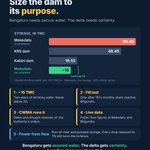
Mekedatu: a middle path both states can live with.
Karnataka wants secure drinking water for Bengaluru. Tamil Nadu fears the delta will lose water. Both concerns are real.
Where it stands: the Supreme Court called TN's plea "premature", and the Central Water Commission sent Karnataka's project report back for revision. The real fight now is over size and control.
The numbers:
• Proposed live storage: 59.46 TMC
• KRS dam: 49.45 TMC
• Kabini dam: 19.52 TMC
• Karnataka's allowed drinking-water use: ~6.5 TMC a year
A reservoir bigger than KRS for about 6.5 TMC of drinking water a year is what worries the delta.
A proposal:
1. Size: ~15 TMC live storage, two years of drinking water. Hard cap of 20 TMC, no bigger than Kabini.
2. Fill only after TN's monthly share reaches Biligundlu.
3. The Cauvery Water Management Authority (CWMA) operates the gates.
4. Live public flow data at Mekedatu and Biligundlu.
5. Power from flow, not storage: run-of-river and pumped storage. Every drop released to TN still turns the turbines.
Karnataka says the dam will also help TN in drought years. Good. Write that into the rules, not just the speeches.
Impact: Bengaluru gets assured water, delta farmers get certainty, Karnataka keeps most of its power, and far less forest goes underwater.
Both states say this is about drinking water. Build it for exactly that.
@CMOTamilnadu @CMofKarnataka @DoWRRDGR_MoJS @CWCOfficial_GoI
#Cauvery #Mekedatu

51
The national number is great. The Chennai number is a warning.
Chennai, Jul–Sep 2026:
• Warehouse leasing: 2.3 mn sq ft (+64%)
• New supply: 2.1 mn sq ft (−9%)
This year so far: 6.4 mn leased, 6.3 mn added. Almost nothing left over.
India now has spare space (vacancy 16%). Chennai doesn't. Tight space means higher rents, and big occupiers start looking elsewhere. Bengaluru leasing rose 150% in Q3, Pune 350%.
Chennai is still India's #2 market, and #2 for 2 lakh+ sq ft deals. Auto (+70%) and electronics (~30%) are the fastest-growing occupiers nationally, and both are Chennai's home turf.
Suggestions:
1️⃣ Logistics-zoned, ready land in SIPCOT parks and along the ring-road corridors
2️⃣ Time-bound warehouse approvals via the single window (Biz Buddy)
3️⃣ Rail- and port-linked warehousing near Chennai's ports
Build ahead of demand, and the big deals (and jobs) stay here.
@TNIndMinOffice @SIPCOTTN @Guidance_TN @CMOTamilnadu @dmuthuk
#InvestInTN #Chennai


Grade A leasing across India’s top 8 cities reached 33.3 million sq.ft. during Jan-Sep 2026, marking a robust 26% YoY growth.
Read more - ow.ly/XwCk5104zsr
Explore more - ow.ly/rlc15104zsx
#ColliersIndia #IndiaRealEstate #Logistics #SupplyChain #ColliersResearch

ALT Industrial & Warehousing Snapshot Q3 2026 - Colliers India
36
Don't let Chennai become the next Kolkata.
In 1971, Kolkata was India's biggest city. It never collapsed. It slowly fell behind, one decade at a time.
Chennai is showing early signs:
• Bengaluru has overtaken it in size (UN estimates)
• The UN expects it to grow just 0.35% a year, slower than every other metro except Hyderabad
The base is still strong. Tamil Nadu makes 41% of India's electronics exports. Office demand rose 15% in 2025. A home loan takes 23% of income. Steady is not enough. Here are the six most important tasks for the next 6 months.
1. Second airport finalisation
Gap: the airport is full. Traffic grew just 4.6% a year (FY15–25), the slowest metro after Mumbai. Parandur was dropped in Aug 2026, and there is no new site.
Fix: name a site, with a date. Expand the current terminal meanwhile.
Worked in: Mumbai and Delhi. Navi Mumbai airport opened in Dec 2025, Jewar in Jun 2026.
2. Building rule reform
Gap: a rule allowing 6.5x floor area near metro lines is still only a proposal. The master plan ran out in 2026, and the new one is due only in 2027.
Fix: notify 6.5x around every metro, MRTS and suburban station. Release the draft master plan for public comment.
Worked in: Ahmedabad. 4x floor area within 200 m of metro and BRTS lines, widened to more roads in Dec 2025.
3. Flood-proofing
Gap: the city spent ₹2,191 crore on storm water drains, yet Cyclone Michaung flooded it in 2023. Many drains were never linked to a canal or lake.
Fix: map and fund every missing link, under one drainage plan, and start work before the 2027 monsoon.
Worked in: Chennai itself. Chitlapakkam's cut-and-cover drains kept it dry during Michaung.
4. High-paying jobs
Gap: factories bring volume, but high-paying design, R&D and global-centre jobs are going elsewhere. Chennai has about 280 GCCs, against about 350 in Hyderabad and about 950 in Bengaluru (ANSR).
Fix: pitch design and R&D centres to the companies already making things here.
Worked in: Coimbatore, which has 75 GCCs and aims for 200 (EY-CII).
5. Faster building approvals
Gap: in Jul 2026, developers were still asking CMDA how the metro-corridor discount applies.
Fix: one approvals cell, clear rules, towers cleared in days.
Worked in: Andhra Pradesh, which approves towers of 12+ floors in 72 hours.
6. Urban mobility
Gap: the MRTS line was built for 6.5 lakh riders a day and carries about 80,000.
Fix: one ticket for metro, MRTS and suburban trains, and keep the metro handover on track for 2027.
Started: the handover was approved in Aug 2026.
India counts again in February 2027. Six months of decisions now can decide whether Chennai climbs or slips.
@CMOTamilnadu @TNIndMinOffice @Guidance_TN @CMDA_Official @chennaicorp @cmrlofficial @MoCA_GoI @AAI_Official

1
75
Cities don't fall overnight. They slip.
Kolkata was India's biggest city in 1971. Today it's No.3. The signs showed decades early:
• it kept getting overtaken
• it grew at half the pace of other cities
• its banks now lend ₹70 of every ₹100 locally, down from ₹93
We checked India's big cities for six signs:
1. Slipping down the ranks
2. Growing slower than other cities
3. Local savings lent elsewhere
4. Slow bank growth
5. Fewer new flyers
6. Dimming night lights
The big metros:
• Kolkata: 4 signs. Needs big employers and faster approvals.
• Mumbai: 2. Grew just 12% in 2001–11 as people moved to cheaper edges like Vasai-Virar; the airport was full. Needs cheaper land across the region and a busy Navi Mumbai airport.
• Delhi NCR: 1. Bank growth is slow. Needs one clean-air plan with its neighbouring states.
• Chennai: 1. Air traffic is growing slowly. Needs a decision on its second airport.
• Bengaluru: 1. Its banks lend ₹62 of every ₹100 locally, down from ₹77. Needs water and suburban rail.
• Ahmedabad: 1. It slipped from No.5 to No.7, but is rising again on cheap land.
• Hyderabad, Pune: 0. Keep land and water ahead of demand.
Most signs (5 of 6): Nagpur, Jamshedpur, Dhanbad.
Hidden warnings. These look steady today but show 4–5 signs: Nagpur, Vadodara, Madurai, Amritsar, Trichy.
Clear for now: Surat, Rajkot, Nashik, Vijayawada, Aurangabad.
The fixes already exist in India:
• Open cheap land at the city's edge (Ahmedabad)
• Bring in one big employer, with deadlines on approvals (Hyderabad)
• Build airports before they fill (Navi Mumbai, Jewar)
• Help one-industry towns branch out (Coimbatore)
India counts again in February 2027. Act on the signs before the count, not after.
1
102
Can Chennai host 450+ GCCs by 2030 without a second airport?
Parandur is off and no new site is final. The current airport is expected to hit saturation around 2028. And you still can't fly nonstop to Chennai from New York, Tokyo or Paris.
Here's why that matters 👇
The CEO test 🛬
When a global company picks a GCC city, its leaders don't visit once. They come back for site visits, board reviews and client days. A city that is one flight away feels close. A city with a change in Dubai or Doha feels far. Given a nonstop option elsewhere, almost nobody picks the connection.
Where Chennai is missing ✈️
There is no nonstop to Chennai from:
🇺🇸 New York, Chicago, Dallas, San Francisco, Seattle
🇨🇦 Toronto
🇪🇺 Paris, Amsterdam, Zurich, Munich, Stockholm
🌏 Tokyo, Seoul, Sydney
These are exactly the places GCCs come from:
• US companies run about 55–60% of India's GCCs
• Europe adds another 15–20%
• Over 60% of Japan's largest companies have no GCC in India yet
Chennai does have nonstops to London, Frankfurt, Singapore and Hong Kong. Its biggest growth markets are still a connection away.
What the research says 📊
A 2026 MIT study tracked 7.5M firms across 800+ cities over 30 years. One layover was linked to about 20% fewer foreign subsidiaries, and two or more to about 34% fewer. The effect was strongest in tech, finance and consulting, which is exactly the work GCCs do.
After Parandur ⏳
• The Parandur airport plan was dropped in August 2026.
• Cheyyur and Manellore are shortlisted, but both are waiting on an AAI feasibility study, so no site is final.
• Chennai airport handled 23M passengers in 2025-26 against roughly 30M capacity, and the state's own policy note expects saturation by 2028.
• CBRE expects Chennai's GCC workforce to grow from 150k to 320–370k by 2030.
Every new long-haul route needs slots, gates and widebody stands. Every month without a final site pushes the opening further past the GCC target year.
The opening 🚪
No South Indian city has had a US nonstop since Air India cut Bengaluru–San Francisco in March 2026. The first one to win it back gets a head start.
3 asks
1️⃣ By 2028: pool GCC travel demand (seats a year to Tokyo, the US and Europe) and take it to airlines as one pitch. Start with Tokyo, which ANA flew from 2019 until the pandemic.
2️⃣ By 2031: set up a route-support fund for the first years and work with the Centre on seat rights, to get one daily US flight and one Europe hub flight.
3️⃣ Next: finalise the site as soon as AAI reports, and design it for long-haul widebodies and cargo from day one.
Chennai doesn't need every route. It needs the ones its investors fly.
@TNIndMinOffice @Guidance_TN @dmuthuk @CMOTamilnadu @UpdatesChennai @aaichnairport
#InvestInTN #Parandur

62
Our neighbours didn't just build big airports. They built aerospace right beside their runways.
Hyderabad put an aerospace park at its airport. Safran chose it for the world's largest LEAP engine repair centre: €200M, up to 1,100 jobs. Then it built a second shop next door that repairs Rafale engines. Pratt & Whitney and CFM are in the same park.
Bengaluru did the same at Devanahalli. Boeing built a ₹1,600 cr campus. Collins Aerospace added 2,000+ roles. Air India is building its aircraft maintenance base right at the airport: 1,200+ jobs, 200+ local firms in its supply chain.
That's the synergy. A runway attracts repair shops. Repair shops attract suppliers. Suppliers attract talent. One engine repair centre trains 100+ technicians a year.
And it spreads. A machine shop that qualifies to make aircraft parts gets better at everything it makes, from auto parts to pumps.
Tamil Nadu already has the base:
• Hosur makes parts for Safran engines
• Salem supplies Boeing directly
• Coimbatore is extending its runway, has aerospace parks taking shape at Sulur and Varapatti, and LMW just hosted Embraer
But aerospace investment doesn't wait. It goes to whichever state has the ecosystem ready first.
Chennai's second airport is the piece that ties it all together. Every month it stays a site study, the next big investment gets planned somewhere else.
Two moves:
1. Name Chennai's second-airport site, with aerospace land built in from day one
2. Finish Coimbatore's runway and parks on a public timeline
TN has the skills. Let's give them a runway.
@TNIndMinOffice @SingaiGR @Guidance_TN @TIDCO_1965 @CMOTamilnadu @UpdatesChennai
@ChennaiREUpdate
#InvestInTN #TamilNadu #Aerospace #parandur

Tamil Nadu now has its own chip incentive scheme. The first plant it should win is one from a Chennai group.
What's already working:
• Germany's Zollner picked Chennai's Avalon for a ₹1,000 cr electronics plant in Kanchipuram
• Avalon now makes power units for chipmaking equipment
• Coimbatore's LMW builds Tejas air intakes, has committed ₹1,050 cr to an aerospace, defence and electronics plant for Airbus and Boeing programmes (about 1,330 jobs), and hosted Embraer in late October
• Sundram Fasteners' defence arm, Sunfast TVS, has defence vehicle orders
• Chennai's TASE opened a ₹150 cr aerostructures export plant in Sriperumbudur and bought a US aerospace firm
The opportunity:
Chennai's Murugappa Group runs one of India's first chip packaging plants, CG Semi, in Sanand, Gujarat. It is already shipping chips.
TN's Semiconductor Ecosystem Scheme 2026 covers packaging plants, offers up to 25% capital subsidy on top of central support, and also backs projects outside the central scheme. Applications are open until 30 Sep 2027.
Three suggestions:
1. Invite CG Semi to place its next capacity, a test line or an R&D centre in TN, close to its Chennai home base.
2. TN's own firms (Avalon, LMW, Sunfast TVS, TASE, CG Power) could plan JVs with each other and with global makers in chip equipment, aerospace parts and defence electronics. Guidance TN could host the first matchmaking round.
3. Publish yearly progress on defence corridor MoUs, such as the 2020 Salem aerospace cluster.
TN's groups are already going global. Let's make sure their next plant is built at home.
@TNIndMinOffice @Guidance_TN @SIPCOTTN @SingaiGR @CMOTamilnadu @AvalontecInd @CGSEMI_Official @lmwatc
#InvestInTN #StartupTN

48
India's only full-scale tunnel boring machine (TBM) plant is in Tamil Nadu. That edge has a deadline.
From 18 Nov, China needs a licence to export TBMs. India plans ₹7–8 lakh crore of tunnels in five years. Every TBM maker now has a reason to build outside China, and Tamil Nadu is the one place in India already doing it.
The edge TN already has
• Herrenknecht, the world's leading TBM maker, set up in Chennai in 2007. Its machines have dug about 200 km of India's tunnels.
• India's two largest TBMs, 15.62 m wide, are being built in Chennai right now.
• A new 12.4-acre plant is coming up in North Chennai.
Why speed matters
• The next plants and suppliers will choose their sites soon. Robbins says it plans an Indian unit and hasn't named a site.
• India still has no TBM designer, no main-bearing maker and no systems integrator. Even Chennai's giants use core parts from Germany.
• Whoever builds those parts first becomes the base for the whole country.
Three moves
• Now: Guidance TN pitches every TBM maker and parts supplier, with a ready site next to the Chennai plant.
• By 2028: a heavy-engineering supplier park anchored by the TBM plant, making hydraulics, motors, gearboxes and large fabrications for tunnels, ships and defence alike. Shared demand keeps suppliers busy between tunnel orders.
• By 2031: a shared test and precision-machining centre plus a refurbishment hub, then Indian main bearings and an Indian design.
The plant is here. The demand is here. The window is now.
@TNIndMinOffice @Guidance_TN @SIPCOTTN @SingaiGR @CMOTamilnadu @Pallavi2607
#InvestInTN

27
20 links. 4 approved, 8 waiting, 8 nobody has asked for. Only 1 has a date. Three asks, now.
@RailMinIndia @AshwiniVaishnaw @CMOTamilnadu @TNIndMinOffice


1
8
Sources:
Approval, 2 Nov: telanganatribune.com/souther…
Alignment and DPR: dtnext.in/news/national/chen…
TN's requests, Mar 2026: dtnext.in/news/tamilnadu/aft…
RRTS studies: dtnext.in/news/chennai/cmrl-…
Corrections welcome.

10
My proposition for Tamil Nadu and China plus one: Cheap land and incentives won't make Tamil Nadu the China plus one. It has to be as organised as China: specialised clusters, backing for small firms, patient capital and speed. Detailed info below or you can watch the video:
The timing is right. As KIEP economist Kyunghoon Kim (@Kyunghoon_Kim_ ) laid out this week, India's mobile phone production grew 29-fold between 2015 and 2025, exports grew 127-fold, and phones are now India's largest export to the US. The next step, he argues, is lifting domestic value addition from about 22% to 40% over the coming decade.
Tamil Nadu has a head start. iPhones for the world are now made at Foxconn near Chennai and Tata in Hosur. But China didn't win on cheap land. It won by being organised.
Here's what China actually did:
- Whole towns specialise. Datang has thousands of sock makers, with their suppliers next door
- Every specialised town gets a shared tech centre (Guangdong has done this since 2000)
- "Little Giants": 12,000+ niche small firms that fill supply gaps, backed with fast credit, state equity and easier listings
The government acts as a patient investor. Hefei took stakes to land factories, then sold and reinvested
Robots at scale: 295,000 installed in 2024, against India's ~9,100 (IFR)
China also ran up huge local debts and built factories nobody needed. So copy the tools, not the debt.
Tamil Nadu's version starts with its own Little Giants: motor makers in Coimbatore, EV-part makers in Hosur, alloy makers in Salem and fabricators in Trichy.
3 asks:
- Pick 500 Tamil Nadu Little Giants, and back them with fast credit and big buyers
- Let state funds take stakes to land factories outside Chennai, with a planned exit
- Approve industrial projects in 21 days, as industry asked for the new Industrial Policy 2026
Don't just be cheaper than China. Be as organised. Which idea should Tamil Nadu act on first?
@Guidance_TN @TNIndMinOffice @SIPCOTTN @TheStartupTN @CMOTamilnadu @SingaiGR @dmuthuk #ChinaPlusOne #InvestInTN
65