

Writing about the human operating state, capacity, and why capable people underperform. ex-athlete, ex-sales
Joined February 2026
- Tweets15.1K
- Following276
- Followers699
- Likes13.2K






Pinned Tweet
The fastest way to become disciplined might be to become a non-negotiator.
Needing discipline often implies a gap between where you are and what you’re capable of.
A capacity gap. Managing that gap spends energy.
Being someone who doesn’t negotiate, and just does what’s beneficial, saves you any thought about discipline, motivation and willpower.
The more you save yourself from decision fatigue, the more energy you can put into taking action.
This applies to creators on X as much as everyday life.
Noticing when your own capacity is dropping might be one of the most high-leverage traits you can develop in the digital age.
I’ve been here a couple of months now, and roughly 90% of the people I’ve talked to during this journey have quit, paused or been on/off the timeline.
It’s not just a matter of productivity and performance. It’s a matter of your mental health.
You can’t be digging the hole deeper and deeper. It’s a fast ticket to burnout.

How to become more efficient at almost anything:
Two rules
1. Notice when you’re sharp. Exploit it.
2. Notice when your capacity is dropping. Recover.
Don’t waste your sharpest hours on low value activities. Don’t spend your tired hours forcing weaker productivity. Get in the rhythm with your capacity instead of pretending it doesn’t fluctuate.
Dance with it.
Conrad retweeted
There’s a reason some people seem naturally consistent. They don’t negotiate with unnecessary friction every morning. They take care of the fundamentals and don’t get controlled by cheap dopamine. Consistency looks like discipline when the real advantage is fewer things getting in the way.
There’s a reason some people seem naturally consistent. They don’t negotiate with unnecessary friction every morning. They take care of the fundamentals and don’t get controlled by cheap dopamine. Consistency looks like discipline when the real advantage is fewer things getting in the way.
Conrad retweeted
How to become more efficient at almost anything:
Two rules
1. Notice when you’re sharp. Exploit it.
2. Notice when your capacity is dropping. Recover.
Don’t waste your sharpest hours on low value activities. Don’t spend your tired hours forcing weaker productivity. Get in the rhythm with your capacity instead of pretending it doesn’t fluctuate.
Dance with it.
Conrad retweeted
Many times we underestimate what simply feeling good can do for how we take on life. It’s easy to feel just alright these days that it creates friction that shouldn’t be there. Notice how little negotiation there is on your best days. It becomes a matter of knowing what creates a good state and what doesn’t.
Many times we underestimate what simply feeling good can do for how we take on life. It’s easy to feel just alright these days that it creates friction that shouldn’t be there. Notice how little negotiation there is on your best days. It becomes a matter of knowing what creates a good state and what doesn’t.
Conrad retweeted
Ask this when you have a bad day:
Does a bad day stay a bad day?
Or does it become:
bad day → bad sleep → skipped training → poor food → more stimulation → another bad day?
I know from experience it’s easy to drift away. It start looping against you.
The skill is building stability. A strong baseline helps you recover faster, before a bad day turns a bad week.
Conrad retweeted
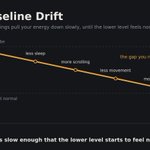
The scary part about living your life at 70% of your capacity is that it works.
Do it long enough and it starts feeling normal. Life still functions. Days get done.
You’re just not the full version of yourself. It feels harmless enough to not question it.
Notice the drift before calling it identity.