

Authentic storytelling through open standards and Content Credentials. Learn more and join us: https://xitter.cf/t.co/wVoLA5CBr6
Joined July 2020
- Tweets878
- Following237
- Followers3.7K
- Likes869





🇳🇴 Norway has a big ambition for its news industry: 80% adoption of C2PA Content Credentials by the end of 2026.
Led by Media Cluster Norway, Project Reynir is bringing publishers and technology partners together to explore what implementing content provenance at a national scale really takes.
👀 Read our conversation with Senior Project Manager Marianne Fjellhaug on the challenges, progress and collaborative approach behind the initiative: adobe.ly/47tWo1B
🇬🇧 Content Credentials are making their way into UK Government communications.
The UK Government is trialing the technology on selected digital content, helping people verify its origin, review editing information and to better understand what they're seeing from official channels.
🔎 Learn how official comms can carry verifiable provenance with Content Credentials: adobe.ly/480qxpa
#C2PA #ContentCredentials #ContentAuthenticity

📱 How much of what we scroll past do we actually stop to question?
🗣️ CAI advisor Henry Ajder and viral JeremyFindsAI creator Jeremy Carrasco explore the growing media literacy gap, the challenges of navigating AI-generated content and how Content Credentials can help people make more informed decisions about what they see online.
🗓️ October 29 at 1PM EDT. Register here: adobe.ly/4hJrEQ2

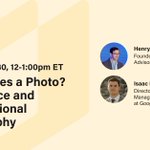
📸 When it comes to computational photography, context matters.
🗣️ CAI Advisor Henry Ajder and Isaac Reynolds, Director of Product Management for Pixel Camera at Google, explored how image-making tools have evolved, what that means for creative intent and trust and how C2PA Content Credentials can help preserve information about how an image was made and edited.
👀 Read the recap and watch the full conversation on our blog: adobe.ly/4hyR16X
💡 From disclosure labels to technical implementation, AI transparency is becoming an increasingly practical conversation.
🗣️ At a recent roundtable hosted by Davis + Gilbert and Tauth Labs, Andy Parsons joined Richard Eisert and Samantha Rothaus for a conversation on evolving AI disclosure requirements, human and machine readable labels and how organizations can put transparency into practice.
Moderated by Simon Erskine Locke with opening remarks from Carina Davidson, the roundtable also exposed the role of C2PA Content Credentials in supporting AI disclosure across the digital ecosystem.

What does it look like when a newsroom decides trust shouldn't be optional?
Suspilne, Ukraine's public broadcaster, just became one of the first news organizations in the world and the first in Eastern Europe to bring visible Content Credentials to its readers, providing a full, verifiable chain of provenance from camera capture to published article. This milestone for journalism proves that content authenticity at this level isn't just possible, it's critical, even under the hardest conditions imaginable.
Suspilne Ukraine and BBC Media Action built this together over the past year, with engineering support from Tim Murphy, CAI community mentor and co-founder of Pixelstream, and early data suggests it's already moving the needle on reader trust.
Read more about how they did it: adobe.ly/4hEDxGN
📸 Can photos still be trusted as accurate records of real-life moments when AI is part of the capture process? As computational photography evolves, camera makers are taking a more active role in bringing transparency to the point of capture.
🗣️ Join CAI advisor Henry Ajder and Isaac Reynolds, Director of Product Management for Pixel Camera at Google, for a conversation about where computational photography is headed and how content provenance can help people understand how an image was made.
That shift is already underway, with Google Pixel 10 becoming the first smartphone to implement C2PA Content Credentials for photos and videos, alongside growing adoption from Sony, Leica and Canon.
🗓️ September 30 at 12PM ET. Register here: adobe.ly/4As1cll

🤔 By the time a piece of content reaches your feed, how much do you know about how it got there?
💡 Adobe Senior Principal Scientist John Collomosse talks with BCS, The Chartered Institute for IT, about how content provenance can give people more useful context around how media was made, edited and shared - and why that matters for digital trust.
👀 Read the full Q&A: adobe.ly/46yFBtA
📹 How do Content Credentials work for live video?
Qualabs and Unified Streaming are sharing their work implementing C2PA across live and on-demand video, from signing Content Credentials to validating them in-browser, ahead of IBC 2026.
🗓️ Join Pablo Flores and Valentijn Siebrands for the online meetup September 3 at 11am ET: adobe.ly/4ciRwiz

🤖 Generative AI hasn't invented disinformation. It has made deceptive content faster, cheaper and much easier to produce at scale.
From AI-generated "slop" to the social dynamics that keep false narratives moving, CAI advisor Henry Ajder spoke with online manipulation and influence expert, Renée DiResta, about what's shifting in the information landscape and why rebuilding digital trust takes more than technology alone.
👀 Read the recap and watch the full conversation here: adobe.ly/4h2Ff4p
📸 "Pics or it didn't happen" gets a little more complicated when AI is baked into the camera itself.
Smartphone cameras can now do much more than capture what's in front of them. Computational photography can enhance, reshape and even add to the final image.
CAI advisor Henry Ajder explains what that means for photography and how Content Credentials can provide more transparency into what happened between the shutter and the final shot.
Join the Content Authenticity Initiative to learn more: adobe.ly/4xr2ivx
👀 We've all had that moment: you see an incredible image online and wonder where it came from, how it was edited, or whether it was generated.
💡 For World Photography Day, Adobe Research explores how provenance can help people better understand the images and videos they see online - from Content Credentials to technologies that keep provenance information connected to an asset as it travels online.
👉 Read more on the Adobe Research blog: adobe.ly/45RAZOX

👀 Claude-generated content is getting a new way to leave its mark.
Anthropic is introducing machine-readable markings across supported Claude models, with imperceptible watermarks embedded in generated text and C2PA Content Credentials attached to supported image files.
The update will roll out globally, providing more transparency about how content was made. We’re thrilled to see this milestone in the adoption of the open, cross-industry standard for content provenance.
Learn more: adobe.ly/3S9IQnM

🤖 From convincing deepfakes and cloned voices to manufactured viral moments, deceptive content can spread before anyone has time to question where it came from. The deeper question: what does it take to build trust in a digital landscape moving this quickly?
🗣️ Join Henry Ajder (CAI advisor and Founder, Latent Space Advisory) and Renee DiResta (Associate Research Professor, Georgetown University; and author of Invisible Rulers: The People Who Turn Lies into Reality) for a conversation exploring what durable trust infrastructure looks like technically, socially, and structurally, and the role content provenance can play in getting us there.
🗓️ Wed. August 26, 12-1pm ET
Register: adobe.ly/4zwzlA3

TikTok has upgraded its role in the @C2PA_org from General Member to Steering Committee Member. The platform has already labeled over 3 billion pieces of AI-generated content using a mix of Content Credentials, invisible watermarking, creator education, and labeling tools.
“TikTok’s early and scaled implementation of Content Credentials demonstrates how provenance can deliver meaningful value in real-world environments,” said Clement Wolf, Chair of the C2PA. “Bringing that experience to the Steering Committee will help accelerate our collective work to make transparency a consistent and trusted part of the digital ecosystem.”
As a Steering Committee Member, TikTok will now contribute to ongoing technical development and help scale adoption of Content Credentials.
Learn more: c2pa.org/c2pa-welcomes-tikto…
It’s important that people can easily see information about where content came from and how it was made. But many apps, platforms, and services don’t yet support viewing Content Credentials natively.
Content Credentials might be on a file, but users often have to actively look for and then inspect the metadata using a separate tool. CAI advisor and Latent Space Advisory founder @HenryAjder explains why widespread adoption of the standard is necessary for it to be effective for everyone.
Join the Content Authenticity Initiative to learn more: contentauthenticity.org/memb…
#contentauthenticity #C2PA #ContentCredentials
🤖 AI-generated content can feel inescapable. From social media feeds and music streaming services to online marketplaces and digital communities, it seems as though our information ecosystem has become saturated with synthetic content.
🎨 This trend is driving demand for spaces that prioritize human creativity. Some companies are experimenting with proof-of-humanity requirements and restricting AI-generated content. Others are introducing tools that allow users to reduce the amount of AI-generated content they encounter.
🗣️ We hosted a conversation with @HenryAjder (CAI advisor and Founder of Latent Space Advisory), Nathanial Freitas (Director of Reality, Proofmode), @saralalala (Group Product Manager, Behance at Adobe), and @StuartRogers (Co-founder and CEO, Spread) on the emerging movement toward safe havens for human creativity and AI-free spaces, and the role of Content Credentials in supporting transparency and authenticity.
Read the recap and watch the full recording on the CAI blog: contentauthenticity.org/blog…
📹 Generative AI can now produce synthetic video that’s virtually indistinguishable from real camera footage. For video journalists, filmmakers, and broadcasters, this creates a fundamental problem: If audiences can no longer trust their own eyes, how can they trust the professionals who create what they watch?
💡 Solving for authenticity at a single point in the production process isn't enough. The solution has to span the entire video lifecycle, from the moment a camera starts recording to the moment a viewer presses Play. We hosted a demonstration-driven conversation with Jen Tse (Community and Advocacy Lead, Content Authenticity Initiative at Adobe), Elliot Marris (Production Workflow Specialist, Sony), Francis Crossman (Principal Product Manager, Premiere at Adobe), and Kenneth Warmuth (Media Engineer and Product Manager, WDR) exploring how C2PA Content Credentials are making end-to-end provenance for video a working reality.
👀 Read the recap and watch the full recording on the CAI blog: contentauthenticity.org/blog…
🗽 Earlier this month, we convened an intentionally diverse audience for Tech Week in New York. Together, we explored Content Credentials as an open and interoperable solution for trust in digital content.
🌐 Our work advocating for adoption of Content Credentials centers on the digital content ecosystem. But there’s nothing like bringing real people from that ecosystem into the same room to deepen understanding, strengthen relationships, and bring a tangible sense of urgency and purpose to our shared mission. We’re looking forward to more events like this one!
Read the highlights on the CAI blog: contentauthenticity.org/blog…