

KBR | NASA Astronaut Human Performance Coach | Director of SHOP-26 | weightlifting coach
Houston, TX
Joined November 2009
- Tweets3.9K
- Following3.4K
- Followers1.8K
- Likes1.9K




Corey Twine retweeted

Can confirm. It’s always sunny in space. Yesterday, we completed USOS EVA 100 and installed a new solar array on space station. Over 25 years operating in the harshest environment and using the sun’s energy to do it! Here are a few photos taken on the spacewalk.


Putting talented people under the same roof doesn’t automatically make them a team. Sometimes it just creates competing philosophies wearing the same logo.
I’ve always viewed a strong human performance team as branches of the same tree. Different expertise, experiences, and perspectives, but connected by shared principles and standards. Over my years in collegiate athletics and tactical human performance, I’ve worked under several directors, each with their own leadership style and training philosophy. Did I always agree with their decisions or scientific rationale? Absolutely not. But I understood my responsibility as part of that team. Challenge ideas internally, contribute where you can, and once a direction is established, communicate a consistent message to the athletes. Why? Because athletes see everything, especially when the professionals supporting them aren’t on the same page.
One place this alignment gets tested is individualization. Athletes understandably want some control over their training, but what they prefer isn’t always what’s best for them. That’s part of why we’re hired, to bring expertise and context they may not have when making those decisions. The problem starts when practitioners confuse accommodating preferences with meaningful individualization, especially when it makes them the favorite. There’s a difference between earning athlete buy-in and buying athlete loyalty by abandoning shared standards. Once athletes realize they can shop around for the answer they want, the practitioners maintaining those standards become the bad guys, and the entire program loses credibility.
A strong team doesn’t require everyone to think alike or use identical methods. It requires enough professional humility to recognize that your personal philosophy isn’t bigger than the collective mission. Disagreement should strengthen the team’s approach, not create competing versions of it.
Different branches, same tree. Otherwise, we’re just individuals working in the same building.
🤖 Made with AI

WHEN SCIENCE LOSES CONTEXT, PERFORMANCE GETS MISUNDERSTOOD.
As a practitioner, I’ve always been frustrated when human performance research becomes so consumed by standardization, statistical relationships, and the perfect scientific argument that it loses operational context.
Scientific rigor matters. So does understanding what we’re actually measuring.
As performance becomes more complex, more variables influence the outcome. Physical qualities interact with skill, coordination, decision-making, equipment, and environment.
Consequently, an isolated physical quality may explain little statistical variance without becoming less important to performance.
The NFL Combine is a perfect example.
Cook et al. (2020) analyzed 1,537 Combine participants. Three physical assessments explained approximately 2.6% of the variance in average snaps played during their first NFL season.
But consider the context. These were already high-level athletes, and playing time depends on opportunity, coaching decisions, injuries, and numerous other factors.
I saw this firsthand recruiting wide receivers. Someone would get excited: “This kid runs track!” We’d ask, “Great. Can he run routes, get open, and catch the football?”
Speed matters. But speed alone doesn’t make a football player.
That’s why teams also evaluate position-specific drills and game film. Each assessment answers a different question.
Human performance needs the same structure:
Tier 1 — Physical Qualities: What capacities exist?
Tier 2 — Functional Assessments: How are those capacities expressed during relevant tasks?
Tier 3 — Operational Performance: Can the individual meet actual job demands under representative conditions?
Without this framework, we risk mistaking limited statistical prediction for limited operational importance.
The answer isn’t abandoning standardization or predictive research. It’s interpreting findings within the appropriate context.
A physical quality can explain little variance and still represent an essential operational requirement. Every physical task imposes demands relative to available capacity. Greater relevant capacity can reduce that relative demand, providing more reserve for subsequent efforts.
The assessment isn’t necessarily wrong. The context in which we interpret it may be.
Reference: Cook et al. (2020). Journal of Strength and Conditioning Research.
#HumanPerformance #StrengthAndConditioning #OperationalReadiness

LICENSURE DOES NOT EQUAL SUPERIOR EXPERTISE.
Contrary to a common assumption, holding a medical or rehabilitation license does not automatically establish the competence or authority to direct strength and conditioning.
Clinical licensure establishes responsibilities and legal authority within a defined scope. It does not confer blanket authority over another profession simply because that profession operates without comparable licensure requirements.
Strength and conditioning has its own specialized knowledge, education, and professional standards. Its lack of universal licensure does not make it subordinate to clinical practice.
And possessing additional credentials does not necessarily resolve the issue. Credentials establish qualifications, not demonstrated competence. That standard applies equally to clinicians and strength and conditioning professionals.
The 2026 APTA–NSCA Joint Principles Statement reinforces this distinction. Physical therapists lead early rehabilitation, both professions collaborate during reconditioning, and strength and conditioning professionals lead performance-phase training.
To be clear, clinicians who have developed and demonstrated competence in both disciplines absolutely exist, and that dual expertise should be recognized and valued. The issue is not professional background but the assumption of expertise without demonstrating it.
When clinical licensure is used to masquerade as strength and conditioning expertise, the consequences extend beyond professional boundaries. Gaps in program design, exercise progression, physical preparation, and performance assessment can compromise the quality of training and ultimately the outcomes we are trying to achieve.
This is not about protecting a profession or defending territory. It is about protecting the quality of practice and the outcomes of those we serve.
Effective multidisciplinary practice requires recognizing professional boundaries, respecting specialized expertise, and holding everyone to the same standard of demonstrated competence.
Licensure establishes authority within a scope. Credentials establish qualifications. Neither guarantees competence or outcomes.
Reference: APTA–NSCA Joint Principles Statement (2026).

GETTING TO GREEN TAKES A TEAM.
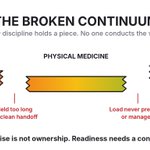
Picture a continuum. On the far left, in red, is injury, dysfunction and pain. On the far right, in green, is full readiness: an athlete or operator who is robust, prepared and performing. Everyone wants people in the green. The challenge is moving them there effectively and keeping them there.
Every discipline can contribute to the breakdown. Physical medicine can remain focused on symptom resolution while physical qualities erode. Strength and conditioning can overemphasize recovery, chase trends or confuse complexity with progress. Medicine can extend clinical authority into areas requiring different expertise. Rehabilitation and performance preparation shouldn’t be mutually exclusive. Even early in recovery, appropriate training can preserve capacity without compromising healing. But designing and progressing training requires more than familiarity with exercise, experience, degrees or credentials. Knowing exercises is not the same as knowing how to train. When injury prevention and rehabilitation dominate the program, readiness can become secondary. The absence of injury is not evidence of readiness.
Human performance requires an orchestra of expertise: medicine, rehabilitation, strength and conditioning, coaching and others. Their roles should expand and contract with the individual’s needs, not rigid professional boundaries. No single discipline owns the continuum. The challenge is coordinating expertise, knowing when each should lead and ensuring readiness remains the objective. Expertise is not ownership.
Readiness needs a conductor.

One of the least discussed vulnerabilities in human performance integration isn't a gap in technology or methods. It's a gap in motives: the practitioner whose loyalty is to their own affirmation rather than to the outcome.
In almost every setting I've worked in, the pattern has been the same. The practitioner gravitates toward the highest-status athlete and uses that proximity for credibility. The athlete's trust should be the lever for evidence-based decisions. Instead it gets spent on staying liked.
The effect is measurable. Decisions start following athlete preference instead of objective markers. Prescription bends to comfort, uncomfortable data gets softened, and the player's position on the readiness continuum reflects it. The model hasn't failed. It just isn't being followed.
The effect on the staff is just as real. Integration depends on shared goals and honest communication across disciplines. A practitioner serving their own status slowly erodes both, however well they present. Over time, best practice drifts toward whatever keeps one relationship comfortable.
Good staffs guard against this on purpose, and it starts with leadership. The internship process is the first filter. It should screen for motive as well as competence: who serves the athlete and who serves themselves. When someone gets past that filter, leaders have to be willing to remove them, especially when the player is attached to them.
Athlete trust is a performance resource. Protect it like one.
#HumanPerformance #SportsScience #Leadership #AthleteDevelopment #EvidenceBased

ARE WE UNDERESTIMATING OPERATIONS AS A SOURCE OF HUMAN PERFORMANCE KNOWLEDGE?
We often view research as where knowledge is generated and operations as where it’s applied. But well-functioning human performance operations do much more than deliver interventions. They assess individuals, monitor exposures, measure responses, adjust programs, and learn from outcomes over time.
This is the value of operational surveillance: systematically observing human responses under real-world conditions. It brings together:
• Testing: Objectively measuring physical and physiological capacities.
• Assessment: Interpreting findings relative to individual capabilities and operational demands.
• Monitoring: Tracking exposures, responses, and changes over time.
• Context: Understanding workload, exercise dose, intensity, recovery, environment, and other influencing factors.
• Reassessment: Evaluating changes following interventions and informing future decisions.
Perhaps the most important element is context.
Consider a decline in strength. Is it deconditioning, accumulated fatigue, insufficient training stimulus, injury, or measurement variability? The measurement alone cannot answer that question. Context helps us understand what the result actually means.
When measurements are reliable, exposures are documented, and individuals are followed over time, operations can generate valuable practice-based evidence. While observational data cannot independently establish causation, they can reveal patterns, improve decisions, and identify questions deserving formal investigation.
Research and operations should not be competing sources of knowledge. Research helps investigate specific relationships, while operational surveillance provides insight into how human responses unfold amid real-world demands. Each should inform the other.
Ultimately, the objective is not simply knowing what intervention was prescribed. It is understanding what was actually delivered, to whom, under what conditions, and what happened afterward.
Human performance optimization should not just produce outcomes. It should continually improve our understanding of how those outcomes are achieved.
#HumanPerformance #SportsScience #PerformanceOptimization
🤖 Made with AI

Familiarity with exercise is not expertise in performance.
A study in the New Zealand Journal of Physiotherapy interviewed four physiotherapists and five strength and conditioning (S&C) coaches about how S&C professionals are integrated into athlete rehabilitation.
What emerged from those interviews:
• S&C coaches were often described as having a limited role, primarily entering during the later stages of rehabilitation.
• Participants believed S&C expertise should be integrated earlier in the process.
• Poor communication and collaboration between professions were identified as important barriers.
The authors make an important distinction. Rehabilitation often focuses on clinical outcomes: range of motion, pain, inflammation, and tissue capacity. But restoring performance requires additional expertise in sport-specific strength, power, agility, endurance, and coordination.
Their argument is that rehabilitation can restore clinical function without necessarily restoring pre-injury performance capacity.
Their proposed model:
→ S&C involvement begins earlier, when appropriate.
→ S&C responsibilities increase as function and capacity improve.
→ Physiotherapy involvement generally decreases as the athlete progresses toward performance, with roles adjusted to individual needs.
My take:
When disciplines operate in isolation, blind spots develop. Whether it’s rehabilitation focused exclusively on resolving injury or S&C focused exclusively on performance, neither perspective alone captures the entire process. That’s a fundamental principle of human performance integration.
Rehabilitation professionals use exercise every day. But using exercise therapeutically and developing high-level physical performance are not necessarily the same expertise. Likewise, understanding performance programming doesn’t qualify an S&C coach to independently manage clinical decisions.
And the higher the demands someone is returning to, the greater the consequences of a fragmented continuum.
Meeting clinical discharge criteria and restoring the physical capacity to perform are not necessarily the same thing. Discharge is a clinical milestone. It isn’t automatically a performance outcome.
The athlete doesn’t need one expert doing it all. They need the right experts, working together, at the right time.
📄 Armstrong ASL, Ramsey CA, Body S. NZ J Physiother. 2021;49(2):89–98. doi:10.15619/NZJP/49.2.05
#Physiotherapy #StrengthAndConditioning #ReturnToSport #SportsMedicine #HighPerformance

Rehab’s biggest blind spot isn’t always in the clinic. It’s between departments.
Ekstrand et al. (2019) examined communication across 36 elite European football clubs in 17 countries, using 77 medical staff reports collected between 2012 and 2016.
One finding stood out:
→ Communication within the medical team (doctors and physiotherapists) averaged 4.5/5.
→ Communication between medical staff and other departments averaged only 3.4–3.9/5.
We communicate well within our disciplines. The challenge appears when decisions require coordination across them.
And the outcomes were meaningful.
The strongest association involved communication between the head coach and medical team. Clubs reporting poor communication had:
Training attendance of approximately 76% versus 83–85%.
Match availability of approximately 82% versus 88%.
Roughly 50–75% greater injury burden, measured as days lost per 1,000 hours of exposure.
A higher incidence of severe injuries (more than 28 days lost).
Poor communication between medical staff and fitness coaches was also associated with lower training attendance.
Communication with club executives or board members? No statistically significant associations with injury outcomes or player availability.
The people making daily decisions about the athlete appeared to matter most.
The authors discuss how communication throughout rehabilitation may help manage expectations, reduce premature returns, and support individualized training-load decisions. These are proposed explanations, not mechanisms directly tested.
Important distinction: This was observational research based on medical staff perceptions in elite men’s football. Association does not establish causation.
But the practical message is worth considering.
The goal was never just a healed tissue or a pain-free athlete. It’s an athlete who is available, tolerating training, and performing.
That requires communication between sports medicine, rehabilitation, strength and conditioning, and coaching.
You cannot manage the entire athlete from inside one department.
📄 Ekstrand J, et al. Br J Sports Med. 2019;53:304–308.
#SportsMedicine #StrengthAndConditioning #Rehabilitation #ReturnToPlay #HighPerformance

🌕 Building a Moonbase is one challenge. Sustaining the humans who live and work there is another.
A sustained human presence on the Moon will require more than habitats, vehicles, and technology. It requires reducing the consequences of being less tethered to Earth.
Physical readiness, medical autonomy, recovery, cognitive performance, and operational resilience must become integrated parts of the mission.
That is what we are bringing together at SHOP 2027 — the Spaceflight Human Optimization and Performance Summit.
🚀 NEW FOR 2027: Our first pre-conference afternoon!
📅 April 26, 2027
We are developing focused sessions on:
Blood Flow Restriction (BFR) — exploring its applications and limitations in human performance.
Crew Medical Officer Digital Assistant (CMO-DA) — examining emerging artificial intelligence capabilities that could help crews manage medical challenges with greater independence from Earth.
And that is just the beginning.
🌎 April 28–30, 2027 | Space Center Houston
Three days bringing together leaders in space medicine, human performance, military readiness, engineering, research, and operations to tackle the challenges of lunar exploration and the next generation of human spaceflight.
The future of exploration depends as much on the human system as it does on the spacecraft.
Join the conversation.
🌐 spaceflighthumanoptimization…
#SHOP27 #HumanPerformance #LunarExploration #SpaceMedicine #Spaceflight #MoonToMars
If you'd rather be wrong alone than right together, you're not working for the team.
High-performance sport is an integrated discipline. Strength and conditioning, sports medicine, physio, nutrition, psychology, sport science, coaching. No single department sees the whole athlete.
So why do so many of us still default to solo decisions when the moment calls for collaboration?
The S&C coach changes the load without talking to the physio. The sport scientist holds data the coaching staff needed before selection. The return-to-play plan gets built in one office instead of across the building.
Often it's not efficiency. It's the desire to own the win.
Some roles demand independent calls, and good leaders make them. But when the outcome would be better with more voices, choosing to go it alone is choosing your recognition over the athlete's result.
The standard I want to hold myself and our field to:
→ The outcome is the scoreboard. Not who scored.
→ Bring people in before the decision, not after.
→ Make sharing credit the norm, not the exception.
The athlete deserves our best collective work, not our best individual highlight.
#HumanPerformance #SportsScience #Leadership #HighPerformanceSport
Corey Twine retweeted

Fitness goals don’t stop in space 💪
During their mission, @NASAArtemis II astronauts used a compact device, the flywheel, similar to a rowing machine, for daily exercise. Using the device helped the crew maintain muscle strength on their mission.
Childbirth does not rewrite the principles of strength and conditioning. It changes the context in which we apply them.
The 2025 Canadian postpartum physical activity guidelines, informed by seven systematic reviews, reinforce an important point: physical activity is part of postpartum recovery, not something that should automatically be restricted. The guidelines recommend aerobic and resistance exercise, daily pelvic floor muscle training, and gradual, individualized progression.
From a strength and conditioning perspective, progressive overload, specificity, appropriate loading, and recovery remain fundamental. What changes is the individual’s readiness and tolerance for training. Pelvic floor function, abdominal wall recovery, tissue healing, sleep disruption, and energy availability require consideration. These factors influence how we prescribe exercise, but they do not automatically establish an entirely different training methodology.
Effective postpartum programming should be grounded in professional competency, assessment, exercise prescription, and appropriate clinical collaboration. Personal experience with childbirth can provide valuable perspective, but it is neither a prerequisite nor a substitute for expertise in strength and conditioning. Ultimately, programming quality should be evaluated by the rationale and evidence supporting the intervention.
Importantly, the authors acknowledge that evidence remains insufficient to establish optimal postpartum resistance training protocols. Postpartum recovery requires specialized clinical consideration, not an automatic reinvention of strength and conditioning. The objective remains the same: appropriately applying established training principles to the individual’s current capacity, needs, and goals.
Reference: Davenport et al. (2025). 2025 Canadian guideline for physical activity, sedentary behaviour and sleep throughout the first year post partum. British Journal of Sports Medicine.
doi.org/10.1136/bjsports-202…

Corey Twine retweeted

I’m so impressed with these answers. This man is an excellent coach and this time next year all of the people that truly care about the team will be singing his praises. The guy can coach. PERIOD. MARATHON NOT A SPRINT.

WATCH: @UMichFootball's head coach Kyle Whittingham on using the bye week to regroup after back-to-back losses, the adjustments that need to be made, accountability inside the locker room, and more:
#GoBlue
A reminder for all of us in human performance, myself included:
When we establish athletic, fitness, or occupational standards, we need to remain sensitive to what we are asking people to do.
I remember coaching football and running the 110's gasser test to gain insight because our athletes had to do it. At 200 pounds, I was built like a skill player but ran the linemen's times because I couldn't pass the skill times. 16s, nah bruh LOL. I was glad when it stopped or changed schools:). It certainly gave me perspective.
I'm not questioning the necessity of standards. Many are absolutely essential. But when someone's playing time, selection, career, or livelihood depends on passing them, the pressure is very different.
Our responsibility is not simply to establish standards, but to ensure they reflect the actual demands, are scientifically defensible, and account for the consequences of imposing them. Understanding what we ask of people should be part of how we establish the standard in the first place.

Corey Twine retweeted
Stay Hard! Exercise on station takes focus, determination, and grit. Without exercise you lose 3% of bone mass per month, 10-15 % of muscle mass and body weight, and see over 10% decrease in VO2 max. Navy Captain Jack Hathaway was a friend and, at times, a personal trainer and coach that pushed me to new levels like David Goggins.
Finishing the workout does not mean the dose was right.
Meeusen and colleagues put it clearly: “Successful training not only must involve overload but also must avoid the combination of excessive overload plus inadequate recovery.”
Their consensus paper explains that hard training can temporarily reduce performance before recovery allows improvement. But excessive stress with inadequate recovery can lead to prolonged performance problems. No single test diagnoses overtraining syndrome, and other causes must be considered.
For me, this brings strength and conditioning back to its foundation: dose, response, recovery, and adaptation. We prescribe exercise for a purpose. Completing the work tells us what someone did. Their response over time helps tell us whether it is working.
The practical takeaway: track performance, listen to the person, and consider sleep, nutrition, and life stress before deciding they need more. Good coaching requires the judgment to challenge someone and the discipline to adjust when the response calls for it.
The goal is to build capacity. We need to know whether our prescription is doing that.
Meeusen et al., 2013. ECSS/ACSM consensus statement on overtraining syndrome.

A green recovery score doesn't mean you're about to have your best day.
Readiness metrics like HRV, resting heart rate, and sleep tell you one thing: how recovered you are compared to your own baseline.
That's useful. A low score is a fair warning sign.
A high score just means nothing obvious is wrong.
It's like a race car with a full tank, good tires, and no warning lights. You're cleared to race. That doesn't tell you how fast the car is, how good the driver is, or who else is on the track.
Performance comes from fitness, skill, tactics, and mindset. None of those show up on a recovery score.
We mix them up because readiness is easy to measure.
Use readiness to manage fatigue. Build performance through training.
Necessary. Not sufficient.
#SportsScience #Performance #Recovery #Coaching
Are we getting youth development completely wrong here in the US?? Because a new study in Science kinda says we might be.
These researchers looked at almost 35,000 elite adult performers across sports, music, chess, even science. What they found is the kids who were dominating early and the adults who ended up world class were mostly NOT the same people. The early stars specialized hard and got good fast. The ones who actually made it to the very top did less of their main sport growing up, played other stuff (about 2 extra sports for like 9 years on average), and honestly developed slower early on. Same thing showed up with Nobel prize winners. They had more hobbies and outside interests than other top scientists who never won one.
And look at what we do here. Year round travel ball at 9, one sport, private lessons, showcases, chasing rankings in middle school. A lot of parents think if their kid isn't specializing they're falling behind. This data says the opposite might be true. Now it's correlation, not a guarantee, but as a coach I see it all the time. Let them play everything. The slow developer at 12 might be your best athlete at 22. Where do you guys stand on early specialization?
We may be thinking about this when we spend hours having 10-year-olds do ladder drills.

"I'm just a non-responder."
I can't stand that phrase. In all my years working with people, I've never met anyone who didn't respond to exercise.
"Non-responder" is a research term, and it gets used far too loosely. If we're going to use it at all, it needs to be tied to the dose. Not "they don't respond to exercise," but "they didn't respond to that program, at that dose, on that test."
The research backs this up.
A 2019 paper in Sports Medicine by Pickering and Kiely asked whether non-responders actually exist. Their answer: probably not.
Much of what looks like "not responding" is something else:
• Normal testing error and day-to-day ups and downs
• A bad test day or low effort on a max test
• Measuring one or two things, when exercise improves dozens
• A dose that simply wasn't enough
When researchers tracked several outcomes, almost everyone improved on something. When people trained more often, harder or longer, the "non-responders" largely disappeared. In one study, adding two sessions per week turned every non-responder into a responder.
The authors do support individualized training, but read why. They aren't arguing that people need different principles. They're arguing for adjusting the dose: the amount, intensity, frequency, length or type of training, based on things like training history, sleep, stress, nutrition, recovery and whether someone can complete the work.
That's not "you're unique, so you need a special plan."
That's "same principles, different dose."
You're not a non-responder.
You just haven't found the right dose yet.
Source: Pickering C, Kiely J. Sports Medicine, 2019;49:1–7.
