

✨ Rompiendo el techo de cristal hasta el cosmos 🚀 Equidad de género + política espacial + innovación tecnológica Consultoría | Educación | Comunicación
Mexico
Joined March 2025
- Tweets760
- Following548
- Followers29
- Likes1.2K




1 in 6 women in the space sector has experienced sexual harassment. Yes, in space too.
Today is #25N, the International Day for the Elimination of Violence against Women, in memory of the Mirabal sisters, murdered in 1960. Violence against women doesn't stay outside labs, space agencies or conferences.
The space sector is a workplace too, and a deeply masculinized one.
🔹 A sector built for someone else. Women are 30% of the space workforce and just 19% of boards. Until 2022, NASA's radiation limits were lower for women astronauts. The US National Academies found harassment is more likely where men are the majority and the organization tolerates it.
🔹 It's not a knowledge gap. People in the sector know the rules. What they don't know is whether anyone will answer when they report, or what it will cost them.
🔹 Impunity can be a contract clause. On Nov 10, 2026, the US Ninth Circuit ruled that the lawsuit by eight engineers, fired after calling out harassment and sexism at SpaceX, will be heard in court, not in private arbitration. The merits are still pending and the company denies the allegations.
🔹 Let's talk about reporting. Studies are few and small, and we found no public measurement in Latin America comparable to @UNOOSA's.
Does your institution have a protocol?
Do you know it?
If we fight for gender equity in space, we also have to talk about workplace violence and harassment.
🔹 New agencies have an advantage. Latin America's new regional space agency, ALCE, can design its reporting mechanism before the first case, not after the first scandal.
At @CosmoEquidad , we know violence against women exists in the space sector too. Naming it is the first step to preventing it.
The data is in the images. Full analysis (in Spanish) on the Cosmo Equidad Substack 👇


It's Tuesday, November 24, and that means #GenderTuesday: the week's space news through a gender lens. 🚀👓🟪
This week's question: who fits in space? Three stories answered it. And each answer came down to a rule written by someone else.
🇭🇰 Who completed the mission?
Lai Ka-ying, Hong Kong's first astronaut, completed all her tasks after about six months on China's Tiangong station (@CNSpaceStation). As payload specialist, she ran the science on board.
Before spaceflight, she was a police superintendent and a mother of three. She could only apply because China opened astronaut selection to Hong Kong and Macao for the first time.
🌐 Who allocates the orbits?
Every satellite needs a place in orbit and radio frequencies. Both are limited. The UN body that coordinates them, the @ITU , just held elections in Doha.
Doreen Bogdan-Martin (@ITUSecGen) was re-elected Secretary-General with 164 of 173 votes. But the board that settles disputes over orbits and frequencies will have 5 women out of 12.
A woman at the top doesn't mean a balanced table.
🌕 Who fits in the spacecraft?
An @ESA study found that a crew of four women would need 1,695 kg less food on a 1,080-day mission than a reference male crew.
The point isn't "send smaller astronauts." It's asking why spacecraft, suits and food were designed around one standard body. @NASA's astronaut call closes December 3.
📸 That's @Astro_Christina on our fourth slide, inside Orion during the Artemis II lunar flyby.
✨ Fun fact: the ITU was founded in 1865. It took 157 years to elect a woman to lead it.
Who can apply. Who decides. Who things are designed for.
That's where equity in space is won or lost.
Which rule would you change first? 👇


🍽️🚀 #FridaySpaceChat · Friday, November 20, 2026
This week is all about coming home: a ship that came back and got caught in midair, debris that washed up on a beach in Mexico, a satellite saying goodbye and a probe that will never return. Here's the context for your dinner table 👇
🚀 Catching a rocket with "chopsticks"
For decades, almost every rocket was used once: it went up and its pieces ended up in the ocean. @SpaceX wants Starship to work like an airplane, landing and flying again. So instead of landing it on legs, it catches it in midair with two arms on the launch tower.
They had already done it with the booster, the bottom half. On Nov 14, for the first time, they caught the ship coming back from orbit, after nearly a day circling Earth. Coming back from orbit is the hard part: it hits the atmosphere at enormous speed and gets extremely hot.
The booster, on the other hand, didn't make it back to the tower: it aborted the maneuver and came down in the Gulf of Mexico.
🏖️ What crossed the border
Starbase sits in Texas, at the mouth of the Rio Grande. On the other side, on Playa Bagdad in Matamoros, Mexico, fragments started showing up.
Profepa, Mexico's environmental enforcement agency, sent inspectors on Nov 17, with the national parks commission and a conservation group collecting debris, and said it would ask the company to take responsibility. SpaceX says it found very little debris, it's not clear it's theirs, and independent tests show no chemical, biological or toxic risk. The review continues.
🛰️ Saying goodbye well is part of the mission
@NASA's Terra has spent 27 years photographing the planet with five instruments: clouds, smoke, wildfires, pollution and the heat Earth sends back to space. It was designed for six years.
It stops collecting data on Dec 1. Before it's switched off in January 2027, it will use its last fuel to lower its orbit, so it doesn't stay in the way of other satellites.
🌌 The one that keeps listening
Voyager 1 launched in 1977, flew past Jupiter and Saturn, and in 2012 became the first spacecraft to leave the bubble created by the solar wind. On Nov 18 it reached one light-day: the distance light travels in 24 hours.
Since Nov 14 it has only sent a carrier signal, no data. It happened in 2023 and the team fixed it; this time the diagnosis could take weeks. Project scientist Linda Spilker wonders how far the Sun's influence still reaches. Voyager is the only one that can answer.
The takeaway: coming home is hard. Sometimes it works, sometimes pieces land where nobody expected them, sometimes you say goodbye carefully, and sometimes all you can do is keep listening.
If you could send Voyager 1 a message that would take a day to arrive, what would you say? 👇


🍽️🚀 #FridaySpaceChat · Friday, November 13, 2026
This week is all about shields: the one Earth has, the one Mars lost, and the one people build when they live far from home. Here's the context for your dinner table 👇
🌍 Earth's sunscreen
The ozone layer sits roughly 9 to 22 miles up and blocks much of the Sun's ultraviolet light. Every Antarctic spring (September–October) it thins over the South Pole: brutal cold creates high-altitude clouds where the chemicals we released for decades eat away at the ozone.
@NASA says the 2026 hole peaked on Sept 18 and was the 7th largest in 48 years of records, thanks to an unusually cold polar vortex.
Bad news? Not really. This is one of the few environmental stories with a happy ending in progress: in 1987 nearly every country signed the Montreal Protocol and stopped making those chemicals (found in aerosols and refrigerators). The layer has been healing ever since, slowly. It should be back to 1980 levels around the 2070s.
🔴 Mars lost its shield
Earth's magnetic field deflects the solar wind, a nonstop stream of particles from the Sun. Mars lost its global magnetic field billions of years ago, and without that protection the solar wind gradually stripped away its air. That's why it's a frozen desert today.
To find out how, NASA sent ESCAPADE: twin spacecraft named Blue and Gold, built by Rocket Lab. On Nov 7 and 9 they swung close to Earth, fired their engines and used the boost like a slingshot toward Mars, so they didn't have to wait for the launch window that opens every 26 months. They arrive in Sept 2027: one will hang back to measure the incoming wind, the other will fly closer to see how the planet responds.
🏠 The human shield
And when people go? Four volunteers spent 378 days in a mock Mars, a 3D-printed home in Houston. This week they shared what they learned. Medical officer Ellen Ellis said she rarely felt isolated because she leaned on her crew every day. Commander Ross Elder said "the real magic" was watching everyone come together. Principal investigator Grace Douglas will use the data to balance health, crew time, food and water on Moon and Mars missions.
The takeaway: Earth has a shield we're helping to heal, Mars lost its own and we're about to find out how. And far from home, the best shield is the team.
What would you bring to survive a year on Mars? 👇


Who gets into the space sector? This week, three doors. #GenderTuesday
🇨🇦 Who takes over
Canada named Alexander MacDonald president of @csa_asc; he starts November 16. He succeeds Lisa Campbell, the first and so far only woman to lead the agency since 1989.
A succession is judged by whether the door that opened stays open.
🧑🚀 Who applies
@NASA opened astronaut applications until December 3. Its 2025 class was the first with more women than men: 6 of 10.
But NASA doesn't publish how many women apply. A structural shift or a good year?
🌕 Who designs the Moon Base
NASA is offering students $1 million to design its Moon Base. The challenge was designed by the Office of STEM Engagement, whose entire budget ($143M) the FY2027 request proposes to eliminate. It doesn't mention girls, women or diversity.
✨ In 1978, NASA picked 35 people from 8,079 applications. For the first time, six were women. The class nickname: Thirty-Five New Guys.
Where does equity matter most: who takes over, who applies, or who learns? 👇
@WomeninAero


On November 8, 1984, 42 years ago, Anna Fisher became the first mother in space. In 2026, Kellie Gerardi became the first person to pump breast milk in microgravity, eight weeks after giving birth.
In between: four decades in which menstruation, pregnancy and postpartum barely showed up in space research.
🔹 Suppressing menstruation with the pill on a three-year mission = about 1,100 pills (KCL & Baylor, 2016).
🔹 In 2027, OP-01 flies: the first study dedicated to menstruation in space, led by Manju Bangalore and Priya Abiram.
🔹 Neither study came from a space agency program: one took place during an independent institute's campaign; the other is funded by foundations and donations.
The underlying question: which body was spaceflight designed around, and who pays to fix it?
Full story in this week's #SundaySpaceRead by Cosmo Equidad 👇
cosmoequidad.substack.com/p/…
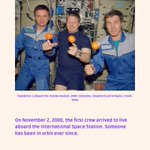
If you’re under 26, you’ve never lived a day without someone in orbit. But the story of who has lived up there has a gap.
On Nov 2, 2000, the first crew moved into the @Space_Station : William Shepherd (@NASA , commander), Yuri Gidzenko and Sergei Krikalev (Russian cosmonauts) @roscosmos . Three men.
But women were already building that home. In May 1999, before any residents arrived, Tamara Jernigan became the first woman to spacewalk at the station.
Four months after Expedition 1, Susan Helms arrived. She spent 163 days aboard and, in March 2001, she and James Voss made an 8 h 56 min spacewalk, the longest in U.S. history at the time.
In 2005, Eileen Collins commanded the first shuttle mission to the station led by a woman. And in October 2019, @Astro_Christina and @Astro_Jessica made the first all-female spacewalk.
Today, more than 290 people from 26 countries have visited the station. How many were women? NASA’s anniversary page doesn’t say.
The station retires around 2030. If we don’t count who was there, the story we keep will be incomplete.
Which woman of the ISS deserves more recognition? Tell us 👇
#CosmoRadar #WomenInSpace #CosmoEquidad


Tonight may be Swift’s last night in orbit 🛰️
Named after astronomer Neil Gehrels, it could spot a distant explosion and alert telescopes worldwide in about a minute.
The rescue twist: Katalyst’s LINK spacecraft got within ~9 miles, then control problems ended the attempt. Tungsten parts may survive the fall.
Ever seen a “shooting star” that was actually a satellite? 👇 #CosmoRadar #CosmoEquidad
Who writes the rules of space? 🚀
This week, chairs moved at @esa, @NASA and @ITU. The pattern isn’t who arrives, but who goes from acting to permanent. #GenderTuesday 👇
🇪🇺🇺🇸 WHO LEADS
ESA appointed two directors for January. One of those directorates is currently led on an acting basis by Géraldine Naja ( @NajaGeraldine ); the permanent job went to a man. At NASA, by contrast, the acting head of Armstrong was confirmed.
An acting role works as a trial. Who does it lead to the permanent job, and who is only asked to hold the chair?
🌐 WHO ALLOCATES ORBITS
From November 9 to 27, the ITU elects its leadership in Doha. Doreen Bogdan-Martin ( @ITUSecGen ), its first woman Secretary-General, runs unopposed. But the bureau that allocates satellite orbits and frequencies has three candidates: India’s Revathi Mannepalli and two men.
Orbits are a limited resource. Who allocates them is also an equity decision.
🔬 WHO COMPETES
Nicky Fox, (@NASAScience_) NASA’s Science chief, presented a new model to select science missions: faster, with more weight on the science… and assessing teams’ track records. Track records reward those who already had the chance to lead. NASA itself showed that anonymous review reduces bias. Will it keep it?
✨ One more thing: in 68 years, only one woman has led NASA. She was acting.
Where does equity matter most: who leads, who allocates orbits, or who competes?
Full analysis on @Substack (in spanish) 👉 cosmoequidad.substack.com/


Rescue or retire? NASA asked industry for ideas to boost, upgrade or safely deorbit Hubble. With no propulsion and re-entry expected around 2033–34, any mission must fly by 2032. Responses due Nov 30. Who decides the fate of a public science asset? @NASAHubble #CosmoRadar #SpacePolicy


🚀 NASA just removed lander assignments from its Moon plan.
Neither @SpaceX nor @blueorigin is assigned to the first @NASAArtemis landing. In 2028, the lander that's ready first flies first.The selection rule for the lander is public and measurable.
The rule for choosing who walks on the Moon is not.
#SundaySpaceRead
Full read on @Substack in spanish : cosmoequidad.substack.com/p/… · Source: @NASA, Oct 23, 2026
🍽️🚀 #FridaySpaceChat (running a day late this week… and landing on Halloween 🎃)
Quick question for the dinner table: what powers almost everything we send into space? The same thing that dries your laundry on the line: sunlight. ☀️
Here’s the story in four photos 👇
1️⃣ The International Space Station (@Space_Station), the home where astronauts live while circling Earth, runs on its solar panels: they power the air, the water and the science. On Thursday, October 29, Anil Menon (@astro_anil, NASA) and Joshua Kutryk (@Astro_Kutryk, Canadian Space Agency @csa_asc) spent 7 hours outside installing the seventh of eight new panels.
Why swap them? The old ones are 20+ years old. And here’s the twist: around 2030 the Station will retire, and it will be steered down into the middle of the Pacific Ocean, far from everyone. Controlling that farewell takes power until the very last minute.
Bonus: it’s the same panel technology that powered DART, the spacecraft that crashed into an asteroid on purpose in 2022 to knock it off course.
2️⃣ Psyche is a @NASA robotic spacecraft headed to a metal asteroid. It may be the core of a planet that never finished forming. We’ll never get to visit Earth’s core; this one, we can. It arrives in 2029, and the mission is led by scientist Lindy Elkins-Tanton (@ltelkins).
3️⃣ What if you’re so far away that sunlight can’t help you? That’s Voyager 1: it launched in 1977 and is the farthest thing humans have ever sent. It runs on heat from a bit of plutonium. To talk to it, we use antennas up to 230 feet across in California, Spain and Australia… and it answers with about as much power as a refrigerator light bulb. 💡
4️⃣ And since it’s Halloween: in 2018, aboard the Station, Serena Auñón-Chancellor (@AstroSerena) dressed up as a mad scientist, Alexander Gerst (@Astro_Alex) as Darth Vader and Sergey Prokopyev as Elvis. 🎸
The takeaway: almost everything in space lives on sunlight. And when the Sun can’t reach you, you learn to save.
What else do you think runs on sunlight without us noticing? 👇


Tomorrow is NASA’s spacewalk 100 outside the @Space_Station. Two astronauts will be outside. A whole team will make it happen. 👇
🧑🚀 Outside: astronaut Anil Menon @astro_anil (@NASA), on his 4th spacewalk, and astronaut Joshua Kutryk @Astro_Kutryk (@csa_asc), on his first. They will install the 7th of 8 new solar arrays, which together give the station up to 30% more power.
🎧 The voice: Canadian astronaut Jenni Gibbons @Astro_Jenni will serve as CAPCOM in Houston, the person who talks directly to the spacewalkers.
🦾 The arm: astronauts Jessica Watkins @astro_watkins and Luke Delaney will fly Canadarm2, carrying Menon and the array into place, while a CSA team near Montreal monitors every move.
📺 Thursday, Oct. 29 · NASA+ and NASA’s YouTube · coverage from 6:30 a.m. EDT
In the photo: two. In the mission: a whole team.
#Spacewalk #CosmoEquidad


Who pays, who guides, and who can switch it off? 🚀
Three decisions that never make the launch photo. That’s where equity is decided. #GenderTuesday 👇
🇦🇺 WHO PAYS
Australia and the @AusSpaceAgency sent @esa a counteroffer to fly Katherine Bennell-Pegg (@AussieAstroKat) to the International Space Station for a month in 2028. The cost: “well north” of AUD 100 million.
She isn’t in line because she’s a woman: she is Australia’s only qualified astronaut. But it confirms something: when a government buys a seat, equity isn’t decided by the rocket. It’s decided by the budget.
Some already called the spending “reckless.” The cost of equity is always debated more than the cost of habit.
🇨🇦 WHO GUIDES
On Oct 29 and Nov 5, two spacewalks will install the last new solar arrays on the @Space_Station.
The voice guiding the crew from Houston: Jenni Gibbons of @csa_asc. She will be CAPCOM, the one person in Mission Control who talks directly to the crew in space.
Power isn’t only about who’s in the photo. It’s also about who coordinates and responds when something goes wrong.
🇺🇦 WHO CAN SWITCH IT OFF
Ukraine signed a letter of intent with Finnish firms @iceye_global and @nokia to explore a satellite network of its own, after @SpaceX restrictions on Starshield disrupted its drones.
When a single company can switch off a country’s critical infrastructure, sovereignty depends on private decisions. And every official named in the deal is a man.
✨ FUN FACT
In 1984, STS-41-G flew two women together for the first time, #SallyRide and Kathryn Sullivan, along with the first Canadian and the first Australian-born person in space. 42 years later, no one has flown under the Australian flag 🇦🇺.
There is no sustainable space sector without gender equity.
What matters most: who pays, who guides, or who controls? 👇


Built for 2 years. Worked for almost 22. @NASA `s Swift observatory just said goodbye. Here’s why it mattered 👇
🔥 Think of it as the sky’s smoke alarm.
Gamma-ray bursts are the most powerful explosions in the universe, and some mark the birth of a black hole. They’re fleeting: blink and they’re gone.
⏱️ Swift’s superpower was speed.
It spotted the flash, swung its telescopes toward it and alerted observatories worldwide within about a minute, so everyone could look before the light faded.
📊 The result: 2,000+ gamma-ray bursts, 1,400+ supernovae and data behind ~7,000 scientific papers. It also helped open “multimessenger” astronomy: studying the same cosmic event with light and other signals at once.
📉 Why it ended: Swift had no thrusters. As the Sun grew more active, Earth’s upper atmosphere puffed up and slowly dragged it down. A private rescue mission this year didn’t succeed. It will burn up in the coming weeks.
👩🚀 One name worth saying: when Swift launched in 2004, astronomer #MargaretChester led ground operations at its mission control at Penn State. Farewells tend to name principal investigators. Missions that last 22 years run on whole teams.
⚠️ What it means: NASA has no direct replacement yet. Its archive stays public for years of discoveries, but for now astronomy is losing its fastest first responder.
Who sounds the alarm now?

As the sun sets on NASA's Swift mission, we celebrate more than 21 years of discoveries. Designed to catch gamma-ray bursts (GRBs), the universe's most powerful explosions, Swift revolutionized our understanding of these high-energy events and showed how they can illuminate everything from the births of black holes to the history of the early universe.
But Swift's legacy extends far beyond gamma-ray bursts. Its rapid-response capabilities turned it one of astronomy's first responders, alerting observatories around the world to fleeting cosmic events and helping usher in the era of multimessenger astronomy. The mission leaves behind a remarkable scientific legacy and a wealth of data that will continue to enable discoveries for years to come.
🍽️🚀 #FridaySpaceChat
An astronaut spent 237 days without gravity… and came back with a denser spine.
Jessica Meir @Astro_Jessica lifted weights every day on the Space Station @Space_Station . Without gravity, bones lose calcium, but her body kept a different record of the trip.
And it’s not the only thing that keeps a memory.
Earth erased almost all its craters with rain, rivers and drifting continents. The Moon didn’t: it’s the photo album Earth lost. Artemis III @NASAArtemis scientist Barbara Cohen wants to bring back rocks from the South Pole–Aitken basin, one of the largest in the solar system, to learn how often we were hit early on.
Nearby, @NASA plans its lunar base: long shadows and craters where the Sun never shines.
And Japan launched MMX to Phobos @JAXA_en , a potato-shaped moon of Mars where pieces of Mars may have landed. It will bring back at least 10 grams in 2031: reading Mars without landing on Mars.
Two moons, a base and some bones. One idea: space keeps a memory.
What would you ask a 4-billion-year-old rock? 👇
A $200,000 deposit per satellite, paid before launch and refunded with interest after a safe deorbit. That's the proposal in a new Nature Communications study (September 2026) led by UCL researcher Indigo Brownhall.
What's happening:
🔹 About 60% of satellites stay in orbit when their propellant runs out, because nothing happens if they don't deorbit.
🔹 Forfeited deposits would fund active debris removal.
🔹 The authors estimate that covering just 20% of launches would cut derelict satellites by 18%.
🔹 It could be adopted country by country, without waiting for consensus at #COPUOS. The EU could extend it through market access, as it did with GDPR.
Through an equity lens:
🔹 A flat amount doesn't weigh the same for a megaconstellation as for a Latin American university CubeSat.
🔹 If space rules move from consensus forums to large markets, the biggest markets will write them. Where does that leave everyone else?
🔹 And the table has a measurable gap: according to @UNOOSA #Space4Women, women are 30% of the space workforce, 24% of management and 19% of boards.
Protecting orbit is urgent. So is designing the rule with those who aren't usually in the room.
What should a fair bond include for emerging countries and organizations?
#SpacePolicy @esa @DLR_SpaceAgency @CNES @AEM_mx @NASA

On October 23, 2026, @NASA will update its plan to return astronauts to the lunar surface by 2028. We'll be listening for one thing: who is going?
Where things stand:
🔹 Artemis II (April 2026): Christina Koch @Astro_Christina became the first woman to fly around the Moon.
🔹 October 13, 2026: NASA named Koch acting deputy chief engineer. She moves to management status and is no longer eligible for spaceflight.
🔹 Artemis III (2027) now stays in Earth orbit. Its crew, announced June 9, 2026, is all men.
🔹 The first crewed landing moved to Artemis IV. That crew has not been announced.
NASA has publicly committed to landing the first woman on the Moon. Nothing announced so far says otherwise, and nothing yet tells us who she will be.
Equity isn't a photo at the end of a program. It's a selection criterion set before the hardware flies.
From quotas to culture. What do you want to hear on Friday?
#SpacePolicy @NASAArtemis

To sell thrusters to the U.S. defense market, Sara Correyero, co-founder and co-CEO of @ienaispace, relocated to Washington for six months.
A woman engineer leading that push matters: it widens what girls and young women imagine is possible.
But if doing defense business means months on the ground, who can walk through that door, and who’s left out? #GenderTuesday

Three seats confirmed, three men. The fourth seat on the next private mission to the International Space Station is still empty.
And in Europe’s astronaut reserve, six women are still waiting to fly. Here’s why. 👇
Tuesday, October 20, 2026. In this #GenderTuesday, we review the week’s most relevant space sector news through a gender lens.
🪑 1. Who picks the seat?
Vast-PAM-1 will be @vast’s first mission to the @Space_Station, targeted for no earlier than July 2027. The crew so far:
🇫🇷 Thomas Pesquet @Thom_astro, commander
🇨🇿 Aleš Svoboda @astro_ales, pilot
🇬🇷 Adrianos Golemis @Astrovenator, mission specialist
One seat is still unannounced.
How are they chosen? A government buys the seat, picks which of its astronauts to send, and the Station’s five partner agencies sign off. The decision that determines who flies is the government’s, and its criteria aren’t public.
We’re not asking for a woman for the photo op. We’re asking who was considered, and by what criteria.
The contrast: on Crew-12, where each agency assigned its own astronaut, two of four crew members were women: @Astro_Jessica in command and @soph_astro. When gender equity is built into selection, women don’t have to wait for a quota to open up.
🇪🇺 2. Europe designs its own door
Europe has no spacecraft of its own to fly astronauts: they ride on Crew Dragon or Soyuz. In December, in Rome, @esa member states will decide whether to build one.
The number that stopped us: in 2022, ESA created its first astronaut reserve, 11 people who passed the full selection. 6 are women. All 4 who have been assigned flights are men.
Why? Each government picks from its own nationals, and the countries that have bought seats each had only one man in the reserve. The talent is there; nationality is the first filter.
If Europe builds its own spacecraft, it can set common, equitable selection criteria from day one.
🛰️ 3. In defense, the door has an address
Sara Correyero, aeronautical engineer and co-founder and co-CEO of Spain’s Ienai Space @ienaispace, has relocated to Washington for six months to sell thrusters to the U.S. defense market.
A woman engineer leading that push widens what girls and young women imagine is possible. But if doing business in defense means being on the ground for months, who can walk through that door, and who’s left out?
A seat that’s bought, rules still being written, and a door with an address. Gender equity isn’t settled in the final crew photo: it’s decided at every entry point. From quotas to culture.
What rules would make crew selection transparent and equitable, regardless of who pays?


🚀 Japan is on its way to a moon of Mars.
MMX (@mmx_jaxa_en) launched on October 19, 2026. It aims to bring at least 10 grams of Phobos back to Earth in 2031 and settle whether Mars’s moons are captured asteroids or debris from a giant impact.
No crew on board, but plenty of decisions. The protocol to analyze those samples was published in 2021, ten years before they arrive.
Around those tables: Sara Russell (@NHM_London), part of the team designing the sample analysis, and @dr_hartzell (@UofMaryland), a participating scientist who studies dust on nearly gravity-free worlds.
We name them because what goes unnamed doesn’t exist, and because a girl who knows their names learns that space also starts in a lab. 🔬
From quotas to culture. #CosmoEquidad


