

Health economist interested in policies to better align medical practice with evidence. Emory University faculty since 2000. All opinions are entirely correct.
Decatur, GA
Joined July 2016
- Tweets2.8K
- Following1.4K
- Followers1.2K
- Likes9.8K




Medicare for All backers project that it will reduce spending on fraud (-$285 billion/year [!!!] according to one policy analysis). Those projections completely ignore the realities of how private insurers and Medicare operate today.

1/ I have a new @Paragon_Inst paper out, “Pay and Don’t Chase,” on one of the oldest problems in Medicare.Original Medicare makes an astonishing $32 billion in improper payments every year, by CMS’s own estimate, and recovers less than 1 percent of the sum.
3
242
David Howard retweeted

CBO highlighting substantial ROI for money spent on program integrity in Medicare and Medicaid


In CBO's estimation, activities funded by the Health Care Fraud and Abuse Control account generate a substantial return on investment in the form of recoveries to the government and reduced spending. cbo.gov/publication/62886

From the @WSJ. Increases in revenue from higher volume under M4A would probably be more than offset by declines in revenue per case.
61
So are we banning Kaiser Permanente?

David Howard retweeted

Hospital Global Budgets are at the heart of Medicare For All's claimed efficiency gains.
Maryland's experiment with Global Budgets since 2014 has yielded higher prices and less treatment of seriously ill patients.
wsj.com/opinion/marylands-ca…

David Howard retweeted

Call for abstracts for NBER conference, "The Economic Implications of GLP-1 Therapies" that I'm co-organizing w @KosaliSimon & @MariaAPolyakova . Submissions due Dec 15, 2026 and the conf is March 4, 2027. Details at link: nber.org/calls-papers-and-pr…
The federal debt is 120% of GDP and trending higher due in part to Medicare. We need to give prior authorization a try.

Traditional Medicare used to skip prior auth. In 6 states, including New Jersey, a pilot called WISeR put AI-assisted prior auth back in.
On Oct 15, a CMS deputy administrator said "there are a lot of things about WISeR that are not working."
It's bad for independent practices. Hospitals can absorb the unpaid admin time. A solo office can't.
The House spending bill would cut off its funding. The Senate voted 46-50 against ending it. Current funding runs out Dec 11.
Doctors, residents, med students: ask your House member and both senators to keep the WISeR funding ban in the final bill. Template below.

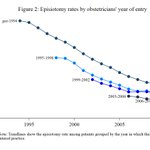
I have an old paper showing that episiotomy rates declined in response to trial results, but women treated by older obstetricians were more likely to have an episiotomy, suggesting that generational change is one mechanism by which evidence is translated into practice.

An episiotomy is a small surgical cut in the perineum, the skin and muscle between the vagina and the anus, made to widen the opening during birth.
The idea was first described in 1742 by Sir Fielding Ould, an Irish doctor, who hoped a planned cut would be safer than a ragged tear. In the early 1900s, American obstetrician Joseph DeLee argued it should be routine, especially with forceps. By the middle of the century, many hospitals cut almost every first-time mother.
The cut is made in the last moments of pushing, after the area is numbed. It can run straight down the middle or angle to one side. The angled cut is less likely to reach the anus. After the baby and placenta are out, the cut is stitched closed.
For decades doctors believed a clean cut healed better and protected the pelvic floor. Later studies showed routine cutting did not stop severe tears and often caused more pain, bleeding, and slow healing.
Today it is used only when truly needed, such as when the baby must be born quickly, when forceps or a vacuum are used, or when a shoulder is stuck. Most births now go ahead without it.
4
183
David Howard retweeted
Radiology practices with technical component ownership/billing are less likely to be consolidated than those which provide only professional services. Hot off the press with @NeimanHPI colleagues in @JACRJournal. jacr.org/article/S1546-1440(…
David Howard retweeted

@UBuffaloEcon is hosting a health econ (and adjacent) conference on Oct. 9th. Come for the beautiful fall, maybe visit Niagara Falls while you're here, and also meet some fellow health econ researchers!
Submit your abstract by Sept. 11!
Submit here: lnkd.in/g6Q33WZd

No hard data, but perhaps the finding that GLP drugs don't have cost offsets is premature.
modernhealthcare.com/provide…

1
1
220
David Howard retweeted

If you don’t first understand how much better the world is today than at any other point in human history, and *why* that is, then the solutions you believe in for today’s problems are probably wrong.
David Howard retweeted
In 2014, Maryland capped hospital spending. The state claims that it has genuinely saved patients money.
tool.nashp.org/

Private insurers substitute observation care for inpatient admissions, saving money.

#100policyarticles100days
#85. Employer Group Waiver Plans (EGWPs). @PeterHuckfeldt and colleagues review 5 state health plans that transitioned Medicare retirees from Traditional Medicare to Medicare Advantage.
11.5% decrease in inpatient admissions.
bit.ly/4fSLJ3Y

1
287
David Howard retweeted

🚨 New WP from our Kenya RCT. Tying malaria testing subsidies and provider incentives to diagnostic results roughly tripled testing and cut unnecessary antimalarial purchases. Because patients overestimate infection risk, these contracts deliver 4x welfare gains of free testing.

Diagnosis-contingent incentives that tie treatment incentives to diagnostic results reduce unnecessary treatment and improve welfare, from @MariaDieci, @paul_gertler, Jonathan T. Kolstad, and Carlos Paramo nber.org/papers/w35543


David Howard retweeted
Good God. She genuinely thinks Fighting the Power is the essence of serious thinking, has never been questioned about it even this far into her career, and is incapable of even understanding what Lee's questions are getting at. She's not deflecting. She really has no idea how ridiculous she sounds.
I became an academic out of being curious about things. Gradually realizing since the 1990s that this kind of person is ordinary in the humanities and social sciences, is routinely given awards and high administrative positions, and is beyond the reach of rational discussion has been one of the most disappointing experiences of my life.
