

Nonprofit research organization reorienting global change science towards a just future through theory, methods, and practice.
Chochenyo Ohlone Territory
Joined July 2021
- Tweets124
- Following15
- Followers544
- Likes25







🌞 Our dedication to environmental justice prioritizes solidarity between human communities and Earth systems, led by communities historically devalued by colonialism and capitalist exploitation.

🤝🏾 The Critical Ecology Lab brings together and produces knowledge to better understand our planet, and cultivate systems in which every ecosystem thrives and human life is cherished.
📸Suzanne Pierre for Emory Archives
#CriticalEcology #CriticalEcologyLab #STEM #EarthDay
In her talk and section “Geology & Greed: Long- and short-term drivers of plant community assemblage”, Dr. Pierre discusses the reasons that certain environmental conditions, such as parent material, topography, latitude,
Paper title: When the Window is a Mirror: how do dominant theories limit our understanding of nature? (ESA 2023 INS23)
Open-access text: doi.org/10.1002/bes2.2145

📢 Our founder recently contributed to an article titled “When the Window is a Mirror: how do dominant theories limit our understanding of nature?”, published in The Bulletin of the Ecological Society of America on April 1st, 2024.

👩🏽🔬The article brings together theoretical talks presented in an Inspire Session at the 2023 Ecological Society of America Meeting of the same title.
The sun serves as a compass for many different species of wildlife.
A darkening sky and lowering of temperatures brought on by an eclipse can cause wildlife to shift their behavior to nighttime routines.

Galen C. et. al. Pollination on the Dark Side: Acoustic Monitoring Reveals Impacts of a Total Solar Eclipse on Flight Behavior and Activity Schedule of Foraging Bees (2018)
doi.org/10.1093/aesa/say035

Source
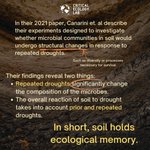
Ecological memory of recurrent drought modifies soil processes via changes in soil microbial community
Canarini, A. et al.(2021)
doi.org/10.1038/s41467-021-2…
Twentieth-century hydroclimate changes consistent with human influence
Marvel, K. et al. (2019)
doi.org/10.1038/s41586-019-1…