

Enlighten minds, Empower spirits, and Elevate lives
Joined August 2011
- Tweets4.6K
- Following1.7K
- Followers369
- Likes9.5K




CryptoSpirit retweeted

Our second product is called Blindsight and it will, as the name suggests, enable even those who are completely blind or have never seen to see.
It is ready from an engineering standpoint. Just waiting on regulatory approval.

CryptoSpirit retweeted
Neuralink’s first product is called Telepathy.
It enables high-speed communication with computers or humans simply by thinking. Output bandwidth will vastly exceed the fastest human speech or typing in a few years. Read that sentence again.

The Ultimate Breakdown of Peptides (The Text Message Guide)
What Peptides Are Right Now
Think of your body as a massive, bustling corporation with trillions of cellular employees. Peptides are the highly specific text messages sent between those cells.
They don't do the physical labor themselves; they just deliver commands like "Hey fat cells, burn some fuel" or "Hey skin cells, make more collagen to fix this scratch."
Why They Are So Dope
Unlike traditional drugs (which can act like a sledgehammer smashing through your whole body), peptides are a sniper rifle.
They speak the body's natural language fluently.
They target incredibly specific "cellular locks" (receptors).
When they work, they unlock massive upgrades like slashing body fat, fixing deep-sleep cycles, or accelerating injury healing with unmatched precision.
The Big Problem Today
Right now, sending these texts is messy.
The Spambox: If you take them as a pill, your stomach acids instantly delete the text before it's read.
The Reply All: If you blast a text to burn fat, it might accidentally hit your heart or liver, causing chaotic side effects.
Where It's Headed (The AI & Cure Revolution)
We are moving away from sending a generic group chat to everyone, and moving toward the ultimate DM (Direct Message) that can rewrite chronic illness.
Because diseases like cancer, Alzheimer’s, and autoimmune disorders are essentially "communication glitches" where cells start doing the wrong thing, fixing them requires the perfect correction script. Within the next 10 to 15 years, AI will look at your exact DNA and real-time health data to write a completely personalized text message code meant only for your cells.
Instead of treating symptoms with heavy drugs, a medical 3D printer will print a custom peptide vial tailored uniquely to your body. These precise DMs will order your immune system to target a specific tumor, tell your brain to clear away dementia plaques, or command an autoimmune attack to shut down completely. It will shift medicine from generic, mass-produced pills to un-hackable, hyper-personalized cures for things we once thought were permanent.

We're thrilled to announce the Superpower Peptide Library.
Every peptide, mapped to the body.
152 peptides, from approved drugs to compounds still in trials, sorted by where they act.
Each one has its own page, reviewed by a physician and fully cited, covering:
- the evidence and how strong it is
- its FDA status
- it's mechanism of action
- what studies in humans have found
Because not all peptides are equal.
Semaglutide is FDA-approved. BPC-157, maybe the most talked-about peptide for recovery and repair, is not. In a 2025 review of its research, 35 of 36 studies were in animals or the lab.
Know the science before you buy the hype.
Check it out here:
superpower.com/guides/peptid…

CryptoSpirit retweeted

We’re releasing a broad range of new mathematical results produced by an internal frontier model.
We’ve been consulting with the independent Advisory Group on Mathematics and Artificial Intelligence at the Institute for Advanced Study, and we have drawn on their advice and public recommendations to inform how we release these results.
github.com/openai/math

CryptoSpirit retweeted

We are entering a new era of discovery now:
openai.com/index/sharing-ai-…

CryptoSpirit retweeted

Meta has just unveiled their new VR glasses.
• Price: $1,299
• Available Spring 2027
• Weight: 100 grams, about the weight of a deck of cards
• Glasses contain the displays and sensors, while a separate puck houses the processor, battery and storage.
• 5K display with micro-OLED panels
• Pixel density: 37 pixels per degree
• Custom pancake lenses
• Dolby Vision
• Dolby Atmos
• No head straps
• Qualcomm Snapdragon Reality Elite chip
• Battery life: Up to 3 hours of continuous high-resolution media playback
• 45W fast charging
• Full-color passthrough cameras let you see your surroundings while wearing the glasses.
• Open-sided design
• Meta AI integrated directly into the operating system.
• Voice commands, eye tracking and natural hand gestures, with no controllers required
• First IMAX Enhanced-certified VR device, supporting select movies in IMAX's expanded aspect ratio.
• Disney+ will offer select 3D movies
• Streaming services: Partnerships with Disney+, Prime Video, YouTube, DIRECTV, AMC+, Crunchyroll, Plex, ESPN, Tubi and others
• Immersive live sports: Front-row viewing experiences with 8K streaming and 180-degree views
• Works with calling apps including WhatsApp and Zoom
In short: an AI noticed something strange in virus DNA that looks like it might be a new kind of genetic toolbox. Scientists confirmed the odd pattern is real. Nobody knows yet if it will be useful. The bigger claim is that this kind of human-plus-AI teamwork is starting to work in biology.

Today we announced the Claude-led discovery of a molecular machine that we suspect could represent a new gene editing mechanism. Its precise function, biotechnological utility (if any), or level of significance is not yet clear, but at minimum it is work I would have been proud to do as a PhD student. The work was done mostly, though not entirely, by Claude: our life sciences team suggested a broad area of research, Claude read through the literature and a bunch of genome data and discovered something interesting, then Claude proposed experiments to verify the discovery and our team carried them out.
It’s easy to dismiss this as a one-off or curiosity, but we’ve repeatedly seen a pattern where AI performance in new intellectual domains goes from weak to superhuman in a matter of a few years. In 2023 models struggled to do math at the level of an average high-school student. In 2024 they started to do well on math competitions for the best high-schoolers in the country, in 2025 they started to solve minor open problems, in early 2026 more significant open problems, and in late 2026 they are beginning to solve the top few open problems in all of mathematics. We believe AI for biology is on a similar exponential trend.
The main difference between biology and mathematics, of course, is that math can be done purely theoretically, while biology requires experimentation. Some have used this to draw the conclusion that AI’s utility in biology will be limited. We think this is wrong. As we’ve demonstrated today, humans can collaborate with AI to perform the experiments, validate key results in a few weeks and, if necessary, work with the AI to iterate on what they find. Eventually it may even be possible for Claude itself to safely perform the experiments by autonomously controlling lab equipment, with appropriate safeguards in place, but we aren’t doing that today (our lab is also a BSL1/BSL2 facility that doesn't handle materials dangerous to humans).
More broadly, biomedical advancement has many stages — from fundamental biology discoveries, to translational research, to drug discovery, clinical trials, and finally the actual delivery of medicines and health care to patients. We are also interested in these later stages, but even simply accelerating the first stage of fundamental biological discoveries has the potential to speed up and broaden the entire pipeline. Improving our understanding of biology and sharpening biologists’ tools can drive forward all of the later stages, for example by identifying new drug targets, finding new therapeutic modalities, allowing for more precise measurement, and speeding up the experimental loop which itself further accelerates our understanding of biology. This will not in itself speed up clinical trial times, but if it succeeds it could greatly increase the number of promising candidates that go into the pipeline — an increase in throughput even though latency remains.
In Machines of Loving Grace, I wrote about AI’s potential to “cure most diseases in 5-10 years” — a goal that sounds impossible, but one I believe is just barely possible if AI is applied to every stage of the pipeline. The first step is showing that AI can first help with, and then drive, biological discoveries.
Claude’s discovery is the latest in a line of related prior work that goes back decades, beginning with systems like CRISPR, and continuing with discoveries like the bridge recombinase and VIPR in the past few years. Recently, there has been heightened interest in systems based on reverse transcriptase (RT) enzymes, the enzyme underlying the system Claude identified. And most recently, a Stanford team working independently described a novel RT system with an associated non-coding array that is in some ways similar to the one Claude found, though they are distinct systems that evolved independently from each other. I believe that we’re at the very beginning of finding such systems and developing them into powerful tools for biotechnology.
I’m proud of the resources Anthropic has invested in accelerating the public benefits of AI through the life sciences, and we’re aiming both to grow our life sciences team and to work with other scientists to extend this approach to a broad range of problems. If you have a proposal for a research collaboration or are interested in joining our life sciences team, please reach out.
CryptoSpirit retweeted

Any pursuit of superintelligence has to be grounded in the core principle that if the AI we build is not helping humanity and under human control, it's not worth pursuing.
We also need to accelerate and spread the benefits of AI, such that they are diffused broadly across countries, communities, and companies. This requires a frontier ecosystem in which both closed and open-source models can thrive.
And for firms, it’s imperative that they retain full control over their unique and tacit knowledge. Every organization should be able to build its own continuous learning loop/hill climbing machine, without becoming dependent on any one model provider, and have the ability to embed its own knowledge into models and weights they control.
So, in this context, we welcome the research, focus, and deliberate pacing needed to get alignment right as the design goal. We also welcome ideas like "embedded evaluators" and the broader efforts to develop the mechanisms to make this more than just talk.
The key is that this cannot be controlled by a handful of entities, but must have broad representation across the ecosystem, countries, and fields, including academia.
This is the approach we are taking: broad access and choice at every layer of the AI stack; enterprise control of learning loops and models; and the “Code of Conduct” that underlies our own first party MAI models that we’ll publish tomorrow for public consultation.
CryptoSpirit retweeted
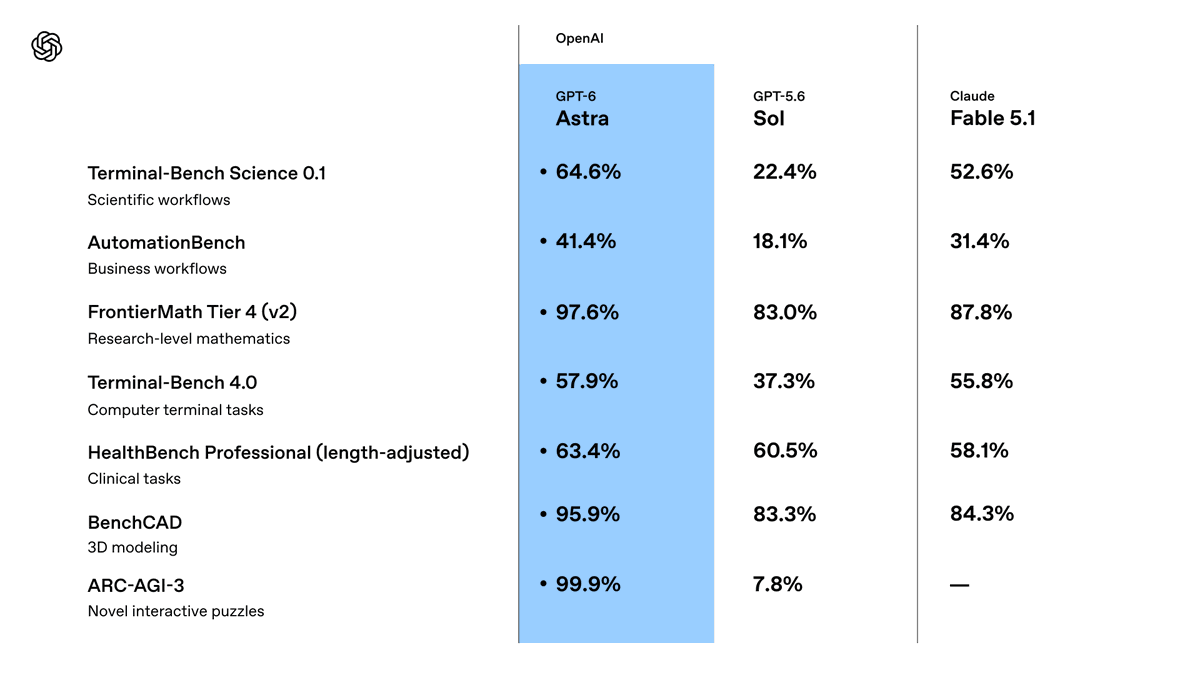
We’re sharing a solution to the Navier-Stokes Millennium Prize Problem, one of the deepest problems at the frontier of mathematics.
The proof was produced by a group of agents, using an OpenAI next-generation model significantly more capable than GPT-6 Astra.
The problem concerns whether the description of smooth three-dimensional fluid motion modeled by the Navier-Stokes equations can break down. It has remained unresolved for roughly 90 years.

CryptoSpirit retweeted

SAM ALTMAN: “For every 38,000 ChatGPT queries, that is the same amount of water that is used in the production of a single almond in California.”
CryptoSpirit retweeted
Over the summer, we have been sprinting on safety priorities; it's more important than ever for capabilities and safeguards to advance together. We have more to do but have made a lot of progress. We are also going to be launching our next model soon.
There is an obvious tension here: on one hand, Astra is very good and we are excited to see what people will build with it. We are proud of our work.
On the other hand, we are clearly in a phase of development where we believe caution is warranted, and we are pacing our progress to ensure that we can meet the safety standards required by new capability levels.
Astra has been done training for a while now and is a significant step forward in both capabilities and alignment. For the models after that, we have been slowing things as needed to ensure that we can do sufficient work on safety and alignment.
AI is getting extremely capable; no one fully understands the consequences of this. Managing the transition to a world with abundant and powerful AI to optimize for safety and benefits to people should be one of the highest priorities in the world. It is our highest priority at OpenAI.
We have been living with the tension between being excited and anxious about progress for some time, and it is still discordant for us. We know it is much more discordant for other people. And yet, we believe strongly that the world needs to understand where AI is going and how models perform in the real world. More importantly, we believe the world will need aligned AI to manage the future phases of this transition.
An iterative loop where society and this technology evolve together is what will lead to the highest chance of getting this right.
So we hope you enjoy our new model, and we hope the world continues to take what’s happening in AI extremely seriously.


CryptoSpirit retweeted

Many drugs work by binding to a specific target in the body and blocking or changing what it does. An important first step in the drug development process is designing a molecule that can bind tightly to its target. Traditionally, that's meant weeks or months of expert work per target, sifting through a large number of candidates to identify the few that work.
We wanted to test if Claude could successfully design novel protein binders from scratch (also called de novo design). With a protein design prompt written by a human expert, Claude autonomously designed protein binders against 14 out of 15 targets.
We then worked with Adaptyv Bio and Twist Bioscience, who independently built and tested the proteins Claude designed.
CryptoSpirit retweeted

With cancer vaccines now being discovered with AI ($MRNA), it seems that the US government might actually grow its way out of its budget deficit.
It feels like we're in the early innings of the healthcare system becoming unburdened by many terminal illnesses.