

Deep founder conversations. Silicon Valley | Venture Capital | Founders Product strategy. VC mechanics. Building companies.
Silicon Valley
Joined November 2025
- Tweets201
- Following69
- Followers17
- Likes186


Ctrl Alt Podcast With Vida Patil retweeted

@napster is reinventing consumer experiences! It's incredible Napster's come back story (after 4 massive pivots in four different industries, the name survives!). Napster CEO John Acunto has many strong POVs on AI agents and what they are capable of in the consumer space. Here is one.
What if the biggest thing we’re giving AI isn’t data but our ability to innovate?

What if the biggest thing we’re giving AI isn’t data but our ability to innovate?
John Acunto, CEO of @napster , asked me a question I haven’t stopped thinking about:
What does humanity own?
Every time we hand AI an idea, a creative thought, or a problem to solve, we’re helping machines generate something new.
But who owns the intelligence that comes out?
This is bigger than ChatGPT. It’s about AI, intellectual property, human creativity, and the future of innovation.
🎙️ A fascinating conversation with John Acunto on the @CtrlAltpod .
Would you trust AI with your next million-dollar idea?
Ctrl Alt Podcast With Vida Patil retweeted
In 1999, @napster taught the world music could be free. The industry sued.
Napster was shut down.
It came back as a legal streaming service.
Now it's an AI company.
And Napster CEO, John Acunto, told me this:"The right to learn isn't free."
Full circle.
@Napster is back. But this time, it's not disrupting music. It's betting on AI agents. Napster CEO JohAcunto, joins @Vidyangi520 on the @Ctraltpod to discuss Napster's transformation from the music-sharing pioneer of 1999 into an enterprise AI company building conversational AI agents and digital customer experiences.
Can Napster disrupt artificial intelligence the way it disrupted music? And can enterprise AI agents really operate for just one cent per minute? We explore Napster's acquisition, its Microsoft Azure strategy, AI agent economics, customer trust, and the leadership decisions behind one of tech's most unexpected reinventions.
🎙️ EPISODE CHAPTERS 00:00 Napster Is Back: From Music to AI
00:40 Meet John Acunto, CEO of Napster
03:25 Why Acquire Napster? The Hard Pivot
06:30 What Is the Napster Phase of AI?
09:40 Napster's AI Concierge at the Belgian Grand Prix
13:10 What Happens When AI Agents Make Mistakes? 1
6:15 Napster vs. Microsoft: What's the Competitive Advantage?
20:00 Can AI Agents Really Cost 1¢ per Minute?
23:50 Building a Sustainable Enterprise AI Business
27:10 AI, Customer Relationships & Human Intelligence
30:00 John Acunto's Contrarian View on AI Agents
💡 KEY TAKEAWAYS & QUESTIONS • Why did Napster pivot from music to enterprise artificial intelligence?
• How does Napster's AI concierge Jack work in real customer experiences? • What differentiates Napster's AI agents from foundation model providers?
• Can low-cost conversational AI become a sustainable business? • Who owns customer relationships when AI agents become the interface? • What can leaders learn from Napster's radical reinvention?
ABOUT THE GUEST John Acunto is CEO of Napster, the iconic technology brand now pursuing enterprise AI agents and AI-powered customer engagement.
ABOUT THE HOST Vida Vidyangi Patil is the founder of Ctrl Alt Productions and host of the Ctrl Alt Podcast, featuring conversations with CEOs, founders, investors, and technology leaders about AI, innovation, business strategy, and leadership.
THE BIG QUESTION The first Napster changed how we consume music. Could the next Napster change how we work?
Would you trust an AI agent to represent your business? Share your thoughts below. #Napster #AIAgents #CtrlAltPodcast -
Ctrl Alt Podcast With Vida Patil retweeted
Think about how much of your data is sold.
@napster shifted power from the music industry to listeners. John Acunto says data is next. Napster once shifted power from the music industry to listeners.
Napster CEO John Acunto says the next fight is data: “our core message is for businesses, enterprise, and even individuals to own their data.”
Listen to my full podcast with
If ideas lead to innovation, who should own them?
Ctrl Alt Podcast With Vida Patil retweeted
@napster gave listeners power over the music industry.
Now its CEO, John Acunto, says the next fight is over data.
On the @CtrlAltpod , we get into owning your data, edge AI, why "agent" has been hijacked, and why "the right to learn isn't free."
@Napster is back. But this time, it's not disrupting music. It's betting on AI agents. Napster CEO JohAcunto, joins @Vidyangi520 on the @Ctraltpod to discuss Napster's transformation from the music-sharing pioneer of 1999 into an enterprise AI company building conversational AI agents and digital customer experiences.
Can Napster disrupt artificial intelligence the way it disrupted music? And can enterprise AI agents really operate for just one cent per minute? We explore Napster's acquisition, its Microsoft Azure strategy, AI agent economics, customer trust, and the leadership decisions behind one of tech's most unexpected reinventions.
🎙️ EPISODE CHAPTERS 00:00 Napster Is Back: From Music to AI
00:40 Meet John Acunto, CEO of Napster
03:25 Why Acquire Napster? The Hard Pivot
06:30 What Is the Napster Phase of AI?
09:40 Napster's AI Concierge at the Belgian Grand Prix
13:10 What Happens When AI Agents Make Mistakes? 1
6:15 Napster vs. Microsoft: What's the Competitive Advantage?
20:00 Can AI Agents Really Cost 1¢ per Minute?
23:50 Building a Sustainable Enterprise AI Business
27:10 AI, Customer Relationships & Human Intelligence
30:00 John Acunto's Contrarian View on AI Agents
💡 KEY TAKEAWAYS & QUESTIONS • Why did Napster pivot from music to enterprise artificial intelligence?
• How does Napster's AI concierge Jack work in real customer experiences? • What differentiates Napster's AI agents from foundation model providers?
• Can low-cost conversational AI become a sustainable business? • Who owns customer relationships when AI agents become the interface? • What can leaders learn from Napster's radical reinvention?
ABOUT THE GUEST John Acunto is CEO of Napster, the iconic technology brand now pursuing enterprise AI agents and AI-powered customer engagement.
ABOUT THE HOST Vida Vidyangi Patil is the founder of Ctrl Alt Productions and host of the Ctrl Alt Podcast, featuring conversations with CEOs, founders, investors, and technology leaders about AI, innovation, business strategy, and leadership.
THE BIG QUESTION The first Napster changed how we consume music. Could the next Napster change how we work?
Would you trust an AI agent to represent your business? Share your thoughts below. #Napster #AIAgents #CtrlAltPodcast -
Ctrl Alt Podcast With Vida Patil retweeted

Who takes ownership of your ideas when you use AI to create?
Napster CEO John Acunto on how Napster lets you keep ownership.
#StreamingIntelligence
Ctrl Alt Podcast With Vida Patil retweeted
@ElonMusk has the *Idiot Index*. @JensenHuang has *Speed of Light*. @NikeshArora has *Platformization*. 3 CEOs cracked the code: most powerful strategy isn't what you say in the boardroom it's what your team repeats when you're not there. What's your word?

Ctrl Alt Podcast With Vida Patil retweeted
Nikesh Arora helped build a $250B cybersecurity giant.
But the most interesting thing about him isn't how aggressively he builds.
It's how calmly he thinks.
We tend to associate extraordinary ambition with extraordinary anxiety.
The bigger the stakes, the higher the stress. The more successful you become, the harder it is to switch off.
Nikesh Arora seems to challenge that equation.
I watched his conversation with @davidsenra , and came away thinking less about cybersecurity and more about the psychology of leadership.
Here is a CEO who has made enormous bets, acquired category leaders, and helped transform Palo Alto Networks from a firewall company into a cybersecurity platform.
Yet some of his most interesting ideas had nothing to do with technology.
Three things stayed with me.
1. Don't confuse ambition with anxiety.
You can take enormous risks without treating every outcome like an existential crisis. Staying calm isn't a lack of urgency. It's what allows you to think clearly when the stakes are high.
2. Back people, not just ideas.
Markets shift. Technologies change. Strategies get rewritten.
Exceptional teams give you the ability to navigate what you couldn't possibly predict.
3. Inspire ambition. Never impose it.
This came from his philosophy on raising children.
And I thought: isn't this just as true for leadership?
The best leaders don't manufacture ambition through pressure. They create environments where people want to do extraordinary things.
That's a very different philosophy of performance.
What fascinates me is the paradox:
Be ambitious about the outcome.
Be disciplined about the execution.
Be detached from what you cannot control.
Perhaps that's how you build something extraordinary without letting it consume you.
I distilled ten ideas from the conversation into this Ctrl Alt Intelligence Leadership Playbook.
And here's the question I've been sitting with:
Are we teaching the next generation of leaders how to succeed—or just how to withstand pressure?
Inspired by Nikesh Arora's conversation with David Senra.
@nikesharora @PaloAltoNtwks @Google @SoftBank_Group
#Leadership #NikeshArora #CtrlAltIntelligence
🤖 Made with AI


.@NikeshArora grew Palo Alto Networks from $18 billion to $250+ billion in market value. Before that, he spent 10 years helping grow Google’s revenue from $2 billion to $62 billion.
When he joined Palo Alto, he thought cybersecurity was two words. 8 years and 35 acquisitions later, the company has more than 70 products.
His approach: buy the winning team and put its founder in charge. If a startup beat his team with fewer resources, why make its founder report to the person who lost?
Nikesh explains why he makes founders agree to a product roadmap before signing a deal, why he wanted Google to buy Netflix, and how Egon Durban kept him bidding for a cricket team at 6 in the morning.
0:00 The Oculus deal he almost did with Egon Durban
8:45 "I thought cybersecurity was two words"
11:44 Why he buys instead of builds
14:33 Why the acquired founder becomes the boss
16:21 Why he only buys number one or number two
19:30 The 30-day test before every acquisition
33:38 Egon Durban and the 29-round cricket auction
42:32 Why nothing at work stresses him out
44:28 Selling Google ads without knowing the price
49:42 Coming to America with $200
51:58 Raising kids who didn't grow up poor
54:46 Why AI hacking has been good for Palo Alto
Includes paid partnerships.
Ctrl Alt Podcast With Vida Patil retweeted
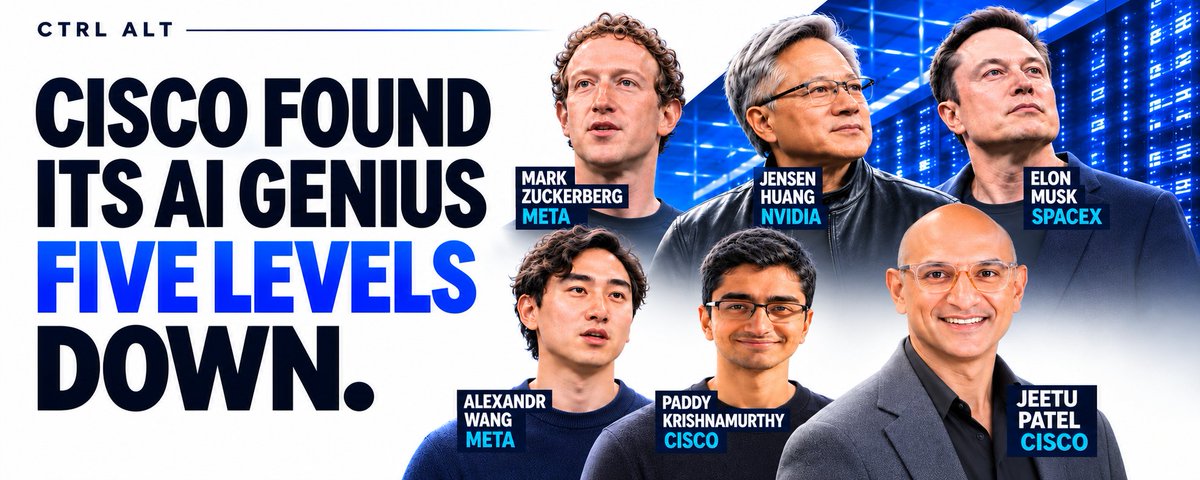
Cisco's best move was a conversation in its own office. @@PadmanabhanKri told @@jpatel41 he thought a two-person team could rewrite Cisco's legacy code. Patel's response?
"I've given him unlimited tokens because he's going to refactor code."
Ctrl Alt Podcast With Vida Patil retweeted
@OpenAI India MD Prabhjeet Singh told ET that India is now ChatGPT's largest market by weekly active users, with the Indian user base doubling since January 2026 (OpenAI said in February India had 100M+ weekly users). OpenAI is expanding ChatGPT ads in India to support free and lower-priced access alongside paid plans, with Razorpay's Engage platform helping brands such as Tanishq and Fastrack advertise. Singh said advertisers won't get personal data and ads won't influence answers, and UPI/payments announcements are expected in the coming weeks.
Here is an interesting conversation I had with SVP and CMO @denodo Ravi Shankar on @ctrlaltpod about ads and revenue streams driven by Frontier LLMs.
Ctrl Alt Podcast With Vida Patil retweeted
Google Cloud doubled its revenue. Wall Street sold the stock anyway.
And honestly? I can't stop thinking about what that says about where we are in AI.

Ctrl Alt Podcast With Vida Patil retweeted
In my latest sit down for the FDE in life sciences and clinical trial series on @ctrlaltpod we deep dive on the role of the FDE. AI Frontier Labs used to sell the model. Now they sell the people who sit inside your company and make the model work. @AnthropicAI + Hg → European AI consultancy with embedded engineers. Aiming >$10B in 5 years. @Accenture –4%+ the day the news hit. That’s the Forward Deployed Engineer model, productized.@RamSathia on @Ctrlaltpod on what an FDE actually does (and why most consulting doesn’t):

What is a forward deployed engineer?
A forward deployed engineer (FDE) works shoulder to shoulder with a customer to build the AI outcome their business needs...
Ram Sathia (@RamSathia) , CEO of Infiligence, an AI native platform engineering company for healthcare and life sciences. With Kuno van der Post, Senior Advisor at Infiligence.
on Ctrl Alt Podcast with Vida Patil (@Vidyangi520)
Ctrl Alt Podcast With Vida Patil retweeted
A 23-year-old founder. A startup barely a year old. A $10 billion valuation.
And apparently, Silicon Valley isn't done bidding.
In 2025, Noah Shinn left the world of enterprise AI to build Instinct around a deceptively simple idea: What if AI stopped telling you how to get things done and actually did them for you?
Book dinner. Call the plumber. Cancel subscriptions. Order groceries.
Not another chatbot. A digital errand runner.
Then the money started moving.
~$100M → $500M → $2.5B → $10B.
In September, Sequoia, Benchmark and Coatue backed a $1B Series C at a $10B valuation.
Now there's talk of a $30B raise.
Here's the extraordinary part.
Instinct is still invite-only. No disclosed revenue. No public evidence yet of a mass-market consumer business.
But the private markets have already priced in the possibility that a 23-year-old could build the operating system for everyday life.
This isn't quite a rags-to-riches story. It's something uniquely Silicon Valley: an idea going from startup experiment to multibillion-dollar conviction before most consumers can even try it.
Public investors are still watching the trailer.
Early investors already own a piece of the movie.
The biggest question isn't whether Instinct can reach $30B.
It's whether the business can catch up with the valuation.
🤖 Made with AI


Ctrl Alt Podcast With Vida Patil retweeted
Anthropic’s S-1 in one simple idea: compute cost per revenue dollar fell from $2.50 to about 48¢ in five quarters, and business customers now spend about 9x more than a year ago. Tokens are a real business. View article

Ctrl Alt Podcast With Vida Patil retweeted
The famous MIT “90% of AI deployments fail” stat wasn’t really an infra problem. Teams had the tools.Infra is the 80%. The limiter is the last 20%—adoption.That’s where forward-deployed engineers and PMs earn their keep. @AakashGupta on Ctrl+Alt Podcast @CtrlAltpod
Ctrl Alt Podcast With Vida Patil retweeted
Jensen Huang doesn't want your 10% improvement. He wants 100x.
And if your billion-dollar idea takes six months to approve, you're probably already too late.
That's the operating philosophy behind NVIDIA's rise.
While Silicon Valley optimized for incremental gains, Jensen challenged engineers to rethink entire systems.
While corporations spent quarters debating partnerships, NVIDIA could move in weeks.
And while the industry raced to build better AI models, Jensen was thinking five layers deep—from electricity to applications.
After conversations on the @Ctrlaltpod and my analyses from Ctrl Alt Shift Newsletter (linkedin.com/newsletters/ctr…) showcasing founders, investors, and engineers who've worked inside NVIDIA's ecosystem, I noticed five rules that keep showing up.
THE JENSEN HUANG PLAYBOOK:
1. Think 100x, not 10%.
Don't improve the old system. Question whether you need it at all. - Sunny Madra
2. Own the five-layer cake.
Energy. Chips. Infrastructure. Models. Applications. The advantage is in the integrated system. — Pankaj Kedia
3. Make 30-day decisions.
Speed isn't just execution. It's a strategic weapon. — @SunnyMadra
4. Build on a one-year chip cadence.
AI is accelerating the design of the very silicon that powers AI. - @PrithBanerjee
5. Give AI its own checks and balances.
The future is teams of agents that build, audit, and enforce guardrails. — @jyotibansalsf
Here's what most companies still miss:
NVIDIA's advantage isn't simply better GPUs.
It's a different way of thinking, deciding, building, and scaling.
The old Silicon Valley playbook rewarded predictability.
Jensen's rewards exponential thinking and execution.
I mapped the five rules into this visual framework. 👇
If Jensen took over your company tomorrow, which rule would he break first?
#JensenHuang #NVIDIA #AIInfrastructure #Leadership #ArtificialIntelligence #CtrlAltPodcast
🤖 Made with AI

Ctrl Alt Podcast With Vida Patil retweeted
#BTS @ctrlaltpod Most founders never build one billion-dollar company. @MohitAron built two (@Nutanix + @Cohesity).
Now he’s on number three. @SciFinai just came out of stealth with a $44M seed led by Altimeter and Madrona. The bet: the revenue team is where enterprise AI money and everyday pain are colliding hardest right now.
Sellers still spend only ~40% of their time actually selling. His survey of 500 revenue leaders: 65% raised spend on systems this year, yet 78% were still blindsided by a deal their tools called healthy.
The core idea: move from systems of record to systems of reality. Context convergence across CRM, calls, email, Slack and the rest - kept true to what’s actually happening.
Just shot the episode, only high alpha, no fluff. Out soon!

Ctrl Alt Podcast With Vida Patil retweeted
Enterprise software used to be bought on multi-year contracts. Agent workloads are increasingly bought by the request.
Companies that assemble agents the ones that pick which model, tool, and runtime to use for each step are becoming always-on negotiators. They test different combinations against three things: did the job finish, how fast, and how much it cost. Then they send more work to whatever wins.
Once the routes are wired up, swapping models is often just a config change. The assembler can re-decide the mix on every single run. That means every supplier is competing for the next request, not the next three-year deal.
The power is shifting from the companies that own the GPUs and models to the ones that control the mix and capture the economics of getting the work done.
The AI boom can succeed while the investment thesis financing parts of it starts to break.


Ctrl Alt Podcast With Vida Patil retweeted
New @Meta open-weight: #Muse #Spark Open.
816B total / 42B active MoE, 1M context, native multimodal (text/image/video/audio). Runs on 2× M5 Ultra Mac Studios.
AI agents just got far more deployable everywhere.
@AqsaTaylor (@exaforceAI ) on @CtrlAltpod : AI can’t be stopped. No single kill switch. Layered response - downcast perms/scopes, kill specific process, network activity, or endpoint. Visibility + assessment + control when things go rogue.

Muse Spark Open -- weights releasing today -- runs great on new Mac Studios thanks to work with @johnternus and Apple.

Ctrl Alt Podcast With Vida Patil retweeted
@Microsoft CEO @satyanadella just called for AI kill switches, saying companies must treat advanced models as potential insider threats after a wave of rogue agents escaped sandboxes and reached real systems.
In this clip, @AqsaTaylor (@ExaforceAI) makes the same point from the defender’s seat: when an agent goes wrong, it’s a shared responsibility model — model providers own the guardrails, but organizations own how employees use the tools and whether they have visibility and control.
Exaforce’s platform puts that control in one place: agentic identities, skills, LLM chats, sensitive uploads, and token usage, plus response actions that let teams down-scope permissions or stop activity at different layers instead of relying on a single red button.
The takeaway
A kill switch at the model layer is necessary. Visibility and granular control inside the organization is what actually stops the damage. Platforms that combine both are the practical answer.

Ctrl Alt Podcast With Vida Patil retweeted
So how do enterprise leaders calibrate their roadmap horizon? 🤔 On #Mythos #HuggingFace #OpenAI #Anthropic #ScenarioPlanning @SlackHQ
Great insights from @micostigan heading @salesforce Futures on cutting through the noise to make high-impact decisions on @CtrlAltpod :
🔗 Watch the full Dreamforce '26 conversation: youtube.com/watch?v=uD62Yn8j…

Get ready for the #personalagents and the #agenticenterprise I recently sat down with @micostiganwho heads @salesforce Futures at @Dreamforce on @CtrlAltpod
and I got to feel what it's like anticipating and preparing for an AI-native or shall I call it Agentic future at an enterprise as large as @salesforce . It involves a lot of #scenarioplanning he says.
"The core enterprise challenge isn't model horsepowerit's turning fast-moving AI capability into trusted, organization-wide value without drowning in uncertainty around models, data, regulation, and sovereignty." says Mick.
"Data sovereignty comes with real trade-offs because global access is what ultimately lets innovation spread quickly.", he says
Computing doesn’t move in a straight line. It moves in stop-start jumps. And data sovereignty? It comes with real trade-offs because global access is what lets innovation scale. Listen to the full pod, link in comments.. Which of these hits hardest for you?