





Cyespx retweeted

Risk is what makes life interesting. Running experiments. Testing some new idea and finding out the result.
F*cking around and finding out.
If you're bored, you're not doing enough FAFO.
If I were long Eisenkot on Kalshi right now, I'd be feeling pretty nervous. If Likud ends up with the most seats and Netanyahu gets the first crack at forming a government, he'll have a chance to wheel and deal his way into a new coalition, which is his particular specialty.
Cyespx retweeted

Just because a technology is valuable long term doesn't mean your leveraged beta won't go to zero
This quoted post is unavailable.
Cyespx retweeted

By nature of being a vol trader, I’ve studied many different market crashes. Not just the common ones in the U.S., but episodes like Britain in 1720, Vienna in 1873, and the Dutch tulip mania of 1637.
There are some interesting behavioral takeaways that aren’t entirely intuitive unless you participate in markets every single day.
One of the biggest for me is that large market moves often need two-way action to develop. Behaviorally, you need participants willing to take the other side, because their eventual need to unwind can help accelerate the move. It’s almost like storing energy that gets released later. To create that dynamic, a “gray catalyst” can be particularly powerful one whose implications aren’t immediately black and white.
Here are two examples that helped produce massive moves in opposite directions that had gray area headlines that led to that two way flow.
COVID (March 2020): What often gets lost in the sauce is that many participants were aggressively betting against the idea that COVID would be severely disruptive. As stocks fell, they bought the dip and sold vol. When stocks kept falling and vol kept rising, some of those positions became fuel for the next leg of the move as participants were forced to unwind.
Looking back, the outcome seems obvious. In real time, the eventual scale of the disruption was far from clear. There was HOPE that it would pass quickly. Headlines about potential treatments, policy support, or a less severe impact repeatedly gave investors reasons to step back in. Stocks would rip 5% higher immediately on that news and hope, only to reverse again even lower when more negative news hit.
Those rallies matter. They give existing longs a reason to stay and new buyers a reason to enter. When the recovery fails, there is another round of positioning that may need to come out. Without that back-and-forth, it can be harder to produce the same degree of forced selling. The uncertainty helps keep replenishing the other side.
Meme mania (January 2021): Companies like GameStop and AMC surged hundreds of percent amid a speculative frenzy and short squeezes. Here, too, there was a gray area. Many investors saw businesses facing serious fundamental challenges, which made shorting them appear rational, especially as their share prices climbed further away from what those investors believed they were worth.
But a compelling fundamental argument does not tell you how far a stock can move before that argument pays off. As prices rose, some shorts covered, while others saw an even more attractive entry point and stepped in. That fresh short exposure created the potential for another round of forced buying if prices continued higher.
The gray area was the gap between the fundamental thesis and the path the market could take. Of course these weren’t great stocks, and the fact that people came in on that helped the waves move higher and higher.
That’s the behavioral dynamic I find so interesting. Uncertainty can keep attracting participants to the other side of a move. As the move extends, their conviction runs into their capital constraints, and an opinion can turn into a forced transaction.
Cyespx retweeted

“Speech to speech. No llm.”
What. The. Fuck.

We believe voice is the most natural way to interact with intelligence, so we created Dessa, the most authentic full-duplex speech model ever built. Talking with it feels like talking with a person…full of emotion, nuance, pauses, and a natural cadence.
block.xyz/dessa

Cyespx retweeted
The second question is particularly good: why hedge a position with another asset?
“To reduce risk” is true, but incomplete.
You could just buy less and hold more cash. Why introduce another position?
“To hedge away factors you aren’t getting paid for” gets closer.
But you still wouldn’t buy a hedge at any price just because it offsets an exposure.
The answer is about the relationship between expected return, volatility, and correlation of the combined position with original trade + hedge.
You might own the original trade because you disagree with the market about its expected return.
You don’t necessarily need to disagree with the market about the hedge. Its value to you can come from how it behaves alongside what you already own.
A hedge can have negative expected returns and still improve the portfolio’s Sharpe ratio, if it reduces volatility proportionally more than it reduces expected excess return.
In other words, buying less scales down the original opportunity. A well-priced hedge can improve the opportunity itself.
You can then potentially lever up the combined position to your original risk budget, earning a higher expected return at the same volatility.
But negative correlation isn’t worth an unlimited price, so if the hedge sacrifices too much expected return, the improvement disappears.
The math makes this clearer. Let S_P be the original portfolio’s Sharpe, S_H the hedge’s Sharpe, and ρ their correlation.
Adding a small amount of the hedge improves portfolio Sharpe when:
S_H > ρ × S_P
Negative correlation lowers the return hurdle.
Example, using expected returns above cash:
Original trade: 5% return, 15% volatility.
Hedge: −1% return, 15% volatility.
Correlation: −0.6.
The original Sharpe is 5/15 = 0.333.
The hedge’s required Sharpe is:
−0.6 × 0.333 = −0.20.
Its actual Sharpe is:
−1/15 = −0.067.
It clears the hurdle despite its negative expected return. Now allocate 90% to the original trade and 10% to the hedge:
Expected return:
0.9 × 5% + 0.1 × (−1%) = 4.4%.
Volatility:
15% × √[0.9² + 0.1² + 2 × 0.9 × 0.1 × (−0.6)]
= 12.66%.
Sharpe rises from 0.333 to 4.4/12.66 = 0.348.
Scale the combined position back to 15% volatility:
Leverage = 15/12.66 = 1.185×.
Expected return = 1.185 × 4.4% = 5.21%.
You added something with negative expected returns and increased expected return from 5% to 5.21%, at the same volatility.


The answer to the question would typically uses two classic frameworks: (1) Merton’s portfolio problem combined with (2) lifecycle investing.
Consider what you’re maximizing; it is NOT expected terminal wealth but arguably TYPICAL (i.e. median) terminal wealth, which coincides with expected long-run compound growth.
By doing some math, you can show that constant-leverage log growth for leverage L is:
g(L) = r + L(μ − r) − ½L²σ²
The expected-return benefit grows linearly with leverage while the volatility penalty grows quadratically.
Differentiate and we can show that the growth-maximizing exposure is
L* = (μ − r)/σ²
“Volatility drag” is already in the equation but its existence doesn’t establish that 1× is optimal.
For illustration, a 10% expected arithmetic return, 3% financing rate and 18% volatility give an optimum around 2.2× before fees.
Lifecycle investing adds another consideration since a young person’s brokerage account may be a small fraction of their lifetime resources.
With sufficiently reliable future earnings, more equity exposure early can spread market exposure more evenly across a working life.
There is therefore indeed a serious argument for moderate leverage, potentially implemented through a broad-index leveraged ETF.

Open AI's dot is so non-functional that even OpenAI's own best models can't figure out how to configure it correctly or to get any support from OpenAI on the subject. @thsottiaux what the fuck are you guys doing over there?
Cyespx retweeted
I’ve seen this quite a bit as well. One of the easiest ways to identify someone who lacks real market experience is to listen to the narratives they construct around the market-making community.
It’s a huge red flag whenever someone speaks about market makers as though they’re some divine hand from the sky that sees all, knows all, and controls every movement in the market.
More often than not, these narratives serve as convenient scapegoats for price action that someone doesn’t fully understand. And when you actually tap the Street, examine positioning, or dig into the underlying data to validate those claims, they frequently fall apart.
The irony is that market makers are often just as constrained by inventory, risk limits, adverse selection, and imperfect information as everyone else. They are not omniscient, nor are they some coordinated entity operating with a singular objective.
Ultimately the “market makers are pinning the gamma bro” type of arguments are similar to the statements you hear from a fish blaming the dealer at the casino for “bad luck” on a few hands.

ken griffin, founder of the $77 bn hedge fund firm citadel, has little patience for blaming every losing trade on hedge fund deleveraging.
he says people love that explanation because it removes their own accountability.
his first questions are about the prices changing, the information his team lacks, and what other investors may have worked out.
only after exhausting those paths does he want to discuss who might be forced to sell.
his concern with reaching for that explanation too quickly:
“I actually stop learning.”

Cyespx retweeted

if you tell 20 of your friends to shoot for 1000x and 1 of them hits it and 19 of them go BK and/or rope you end up working at the family office of a guy who views you as his day 1 friend who believed in him
Anyone who has sat in the queue on Papertrade xyz for 10 minutes, watching their queue position get further away until they get liquidated on one side or the other, leaving them naked, understands that Papertrade is not actually tradable in its current format unless you're points farming.
So, from a long-term perspective, once the points farming opportunities are no longer so valuable, are they going to actually adjust the platform to make it an actual trading platform instead of just a loss farming platform?
I mean, to have long term viability, it would have to have some usefulness for actual trading at some point?
You know that Astra is being particularly ridiculous when even its own autoprompt is calling it out for its fucking stupid. 🤣
Cyespx retweeted

Putting together a small group of independent street kwants focused on systematic trading (Low-Freq/MFT).
Mainly looking for people who have been researching quant trading for a while and are already running live systems/portfolios.
The idea is to exchange research, discuss alpha/features ideas, infra, execution, and generally help each other learn and improve.
If you think you'd be a good fit, feel free to DM for an invite.
Cyespx retweeted

There is a reason for this. The size of a coin has explanatory power over how much it trends
For smaller coins this typically means *negative trend effects*
This is one of the strongest edges in crypto, but because it only works on small coins and small coins are subject to squeezes it still persists
I don't know what's worse... that a naked pyramid scheme is being pumped so aggressively on my timeline, that it's being backed and pushed by so-called "respectable" accounts, or that I'm also in on it.
Now that both Codex and Claude code both fill in a suggested prompt after every answer, my job has basically been reduced to hitting return. I'll be plenty happy when they can just cut me out of the process completely.
Cyespx retweeted

Add a new signal that mean reverts the signal in the tails. A linear weighted composition of the two signals will give you the required behaviour. Properly, out of sample and robustly, fit the linear weights.
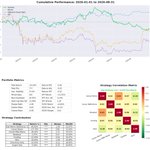
As you can see on this strategy specific report, significant changes were made to the system during September.
I generally have a process of creating a system with some minimal amount of testing based on a theoretical foundation, then running it in prod to see how it actually works, especially in terms of execution. Working out the execution kinks is a very long, difficult process. The edge cases just continue to pop up day after day, week after week, month after month.
Around mid year, I really started looking at what I had and thinking about what needed to be improved, gotten rid of or changed. A lot of work has gone into creating a much more refined system over the last couple of months, with better signals and strategies.
The main changes are as follows.
Funding was replaced with something I call accelerated funding, which uses the rate of change and funding rate acceleration to determine the entry rather than just the funding rate itself.
In an attempt to come up with a short-term momentum system that would actually work, I ended up with three different systems: one pretty short-term, another more medium-term, and another that actually came out somewhat long-term. The medium and long-term ones replaced Breakout and Periodic Momo, which were both taken out on 9/9.
All of these new systems backtest very well, which is why they've been put in. But as anyone who's backtested on point-in-time Binance data knows, when you actually run this shit on Hyperliquid, the results do not necessarily correlate, especially when it comes to funding. The Binance universe is just so much different in terms of coin selection.
I can't actually run on Binance for two reasons. First, they are thieving fucking scumbags who deserve to get put up against the wall. Secondly, they are a KYC CEX and I am in the wrong jurisdiction.
The pairs system was taken out early in the month and went back in right at the end, at half size. A number of adjustments were made to make it more difficult for one coin decoupling significantly to hurt the whole system. So in an obvious hack situation, like what happened to kBonk, it can no longer pile into the same coin across several pairs, and a pair that blows up gets stopped out.
My worst-performing strategy this year has been Carver RWA Momo (although it had a decent September). It was an attempt to leverage equity momentum, but it hurt me pretty badly when that momentum unwound in the most brutal manner possible. It accounts for around 6 percentage points of the roughly 8% I'm down this year.
It never backtested particularly well, but I really wanted exposure to equity momentum as well as diversification from crypto.
For October, I have reduced the asset base so that it only trades macro markets instead of single names. There's still significant equity coverage when you consider the S&P 500, NASDAQ 100, EWJ, etc. But it also now has a carry element, which makes it slightly more mean reverting.
It has a much better theoretical foundation and a better backtest, while still allowing me to maintain some equity momentum exposure and keep the diversification.

