

Here to connect patients, families, and the medical community with resources and information about the severe adverse drug reaction, D.R.E.S.S. Syndrome.
Richmond, Virginia
Joined June 2020
- Tweets758
- Following531
- Followers441
- Likes1.1K





October is Health Literacy Month!
Health literacy means the ability to find, understand, and use information to make informed decisions about your health.
And unfortunately, health literacy is worryingly low in the US. Nearly 9 out of 10 adults struggle to understand health information.*
But, that’s not all their fault!
Health communications are massively confusing and complex. Medical jargon, dense messaging, and poorly designed information run rampant in this landscape.
For people experiencing DRESS Syndrome, they’re often trying to make life-saving decisions for their health.
But, how can they easily do this when the information they receive from doctors, hospitals, and care centers is unnecessarily difficult?
Health literacy skills are not merely a person’s responsibility to improve.
Medical professionals, organizations, and systems must communicate plainly so patients can easily understand the information that affects their health and lives.
In honor of Health Literacy Month, here are some commonly used medical phrasing and their plain language translations.
What confusing medical language are you tired of reading?
Let us know in the comments! 👇
*Source: National Library of Medicine
------------------------------------------------------------
Video Definitions:
- Exanthematous morbilliform eruption and morbilliform drug exanthem
A rash that looks like measles and spreads across the skin. The word "drug" means a medicine caused it.
- Exfoliative dermatitis
Red, inflamed skin that peels or flakes off over large areas of the body.
- Facial edema
Swelling in the face.
- Systemic involvement
The reaction affects organs inside the body, not just the skin.
- Latency period
The time between starting a medicine and getting sick. With DRESS, this is usually 2 to 8 weeks.
- Culprit drug
The medicine that caused the reaction.
- Malaise
Feeling sick, tired, and run down.
- Sequelae
Health problems that show up later because of an illness.
* National Library of Medicine
Exciting developments for SCAR research!
Vanderbilt Health has officially received funding from the National Institutes of Health (@NIH) to establish and lead the first U.S. research network devoted to DRESS and other severe cutaneous adverse reactions (SCARs).
Our scientific advisor, Dr. Elizabeth Phillips, will be the principal investigator, leading a collaboration that brings together 23 clinicians and researchers from 13 medical centers across the country.
The DRESS Syndrome Foundation helped shape the Consortium's research aims and will serve as a patient advocacy partner in this work.
This is a big step for our community!
Thank you to the researchers, clinicians, patients, families, advocates, and everyone involved in making this work possible.
We’ll continue to keep our community updated as research unfolds.
Read more about the Consortium and its work: news.vumc.org/2026/10/05/van…

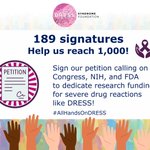
Have you signed our petition? ✍️
We’re urging the U.S. Congress, NIH, and FDA to dedicate research funding for better understanding of severe cutaneous adverse reactions (SCARs) like DRESS Syndrome.
To date, no dedicated research funding exists …
despite ongoing new cases of SCARs to existing and new medications.
despite the lives of patients and families forever changed as a result of SCARs.
despite a $150 million burden on the medical system each year from people developing these severe drug reactions.
We will not accept these outcomes.
Patients deserve to better understand the disease afflicting them. Families and caregivers deserve to know how to better navigate care for loved ones. Researchers deserve the funding they need to lead scientific understanding.
The time to act is now. Join us!
Sign our petition today: dresssyndromefoundation.org/…...
#AllHandsOnDRESS

Prof. Michael Ardern-Jones’ research is revealing what makes DRESS biologically distinct—and why better diagnostics and treatments require global collaboration.
We’re raising our hands for the investment needed to move this work forward.
#AllHandsOnDRESS #DRESSSyndrome

A message from our Scientific Advisor Dr. Elizabeth J. Phillips of Vanderbilt:
“No single lab, clinic, or patient can solve this alone. But together—all hands on DRESS—we will.”
#AllHandsOnDRESS #DRESSSyndrome
Today is National DRESS Syndrome Day. 💜
Awareness saves lives. The sooner DRESS is recognized, the sooner patients can receive the right care.
Today, patients, families, providers, and allies are raising their hands to spread awareness. Follow along as we share voices from around the world.
#AllHandsOnDRESS #NationalDRESSSyndromeDay #DRESSSyndrome

Join us tomorrow for National DRESS Syndrome Day. 💜
We’ll be sharing patient stories, research updates, and ways to take action—including our petition for dedicated federal research funding.
All Hands on DRESS starts July 16.
#AllHandsOnDRESS #NationalDRESSSyndromeDay

We're honored to be featured on the podcast, "Together Through It: Wisdom from Unexpected Journeys" with host Angela Paxton.
DRESS (Drug Reaction with Eosinophilia and Systemic Symptoms) is a life-threatening, immune-mediated drug reaction — and awareness saves lives.
In this conversation, our Founder and Executive Director Tasha Tolliver talks about why every case matters and shares part of her own family's story.
Remember: Medication + Fever + Rash = Suspect DRESS 💜
This Thursday is National DRESS Syndrome Day. Listen to the full episode, then join us for All Hands on DRESS — ow.ly/Yi0X50Zn6C1
Listen now: ow.ly/BM0a50Zn6BZ 🎧

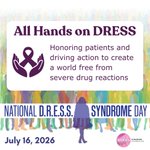
National DRESS Syndrome Day is July 16! 💜
Each year, we recognize this day worldwide to build awareness of DRESS Syndrome and honor patients who’ve experienced this severe drug reaction.
Our 2026 theme is "All Hands on DRESS” — and we’re driving action to better understand, and ultimately, prevent DRESS. 🙌
DRESS Syndrome and other similar severe drug reactions are under-researched and misunderstood.
To date, no dedicated funding stream exists in the National Institutes of Health (NIH) or the Food and Drug Administration (FDA) for research into severe cutaneous adverse reactions (SCARs), including DRESS and Stevens-Johnson Syndrome/Toxic Epidermal Necrolysis (SJS/TEN).
Our goal is to change this outcome. To do so, we need All Hands on DRESS!
You have various ways to get involved this year:
- Sign our petition urging Congress, NIH, and FDA to dedicated funding toward SCARs research ✍️
- Write a letter to your Congresspersons urging them to prioritize SCARs research funding (download our template) 🔬
- Raise your hand for DRESS and share a picture of video online as to why awareness matters to you ✋
And many other actions.
Learn more on our website! dresssyndromefoundation.org/…
#AllHandsOnDRESS #NationalDRESSSyndromeDay

ALT Graphic promoting National DRESS Syndrome Day on July 16, 2026, with a purple ribbon and hands symbol honoring patients and raising awareness of severe drug reactions.
🧵 Year after year, the same drugs keep showing up at the top of DRESS reports. In our registry. In the research. Worldwide.
Vancomycin. Bactrim/TMP-SMX. Carbamazepine. Minocycline. Allopurinol.
But many different medications can cause DRESS — no matter which drug was yours, your experience counts.
Awareness and early recognition matter more than ever. Your reported case is part of the proof.
📋 Register: surveymonkey.com/r/YVRD38H
#DRESSSyndrome #SCARs #PatientRegistry #DrugSafety #Pharmacovigilance

For some severe drug reactions, genetic screening can already help identify patients at increased risk before a medication is prescribed.
Can we do even better?
Encouraged to see research exploring new ways to identify risk before patients are harmed.
Read the paper summary:
ow.ly/3MTC50Z9cHC
Thank you, @Dr_AndrewGibson and collaborators at @MurdochUni, @VUMC, @Harvard Medical School, and @UIC.
#DRESSSyndrome #SCARs #DrugSafety #PrecisionMedicine

SCAR 2026: Stronger Together is a wrap!
What a powerful week sharing lived experiences of severe drug reactions alongside critical research on these diseases.
Thank you to Vanderbilt University Medical Center, Michelle Martin-Pozo, PhD, April O'Connor, Dr. Elizabeth Phillips, and team for your efforts organizing and bringing us all together!
We're grateful for the chance to share insights from our Register Your Case survey — self-reported data capturing the lived experiences of patients and their loved ones.
And we especially want to thank the patient community members who joined us in person as panelists:
- Meghan Garcia, mother of a pediatric DRESS survivor
- Amy Emberly, DRESS survivor
- Hayven Green, DRESS survivor
They each shared the critical perspective of living with DRESS Syndrome, from the difficulty of getting a diagnosis to long-term health effects and the gaps in navigating this complicated disease.
Their stories were powerful. Their presence even more so. Thank you for all you do to advocate for better treatment and deeper research. You and your voices matter.
Another shout-out goes to the SJS/TEN patient community and our friends at Stevens-Johnson Syndrome Canada and SJS Awareness Oregon. It was powerful being in the same room together and learning from your lived experiences of a different yet similar severe drug reaction.
And, a sincere thank you to every researcher and clinician working hard to better understand severe cutaneous adverse drug reactions (SCARs) and help patients. Your work is making a difference.
Here are highlights from the meeting:
- Dr. Dean Naisbitt offered an insightful framing of who's at risk — all of us carry HLA and T-cell receptors capable of engaging common culprit drugs, and TNF-α may play a role in who develops a reaction.
- Dr. Roni Dodiuk-Gad stressed the social and mental health impacts on patients and how collaboration and recognizing what we don’t yet know is critical for improved care.
- Dr. Annick Barbaud mapped the role of skin testing in informing drug causality and cross-reactivity in SCAR, including existing gaps and what consensus will require.
- Dr. Saskia Oro made the case for higher-resolution evidence on systemic steroids as the staple treatment and outlined recommended next steps.
- Anita Hanson introduced the "My SJS Passport" — a tool to support survivors after diagnosis, sparking discussion about a potential "My DRESS Passport." We look forward to seeing what develops.
- Dr. Elizabeth Phillips shared critical updates on genetic testing and SCAR, including HLA prediction, current gaps, and pathways to deeper patient support.
We continue to believe in a world where severe drug reactions are identifiable, treatable, and preventable. Meetings like this bring that vision one step closer.

ALT Large diverse group of people seated outdoors on chairs under string lights with trees and stadium in background.

ALT Group of seven people standing together in front of a screen displaying 'SCAR 2026: Stronger Together' at a conference venue.
The global meeting on DRESS Syndrome and SJS/TEN is next week!
Join us at SCAR 2026: Stronger Together in Nashville, TN, May 18 – 19, for a meaningful discussion about new research and insights on DRESS and severe adverse drug reactions.
We’re excited to have representatives from our patient community joining us for a panel on the lived experience of DRESS Syndrome!
Featuring:
- Meghan Garcia, mother of pediatric DRESS survivor based in Arizona, US – triggered by: sulfasalazine
- Amy Emberly, DRESS survivor based in Tennessee, US – triggered by: vancomycin
- Hayven Green, DRESS survivor based in New York, US – triggered by: minocycline
Registration is open until this Sunday, May 17. You can join in person or virtually.
Save your seat! medsites.vumc.org/cdsi/scar-…

D.R.E.S.S. Syndrome Foundation retweeted

🚨Primary Care Physicians 🚨 Join #DHS2026: Challenging Evidence 🧠💊
📍 Melbourne | 📅 23–25 Oct
✔️ Primary care–focused sessions
✔️ Practical skills and cases
✔️ Global experts + real-world insights
Bring #drugallergy #antibioticallergy knowledge and care into your practice.
👉 dhs2026.org/
@RACGP #GPeducation #PrimaryCare #CPD @TheDohertyInst @EAACI_HQ

The DRESS & SJS/TEN communities are heading to Nashville this May!
Join us at SCAR 2026: Stronger Together — a global meeting hosted by @VUMC, focused on severe drug hypersensitivity reactions.
May 18–19 | Nashville, TN
In-person + virtual
🔗 Registration: ow.ly/tazo50YJcXz
#SCAR2026 #DRESSSyndrome #SJSTEN #DrugReactions

Announcing SCAR 2026: Stronger Together!
The next global meeting on severe cutaneous adverse reactions (SCARs) is May 18 – 19, 2026, in Nashville, TN, USA. Attendees can join in-person or virtually.
The event is hosted by Vanderbilt University Medical Center (VUMC) and will bring together medical-research and patient communities for discussion on SCARs, including DRESS Syndrome and SJS/TEN.
We’re excited to host a panel along with Stevens-Johnson Syndrome Canada that will feature DRESS and SJS/TEN patients sharing their lived experiences with severe drug reactions.
Interested to learn more? Sign up to receive more information and registration details from VUMC at the link below.
Hope to see you there!
Sign up: surveymonkey.com/r/SCAR2026

ALT SCAR 2026 conference details with topics on steroids vs corticosteroid-sparing therapy, SCAR research gaps, and immunomodulatory drugs.