

PhD student @MIT in ML + robot learning | UC Berkeley EECS w/ Honors | Prev @nasa, @amazon, @berkeley_ai | Astronaut+Goldwater Scholar, NSF GRFP
Joined April 2019
- Tweets125
- Following507
- Followers1.1K
- Likes558



Crazy dexterity and high speeds unlocked through a VFA

@EkaRobotics has raised a $150M Series A.
Generality v/s Performance is the fundamental tension at the frontier of robotics. Generality without performance is just a prototype. Performance without generality is just a single-purpose tool.
Customers shouldn’t have to choose. Eka breaks the tradeoff. Powered by our Vision-Force-Action (VFA) model, we deliver the performance and versatility customers need to put robots to work every day.
Eka is built on three convictions:
⚡️Force is the language of manipulation.
🚀 Reinforcement learning is how dexterous manipulation scales.
🎂 System 1—fast, reliable physical execution—is the bottleneck to solve.
With this funding, we will scale our model and accelerate customer deployments.
Grateful to be building alongside a dream team and investors who share our ambition.
Training for blind manipulation pressures your policy to learn an intelligent "searching" mechanism in context!

Every robot already carries contact sensors: its own joints. When a robot touches something, its joints drift slightly off their commands, and the encoders pick it up. Legged robots and humanoids already leverage this signal to walk blind - but is it enough for blind precise assembly?
We find that it is! Our policies can insert pegs, mesh gears, and thread nuts using only the robot's joint positions - no camera, no tactile, and no object poses. And the peg policy works zero-shot in the real world! 🧵
w/ my amazing co-first author @younghyo_park, and advised by @kushalk_ and @pulkitology.
The humanoid sim2real goat dropped another banger, check it out!

(1/9) Same rewards. Less domain randomization. Higher jumps. Stable landings.
Just by improving the actuator model.
Introducing Contact-UAN: a residual world model for humanoids, learned from proprioception. No torque sensing or motion capture.
Project website: contact-uan.csail.mit.edu.
Crazy stuff: SGS + OmniReset on multi-task RL!

(1/6) From @GoogleDeepmind’s AlphaGo to AlphaZero, we saw machines find moves that reached beyond what we’d imagined for them. No one taught them those strategies. They emerged from reinforcement learning: playing, failing, and trying again under a single binary task reward for success or failure. Inspired by them, we couldn’t help but wonder: what might a robot discover if we gave it that same freedom to learn?
That question led us to AlphaNIST. Starting tabula rasa, with that same binary reward plus only a simple control cost, a single policy solves all 20 @NIST assembly tasks at a 98.2% success rate in simulation. More surprising still, AlphaNIST can complete 10 different tasks in a row, receiving that reward only once, after all 10 are done.
Just as AlphaGo’s strategies surprised its creators, AlphaNIST discovered dexterous strategies we couldn’t have come up with ourselves.
Paper: arxiv.org/abs/2610.13354
Website: alpha-nist.github.io
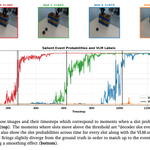
Nice idea to integrate memory supervision with policy training!

There’s lots of buzz around agentic harnesses for robots, particularly for long horizon tasks that require complex reasoning and memory. But what will it really take to turn a reasoning agent into a reactive, reliable and low-latency robot policy?
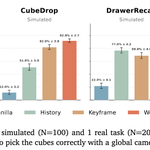
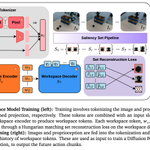
In our new paper, workspace models, we design a new memory architecture that acts as a latent harness for stronger reasoning models. Here’s why we think this might be the way forward:
(1/9)

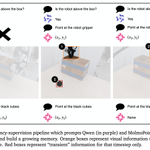
We emphasize that the training framework proposed in this paper can be extended to many capabilities outside memory as well! In particular, any useful computation identified by a reasoner can be amortized at train-time into a “latent harness” to support better control.
Here's an example on a real Franka robot!
(8/9)
Check out our ArXiv here: arxiv.org/abs/2609.20820
Huge shout out to @max_simchowitz @pulkitology @IdanShenfeld @JohnMarangola
Excited to see what folks can do with strong frontier models like Astra to deliberate on supervision for training reactive robot policies!
See y'all at #CoRL2026 !
(9/9)

Crazy awesome humanoid skills 🔥
Taking humanoid soccer out of the lab: no instrumentation, no controlled environment. Real fields, around people.
Trained in simulation. Deployed in reality.
No post-training. Just pre-training.
Dribbling. Passing. Turning. Scoring goals.
Work led by Avi, Khai, @nolan_fey along with @martinpeticco @JohnMarangola, and Venki.
Fascinating and inspiring idea as we begin thinking about very-long-context continual learning!

In-context continual learning requires models to accumulate experience and reuse it later in the same sequence. But an RNN compresses an ever-growing history into a fixed-size state, where each token gets a single write into memory.
We study dynamic compression: letting the model revisit the past and reorganize its state as it discovers what needs to be reused.

Cool application of SDFT!

Continual learning running on a phone.
Not inference. Not a fine-tune you kick off with a dataset. A small language model (SLM) that keeps learning from its own experience while it's being used, with every gradient step on the handset.
How it works (lin826.github.io/SLM-Online-…):

Great results from my even greater friend!

Excited to share SPD: simulation pre-training for dexterity. We pre-trained a policy in simulation and fine-tuned with less than 2 hours of real data (with @sarthakkamat)
Turns out using VLMs to guide exploration in prompt space can rapidly improve VLA performance!
