

agents @sierraplatform, prev: llms @otter_ai, cofounder @octane_security, bme+cs @dukeu, gene editing @stanfordmed
San Francisco, CA
Joined October 2019
- Tweets126
- Following841
- Followers189
- Likes5.2K




Pinned Tweet
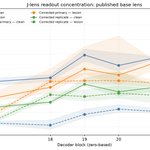
I've found early evidence of lesion-induced functional compensation in language models.
When a child loses a hemisphere to disease, the other one can rebuild much of their language from scratch.
Something similar happens inside a model trained with its J-space ablated.

Devin Shah retweeted

Locus sets the frontier for automating molecular design
Our automated research system Locus develops scientific AI models that outperform SOTA expert solutions
Unlocking the potential of scientific AI requires leveraging proprietary data. Locus achieves this autonomously 🧵👇
--
We test Locus across a number of tasks related to molecular scoring and design: training molecular property prediction models for a proprietary task, fine-tuning Boltz-2 to predict small-molecule potency, and building antibody design workflows around BoltzGen, Boltz-2, ESMC, and ESMFold2.
Each of these settings are real-world AI for science use cases, where tasks are often out-of-distribution for existing foundation models and limited in data, while featuring expensive and noisy evaluators. Compared to state-of-the-art baselines and LLM agents set to optimize these tasks, Locus achieves higher performance. Additionally, Locus generalizes better despite limited data, finds more sample efficient solutions, and explores a higher diversity of solutions.

Devin Shah retweeted

🚀 Introducing DeepInfer, our in-house inference framework, now fully open source!
Powering DeepSeek-V4.1-Flash at scale with high throughput and low latency. We’re sharing our production stack to help the community lower compute costs, reduce energy use, and make AI more affordable.
🔗 github.com/deepseek-ai/DeepI…
1/4


this is a huge step for our team, and our models are only getting better

Accuracy in transcription matters. If your notetaker gets details wrong, or you don’t identify the right speaker, it becomes impossible to drive automation after the meeting ends. That's why we're so excited that @otter_ai is now #1 in automatic speech recognition (ASR) on the @huggingface Open ASR Leaderboard! 🥇
ASR is the technology that turns spoken words into text, and it's the foundation of everything Otter does. Every summary, action item, and insight starts with getting those words right. That's why, unlike other AI notetakers, we built our speech recognition in-house. Owning the foundation lets us keep improving accuracy and build on top of it: searchable intelligence, automated action items, and agentic workflows that turn conversations into action.
The leaderboard is run independently by Hugging Face, with open evaluation code and data. It ranks more than 80 systems, and Otter is ahead of those from some of the biggest names in tech, including Microsoft, Zoom, NVIDIA, and IBM.
We helped define this category ten years ago, and we're not done raising the bar.
See the full leaderboard 👉 bit.ly/4yNePKx

5
227
Devin Shah retweeted

interpretability might be the most important scientific problem in the world right now, as I don't think we can solve alignment if we don't know what we're building. I think I have good news about it. I co-authored early work in mechanistic interpretability at OpenAI and came away pessimistic, because neural networks appeared to fold into arbitrary tangled knots. years later, I started openai's first large-scale automated interpretability project, finding about 2% of neurons legible with the primitive tools we had
with modern agentic tools and a much closer look, the picture looks totally different. the vast majority in models up to trillions of parameters are legible, and their circuits beautiful. many famous examples of tangled neurons turned out to be misunderstood. The roadblocks I expected mostly aren't there. I now think ambitious interpretability will be solved by the time we need it most, and possibly quite soon, as automated scientists keep improving. it may be a bitter lesson for interpretability: the simple thing, at absurd scale, works
already-clean.goodfire.com/

Devin Shah retweeted

Training large models with RL typically runs on a fixed homogeneous cluster of the latest accelerators for numerical stability and faster throughput. This throws away inference optimization work done for other vendors and generations, limits the capacity you can utilize, and is unnecessarily expensive.
So we trained a model on agentic coding tasks using fully asynchronous RL and mixed-precision, mixed-accelerator samplers. With off-policy correction, training stayed stable through convergence, on par with homogeneous samplers, at a lower cost.
Devin Shah retweeted

Drug discovery is where frontier AI can matter the most.
Today we're announcing @Chaidiscovery’s collaboration with @GSK, following a successful wet-lab evaluation of our models. Using Chai-3, @GSK found binders to every target tested.
AI is entering its proof-point phase.
i totally agree that these types of labs are the future of biotech. whether it is pesticides, personalized medicines, or even immunotherapies, having a quick verification loop is a good thing. though i still think there's some work to be done on making the lab more automated itself (inventory management, pipetting, transport, etc). i believe a company tackling lab automation will also be big winners here, dm me if ur building in this space!

We built an 8000 sqft. high-throughput wet-lab in 30 days, to solve molecular discovery - starting with pesticides.
Most teams in drug-discovery don’t receive target-organism verification until clinical trials. Pesticides allow us to rapidly validate our model in the target organism directly. With the help of our high-throughput lab, we were able to generate compounds that killed a $13 billion pest, the Fall Armyworm.
We believe that the bitter lesson is coming for biology.
1
6
566
Devin Shah retweeted

After six years in stealth, Atomic Machines is out. Our mission: on-demand, universal command of matter. First beachhead: the Matter Compiler, an AI-native manufacturing system that builds working micro-machines from code alone. No per-product tooling. No process development. Different code, different machine.
I see this happening with bio as well (serving both experimental bio and patients).
Large scale labs can expose an API, models can submit experimental configurations, and experiments run in the background in an automated lab (you can pay for reserved capacity which locks resources and machines, or on-demand experiments which queue up). C5R is a step in this direction. A sort of bio neocloud.
That same firm can expose APIs for running patient tests (e.g. blood work) and handling secure sample delivery and results. Specialized labs don't have the ability to quickly reinvent their interface to communicate with personal agents.

OK, here's the future of manufacturing in the US. This is how we will Reindustrialize.
- MCP servers become standardized and as ubiquitous as web pages
- MCP servers fully define shop capabilities, materials, etc.
- Every shop has an owned API that provides real-time, first principles, shop-specific DFM, prices, and lead-times
- AI agents design and source by searching for shops with the right combination of capability, speed, and price
Because all of the above requires savvy most legacy shops don't have, they either fade away or pivot. There will be fewer shops, and they'll be at billion-dollar scale.
This will be an ultra-connected, automated, agent-friendly network of shops. It will completely eliminate the need for brokers and marketplaces - the marketplace is the internet, and information is distributed uniformly via MCP and imminently discoverable by AI agents, who handle almost all sourcing and, eventually, design.
Every design becomes manufacturable by default. Prototyping and production speeds skyrocket. Economies of scale reduce costs as a smaller subset of extremely large shops aggregate enough volume to create meaningful efficiency.
This future is created by the organic, inevitable evolution of information-dense MCP servers and the AI agents that use them. Shops that don't have them become irrelevant, and demand concentrates among the shops that do.
This doesn't require new software, or new marketplaces, or shop-to-shop collaboration tools. Not even a little. It requires 1) maturation of agentic physical design, and 2) a small number of highly competent direct manufacturers who lean in and serve this new ecosystem as it develops.
1
4
430
Devin Shah retweeted

🧵 Biohub, @ENERGY, @NIH, and new funding partners today announced a major expansion of an international effort to generate and make accessible the data enabling predictive AI models of biology. Together, the organizations are investing $1.8 billion in funding, data, computation and new measurement technology - largest coordinated commitment to map the biology of the cell to power development of digital models of biology. bit.ly/3UhjoxD

Devin Shah retweeted

How fast is AI's research taste improving?
We find that the experimental research taste of frontier models has doubled every ~3 months since December 2025. The best model, Opus 5.5, now exceeds our expert human baseline. Our human experts are experienced researchers, but most haven’t worked at a frontier lab.
Why measure research taste? In the AI Futures Model, it largely determines how quickly artificial superintelligence is reached once coding is fully automated.

Devin Shah retweeted

DeepGEMM Ascend is now open source.
We achieved 99.8% of the hardware limit on GEMM and 98% on MegaMoE.
github.com/deepseek-ai/DeepG…

Devin Shah retweeted

This bad boy is gonna fit so many sandboxes in it
Beautiful piece of technology




Devin Shah retweeted

In 12 weeks, we built a research facility that is run entirely by AI.
AI designs, executes, and observes experiments end-to-end across biology, chemistry, and materials science.
We’re introducing SciUniverse: a benchmark that measures AI’s ability to do real-world scientific research.
very cool result! i'm very excited to accelerate biotech progress

Claude has discovered a previously unknown enzyme system hidden in the DNA of bacteriophages. Beside the enzyme’s gene sits a long array of repeating DNA—a structure that looks somewhat similar to CRISPR.
We don’t yet understand what this system does, but only a handful of known systems share its features, and all of them are able to cut, copy, and paste DNA. Historically, the discovery of such programmable systems has helped revolutionize medicine. CRISPR, for instance, is now the foundation of genetic medicines. But it will take much more work to learn what this system does, and whether it can be put to similar use.
Read more: anthropic.com/news/claude-di…

1
1
573
actually huge, both models are great

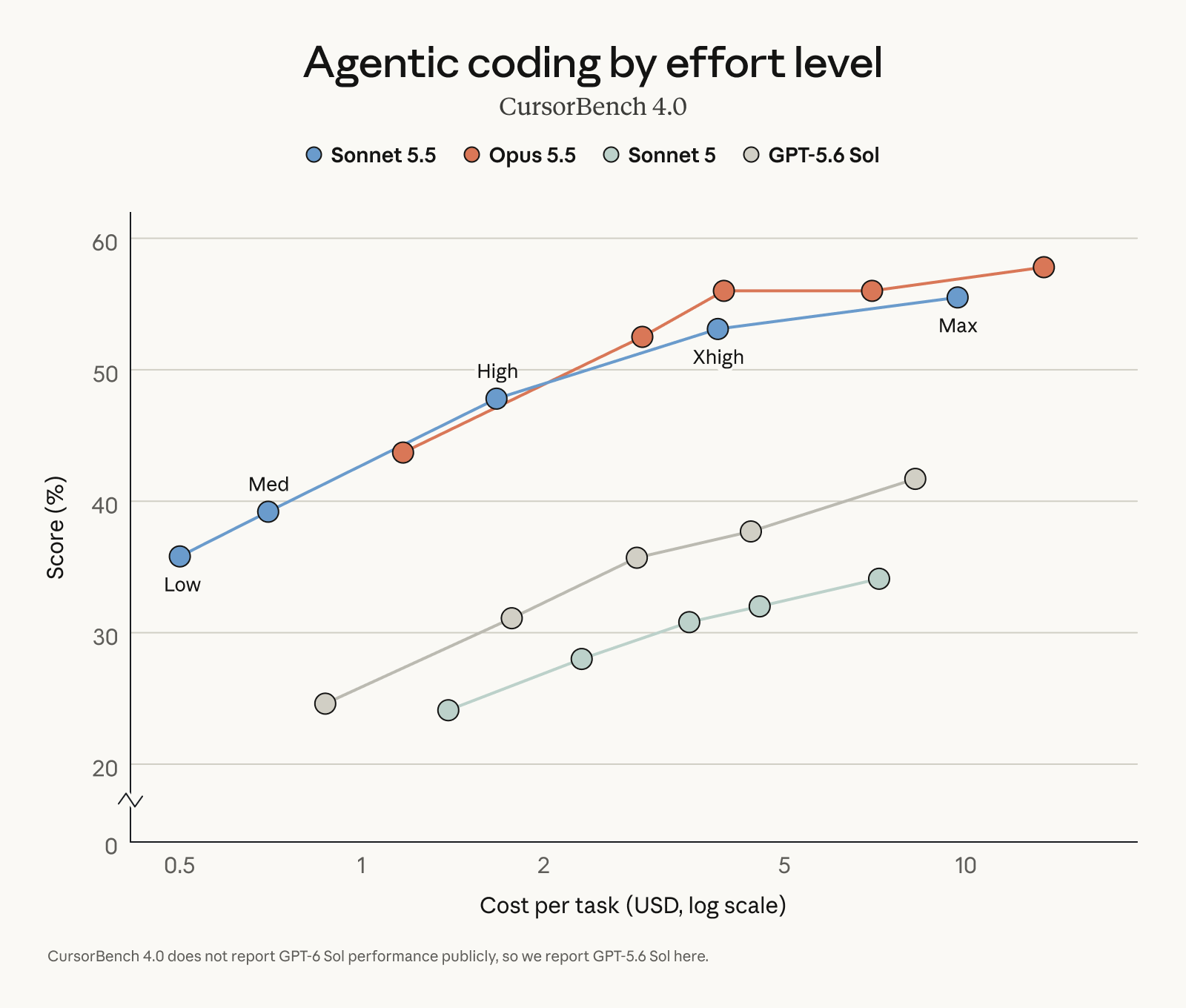
welcome Sol and Luna to the GPT-6 family! better than GPT-5.6, and 50% cheaper too thanks to improvements in caching and inference openai.com/index/introducing…

1
207