Dillon Brout (@DillonBrout) header
Dillon Brout (@DillonBrout) profile picture

Assistant Professor of Astronomy and Physics at Boston University. aka “the Saxtrophysicist”. Measuring the acceleration of the universe with Supernovae

Boston, MA
Joined December 2010
Photo by Dillon Brout (@DillonBrout)Photo by Dillon Brout (@DillonBrout)Photo by Dillon Brout (@DillonBrout)Photo by Dillon Brout (@DillonBrout)Photo by Dillon Brout (@DillonBrout)Photo by Dillon Brout (@DillonBrout)Photo by Dillon Brout (@DillonBrout)Photo by Dillon Brout (@DillonBrout)Photo by Dillon Brout (@DillonBrout)Photo by Dillon Brout (@DillonBrout)
I can’t believe this happened! Bucket list ✅! My late cousin and my inspiration Robert Brout and I were both cited in the same paper! arxiv.org/pdf/2103.01183 @EleonoraDiVal @lucavisinelli @ULBSciences @pennphys @CenterForAstro @theDESurvey 1/8
1
2
22
Let’s go!
Hey! ICYMI It's been almost a month since Roman's launch and the observatory is currently on its way to L2, a million miles from earth. Stay up to date on the mission here: science.nasa.gov/blogs/roman…
1
78
1/ With NASA's Roman Space Telescope launch 🚀 in T-20 days and our official team jerseys in hand, this is the perfect timing to congratulate my PhD student, @rujutapurohit, on her first-first author paper 🎉 Paper: arxiv.org/abs/2607.08886 Roman Hype: teapaw.org/nasa/status/2082526878…
LIVE: In one month, @NASARoman will lift off to help us study some of the greatest mysteries in the universe! Tune in as NASA experts give an overview of the mission and its status. teapaw.org/i/broadcasts/1qxvvvQRL…
1
1
6
657
2/ Rujuta is tackling the first of several of the subtle instrumental effects that Roman Supernova cosmology will need to understand at the sub-percent level if we want to make precision measurements of dark matter and dark energy.
1
3
83
Really excited to be a part of this!
LIVE: With @NASAGoddard’s largest clean room as a backdrop, experts provide an update about the recently-completed @NASARoman Space Telescope. teapaw.org/i/broadcasts/1dJrPEbvO…
1
6
250
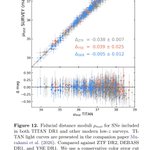
Announcing a new collaboration called TITAN: Type Ia supernova Trove from ATLAS in the Nearby Universe ~3000 cosmology-grade SNIa below z<0.1 in DR1 and here we present preliminary calibration arxiv.org/pdf/2512.21903 More DR1 papers coming! BU, UHawaii, Oxford, JHU - Collab
1
2
8
498
Really impressive work by Eli Marlin and Yukei Murakami. They validate the ATLAS telescopes and reference catalogs with the exquisitely uniform DES catalog and find excellent agreement.
1
54
After 4+ years of data collection and processing and we’re excited to finally announce our new southern hemisphere low redshift supernova survey called DEBASS! Papers on survey overview, data quality, and forecasts: arxiv.org/abs/2508.10878 arxiv.org/pdf/2508.10877 A 🧵
1
4
150
We set out to build the highest quality low-z dataset for cosmology with an eye on exquisite control of systematic uncertainties. For this reason, we use DECam, the same camera used for the Dark Energy Survey supernova dataset of ~1700 high-z supernovae.
1
32
Congratulations to the LSST Team on the beginning on “the greatest movie of all time”. Proud to be a guest here speaking at the Harvard watch party and got my hands on a special edition US minted Vera Rubin Dark Matter quarter!
Introducing...your sneak peek at the cosmos captured by @NSF–@doescience Vera C. Rubin Observatory! Can you guess what regions of sky they are? This is just a peek...join us at 11am US EDT for your full First Look at how Rubin will #CaptureTheCosmos! ls.st/rubin-first-look-lives…
1
9
416
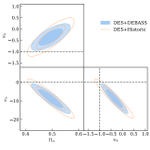
So excited for my grad student TZ's 1st paper (and 1st of the Brout BU group)! We were able to unite some of the "tensions" in cosmology along a single axis. In a time where it seems tensions are popping up everywhere, this was a refreshing result! arxiv.org/abs/2412.04430 a 🧵
2
6
17
901
There are three interesting anomalies that have come up since the recent uncalibrated DESY5 Supernova (SNe) and DESI Y1 BAO results. 1) The observed values of the matter density (OmegaM) in LCDM are not in excellent agreement (~3 sigma discrepant) across SNe, BAO, and CMB.
1
2
3
130
Happy 100th anniversary to the discovery of our neighboring “Island Universes”!
7
1
29
3,174
Just got asked about this new paper (2411.05642) that says blue dust-less SNe give lower H0 than redder SNe. Splitting up samples by color is an interesting null test and it looks to me like the data passes. A thread.
1
2
12
1,114
Here is the main figure fitting H0 in bins of SN color (they are correctly careful to do this for both calibrators and Hubble flow). The bluest point is 1.3 sigma below the mean for all SNe, which the authors suggest might indicate a dust-related solution to the Hubble tension
1
132
Had a really wonderful chat with @iraflatow on Science Friday @scifri about Dark Energy and the recent BAO and Supernova Results! You can hear it broadcasted today (May 17th) around ~2:30pm on 500 different public radio stations across the country. sciencefriday.com/about/stat…
Today on #SciFri 📻
3
1
11
3,629
Great summary of inflation and I appreciate the Robert Brout shoutout @StartsWithABang !
1
1
4
637
A really nice chat with @monisharavis about the recent @theDESurvey results for dark energy and dark matter. We also discussed the future of @VRubinObs @LSSTDESC which will be a complete game changer!
2
9
1,580
An even more detailed thread on our latest result with some really awesome graphics by my co-lead @MariaVincenzi7
Big news! We published the results from the Dark Energy Survey Supernova (SN) Program! We relied on a special type of Supernovae 🎇-the Type 1a– to better understand what is causing our Universe to expand faster and faster🏎.. arxiv.org/abs/2401.02929 arxiv.org/abs/2401.02945 🧵1/8
1
7
428
Today we have released the major result for measurements of Dark Energy and Dark Matter using Type Ia Supernovae in the Dark Energy Survey (@theDESurvey)! We've been working towards this robust result for more than a decade arxiv.org/abs/2401.02929 arxiv.org/abs/2401.02945 a🧵
2
22
2
73
5,802
Using Type Ia Supernovae as distance indicators by comparing their relative brightnesses, we're able to constrain the expansion and acceleration of our universe as a whole. This has required collecting as many supernovae (>1500) on the most precisely calibrated camera possible.
1
7
223
PSA: While this @drbecky_ video is a really great explainer, it is important to note that our Pantheon+/SH0ES analysis *already does* include peculiar velocity corrections! So the effect is even smaller than the paper states...
1
1
1
441
This remains true for the @PBSSpaceTime video as well!
109
We have a data science related TT faculty job opening in Physics as well! If you do heavy ML in your work, you are encouraged to apply! – at Cambridge, MA
ICYMI @BU_CDS is recruiting a cluster of 8 new faculty members pursuing Foundational, Methodological, and Use-inspired #AI research, in collaboration with 6 other academic units @BU_Tweets. Check our @AcademicJobs ad on @CRAtweets and spread the word! cra.org/job/boston-universit…
1
2
598
Truly incredible to think about how much humanity has learned in the last 100 years!
Replying to @carnegiescience
In fact, the discovery that the universe exists beyond our own Milky Way happened on the 100-inch Hooker telescope at @MtWilsonObs 100 years ago next week.
2
3
9
1,354