

Providing free and confidential Protection and Advocacy services statewide to people with disabilities for 40 years. Call 800-342-0823 to request assistance.
- Tweets9.8K
- Following1.8K
- Followers2.9K
- Likes7.1K



ALT Flyer for Disability Rights Florida’s paid communications internship. Large headline reads “Make Content That Counts.” The flyer lists: paid communications internship, create graphics, plan social posts, explore accessible digital storytelling, $20 an hour, remote or hybrid, 10 to 15 hours a week, for students at Florida colleges and universities, and apply by November 6, 2026. Contact email is [email protected].

ALT Disability Rights Florida graphic about early voting. On the right, a smiling Black woman with braided hair uses a red rollator walker inside a voting location. Large torn-paper text on the left reads, “Your Right: Early Voting Is Underway.” A smaller note says, “Early voting dates can vary by county. Check with your county Supervisor of Elections.” Disability Rights Florida and VOTE! logos appear across the bottom.

ALT Disability Rights Florida graphic for the second U.S. v. Florida Listening Session. A young person wearing a pink shirt sits in a wheelchair while an adult stands closely beside them. Large text reads, “Share your experience with DRF.” The session is for Florida families of children and young adults under 21 with complex medical needs. Session 2 is Wednesday, October 14, from noon to 2 p.m. ET. Registration link is in the comments. Disability Rights Florida logo appears at the bottom.

ALT Disability Rights Florida voting graphic titled “3 Voting Rights You Should Know.” The three rights listed are: vote privately and independently, accessible voting equipment, and assistance if you need it. On the right, a woman stands at a voting location holding a paper ballot. A yellow note says, “Swipe to learn more.”

ALT Disability Rights Florida graphic about the right to vote privately and independently. Text reads, “Accessible voting systems should support your ability to mark and cast your ballot with privacy and independence.” Illustrations show a lock symbol and a ballot being placed into a ballot box.

ALT Disability Rights Florida graphic about accessible voting equipment. Text reads, “Polling places must be accessible, and at least one accessible voting system must be available.” An illustration shows an accessible voting machine with a touchscreen, audio symbol, and control pad.

ALT Disability Rights Florida graphic about assistance while voting. Text reads, “You can receive help with voting if you need it. The person helping you does not get to make your choices for you.” An illustration shows a ballot box and a symbol of one person assisting another.

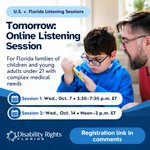
ALT Disability Rights Florida graphic for U.S. v. Florida Listening Sessions. A young person wearing glasses and a blue sweatshirt looks at a device while an adult sits beside them. Large text reads: “Tomorrow: Online Listening Session.” The sessions are for Florida families of children and young adults under 21 with complex medical needs. Session 1 is Wednesday, October 7, from 5:30 to 7:30 p.m. ET. Session 2 is Wednesday, October 14, from noon to 2 p.m. ET. Registration link is in the comments. Disability Rights Florida logo appears at the bottom.

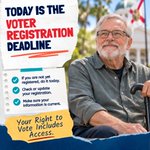
ALT Vertical Disability Rights Florida graphic about Florida’s 2026 voter registration deadline. Large text on the left reads, “Today is the Voter Registration Deadline.” A checklist below says, “If you are not yet registered, do it today,” “Check or update your registration,” and “Make sure your information is current.” A yellow note reads, “Your Right to Vote Includes Access.” On the right, an older white man with glasses and a white beard holds a cane. Palm trees, a government building, and a Florida flag appear in the background. Disability Rights Florida and VOTE! logos appear across the bottom.

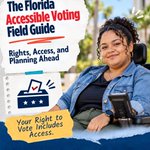
ALT Vertical Disability Rights Florida graphic promoting The Florida Accessible Voting Field Guide. On the left, torn-paper-style panels read “Voting,” “The Florida Accessible Voting Field Guide,” and “Rights, Access, and Planning Ahead.” A ballot box illustration appears below. A yellow note reads, “Your Right to Vote Includes Access.” On the right, a smiling woman with a disability sits in a customized power wheelchair outdoors. The Disability Rights Florida and VOTE! logos appear across a dark blue footer.

ALT Graphic promoting Florida’s voter registration deadline. On the left, large navy text reads “Voter Registration Deadline,” followed by “Florida General Election” and a calendar graphic showing October 5, 2026. Below it reads, “Check your registration before the deadline” and “Your Right to Vote Includes Access.” On the right, a Black woman with long locs stands outdoors holding a phone and folder and using a forearm crutch. Disability Rights Florida and VOTE! logos appear across the bottom.

ALT Graphic for U.S. v. Florida listening sessions. A mother smiles at a child using adaptive seating. Text says DRF wants to hear from Florida families of children and young adults under 21 with complex medical needs who rely on private duty nursing or other in-home care. Online sessions are Oct. 7 and Oct. 14.

ALT Blue underwater graphic for a Disability Deep Dive special episode, with coral along the sides. Text reads “Live from The Family Café 2026” and “8 conversations, resources, rights, community.”

ALT Olmstead Voices graphic featuring John Collins, a man wearing glasses and a dark shirt. Headline reads, “John wanted a home of his own and more choice over who supported him.” Text explains that John spent years in foster and group homes before moving into an apartment with waiver services. His goal was to own his home and have greater control over his care.

ALT Olmstead Voices graphic titled “His Story.” Headline reads, “Finding the right place to live took time.” Text explains that John has cerebral palsy, uses an electric wheelchair, and needs physical assistance with personal care. After living in a foster home and several group homes, waiver services helped him move into an apartment and live more independently.

ALT Olmstead Voices graphic titled “His Story.” Headline reads, “John wanted more control over his home and his support.” Text explains that John applied for a mortgage, was approved, and now owns his home. Through Florida’s self-directed CDC+ program, he can arrange his personal care support and has had a stable caregiver for the past 13 years.

ALT Olmstead Voices graphic titled “Why it matters.” Headline reads, “Olmstead is about choice in where and how you live.” Text explains that for John, community living means owning his home, choosing how his support is arranged, and sharing his life with his wife. His story shows how community-based services can support greater choice, stability, and control over everyday life.

ALT Olmstead Voices graphic featuring Robert, a man wearing a light-colored shirt. Headline reads, “He was once told an institution was his future. He built a life in the community instead.” Text explains that Robert found opportunities to learn, work, live independently, and become part of his community.

ALT Olmstead Voices graphic titled “His Story.” Headline reads, “Robert grew up with opportunities to be part of his community.” Text explains that after leaving an institution, Robert lived at home and participated in community programs. As an adult, he received Social Security benefits and continued building skills and experiences outside an institutional setting.

ALT Olmstead Voices graphic titled “His Story.” Headline reads, “Community-based support helped Robert build an independent adult life.” Text explains that a Home and Community-Based Services waiver helped Robert move from his family home into an apartment with a roommate. He worked for many years and now continues living independently with support and volunteering at his church.

ALT Olmstead Voices graphic titled “Why it matters.” Headline reads, “Olmstead is about having the opportunity to build a life in the community.” Text explains that Robert’s access to community-based services and support has helped him have a home, work, volunteer, and remain part of his community.

ALT Cover slide with the heading “Legal Update.” Large text reads “Texas v. Kennedy.” Below, three bullet points read: “What changed,” “What it means,” and “What comes next.” A simple illustration shows a gavel next to a legal document. At the bottom, a green footer reads, “Rights matter. Community matters.” with the Disability Rights Florida logo.

ALT Slide heading reads “What happened?” Four bullet points explain: On September 23, 2026, the judge signed a final order. The court removed parts of the 2024 Section 504 rule about community living. The change applies across the country. The case is now closed. On the right is an illustration of a legal document and a gavel. A footer reads, “Rights matter. Community matters.” with the Disability Rights Florida logo.

ALT Slide heading reads “What does this mean?” Three bullet points explain: The removed parts said services should support people with disabilities in community settings when appropriate. Removing that language is a setback. It may affect how protections for community living are explained and enforced. On the right is an illustration of a small house, trees, a bench, and nearby buildings. A footer reads, “Rights matter. Community matters.” with the Disability Rights Florida logo.

ALT Slide heading reads “What did not change?” Four bullet points explain: Section 504 is still the law. The Americans with Disabilities Act is still the law. The Supreme Court’s Olmstead decision still stands. The court did not say rights to community living are unconstitutional. On the right is an illustration of a blue law book and a green shield with scales of justice. A footer reads, “Rights matter. Community matters.” with the Disability Rights Florida logo.

ALT Olmstead Voices graphic featuring Amanda, a woman seated and smiling at the camera. A quote reads, “Being able to help others and contribute to my community is very important to me.” Text explains that Amanda lives in her own apartment, works full-time, and uses home and community-based services that help make that possible.

ALT Olmstead Voices graphic titled “Her Story.” Headline reads, “I love being able to work.” Text explains that personal care attendants help Amanda with bathing, dressing, getting in and out of her wheelchair, preparing meals, cleaning, and other daily needs. This support also helps her get ready for work and continue living in her own home.

ALT Olmstead Voices graphic titled “Her Story.” Quote reads, “I love to go to concerts, and I love to go on trips.” Text explains that community living is about more than work or housing. For Amanda, it also includes friendships, travel, concerts, and enjoying the things that matter to her.

ALT Olmstead Voices graphic titled “Why it matters.” Headline reads, “Olmstead is about having the chance to be part of your community.” Text explains that Amanda works full-time supporting other people with disabilities and that community-based services help her work, live in her own apartment, and contribute to her community.