

builder, ai, markets, and general data nerd | https://teapaw.org/t.co/zs1Hb6u5e0
In the lab 🧪
Joined March 2025
- Tweets20.3K
- Following1.3K
- Followers1.6K
- Likes18.8K



Pinned Tweet
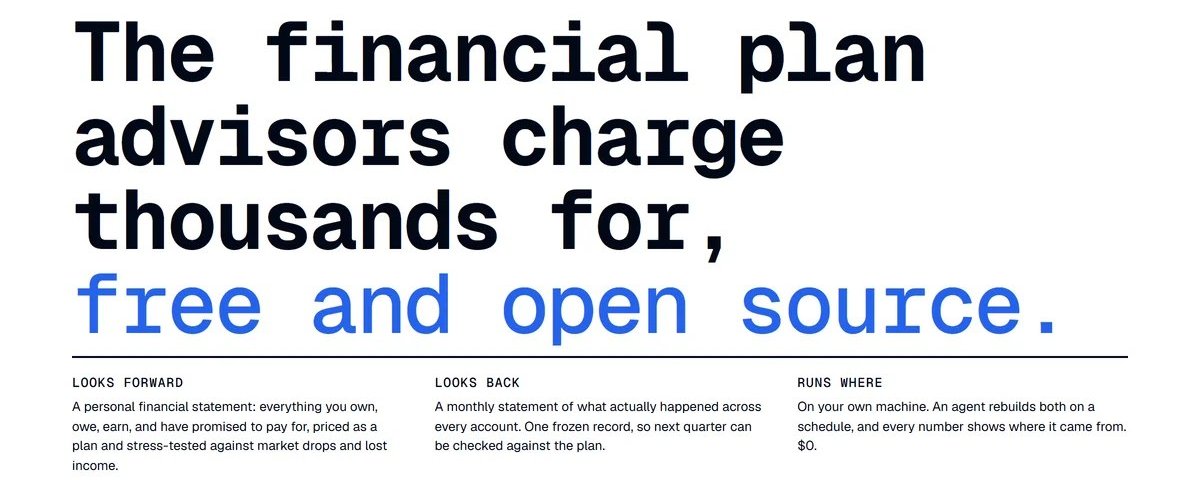
Foliome now prices every goal in your household's plan and gives you everything you need to monitor and manage your wealth. Not just another dashbaord. Open source, runs on your machine.

Most startups build first and look for customers later. Prospecting gets pushed back because it means another tool, another subscription and a list you have to clean.
@composio now enables you to run people search inside the agent you already use, and you pay per search with no plan to sign up for.
Tell it who you're building for. It comes back with companies that actually have the problem, so the feedback you hear comes from people who'd use the thing. It finds the person who owns the budget, so a yes means someone would pay for it. And it all lands in a sheet for about 32 cents per 20 leads, which makes outreach a ten-minute job you can start this morning. Their replies start shaping what you build next.
🤝 Paid partnership

Introducing people search for Fable
- find leads for cents
- get and verify their work emails
- pay per use across Apollo, Clay, Firecrawl and more
composio.dev/instant/people-…
start with up to 70 verified leads for free
2
64
I built a voice keyboard on a Raspberry Pi, and it worked. I talk, and the words land wherever my cursor is. Building it convinced me the future of AI is something you own.
Interface puts that on your hand, in a $99 stainless-steel ring. I don't think people realize yet how much AI hardware can change an ordinary day.
Put the phone down and talk to the ring. Capture the idea you get on your commute without taking your hands off the wheel. Have real meetings and have the insights served to you when people leave. Knock out emails by talking instead of slogging through Outlook.
And it goes past typing. Press and hold, say what you need, and the ring hands it to the agents you already use, like Claude or ChatGPT. The work happens on your devices while you keep moving.
Pre-order yours now.
🤝 Paid partnership

3
239
Gemini 4 Carbon is live in the API at $2/$10 per million tokens, the same introductory rate as Argon. It spends more tokens reasoning and verifying, so its cost per task will likely land above what that sticker implies.
Argon's $1.99 per task moves to near $4 when its rate doubles on November 30, against Astra's roughly $3.30. If Carbon's introductory rate follows the same schedule, a heavier reasoner could start from a higher base than Argon did.
The missing Carbon rate card was the open question in my earlier post. It's now posted, and it carries the word "introductory.


Google's frontier lead lasted two weeks.
Gemini 4 Carbon scores 59 on the Artificial Analysis Index, ahead of Opus 5.5 at 58 and GPT-6 Astra at 57. Argon, which only tied Astra, is no longer Google's best model.
I laid out Argon's pricing in October. $2/$10 per million tokens doubles on November 30, which moves its $1.99 per task to near $4, against Astra's roughly $3.30.
No Carbon pricing has been posted yet. Anyone budgeting around Argon's 95% cache-read discount should wait for Carbon's rate card first.

1
64
Goldman's 2030 forecast puts Anthropic at $600B of annual revenue. A $2T valuation sits at 435x the $4.6B booked in 2025, so this is the revenue figure the price has been waiting on.
Holding a 33x multiple, $2T only needed about $60B of revenue, 13x 2025. Goldman's forecast clears that by a wide margin, but only by 2030.
Goldman also doesn't expect positive free cash flow until that same year.

435x revenue.
On the post's numbers, $2T against $4.6B of 2025 revenue is about 435x. The $150B analyst figure works out to roughly 33x, which is already rich for a company losing $42B.
Holding that 33x multiple, a $2T valuation needs about $60B in revenue, 13x what Anthropic booked in 2025.
57
If you're trying to make any kind of money for your products, this one's for you.
loglogai built a simulated X ad market, handed 14 AI agents the same 45 small-business briefs with budgets from $100 to $2,700, and scored every run on purchases.
The winner was a small open model, DeepSeek Flash, fine-tuned on 312 campaigns run by experts. Where a simple scripted campaign brought in 100 sales, it brought in 131. Grok, running ads on X's own product, brought in 109. Then they took it live: $200 of real spend bought 383 relevant site visits with Yvligo and 123 with Grok.
What it learned is how to actually run a budget: pausing the ad that pulls clicks and zero sales, moving spend to the version people buy from, and pacing money across the campaign. One pass over 312 examples taught all of that, at $0.40 a run. That puts a competent media buyer within reach of the smallest accounts on the platform, the ones no agency will take.
Weights, traces and the simulator are all MIT-licensed. The team says the live runs came back messier than the sim in places, and they fed those gaps back into the simulator.

Meet Yvligo, our open-weights model for running X ads.
(3x better than Grok 4.7)
At loglog.ai, we built an X simulation and post-trained DeepSeek V4.1 Flash, outperforming frontier models
Live results:
Yvligo: 383 relevant website visits for $200
Grok: 123 visits
57
Publishing the eval and training data with the weights also hands everyone the recipe. At 53M tokens, it's cheap to run the same fine-tune with a different rubric, so the values sitting one fine-tune away cuts both ways.

Introducing Arete-27B: Qwen3.8-27B, post-trained to reinforce Western values.
Chinese open models are currently the strongest available, but they ship with state-aligned behavior in the weights. We built an 803-prompt eval across seven value categories, including freedom of expression, democracy, and privacy, and measured how often a model adopts China’s party line.
After fine-tuning on roughly 53 million tokens, Arete-27B's propaganda rate fell from 22% to 1%, in line with the Western models we tested. Its Hermes Bench score shows no significant performance tradeoffs.
The values in an open model are one fine-tune away.
Our eval, weights, and training data are available now along with the full blog post: nousresearch.com/arete
1
117
The S&P fell 4.4% and the Nasdaq 5.5% in a day while corporate profits are still growing about 20% YoY. Earnings didn't change overnight, so the selling looks like positioning rather than a reassessment of fundamentals.
UBS says trend-following quant funds are still heavily exposed to equities and may need to cut more. A fund forced to reduce risk sells what is liquid, so a bounce in thin futures can fade without any new news.
This fits the 75-day unwind of an 18-month AI build-up we mapped in October. Positions that took that long to build don't exit in one session, and assets with zero AI exposure could keep taking losses while the index looks calm.

75 days to unwind 18 months.
AI positions built over 18 months are coming out in 75 days while corporate profits still grow ~20% YoY and the S&P 500 barely moves. Earnings are intact. The selling comes from fund balance sheets.
Leveraged funds under pressure sell whatever is liquid, which would explain the spread into credit, multistrats and European bonds. Assets with zero AI exposure could take losses while the index looks calm.
2
77
The Nasdaq is in correction territory, and the question that decides how bad it gets is where the debt sits. Anthropic alone carries $437.4B of compute commitments owed whether the capacity gets used or not, plus another $226.4B that can be canceled.
Contracts with Google ($121.3B) or Microsoft ($44.9B) land on balance sheets that can absorb a miss. Contracts with Nscale ($44.6B) and Lambda ($41.3B) depend on how those builders financed the buildout. If that was SPVs and private credit sold on to pension funds, a demand miss stops being a tech correction.
I mapped the healthy-versus-destructive split in April.
dodatathings.dev/blog/ai-cap…

Two economists, same zero.
Apollo's chief economist now says AI has delivered "zero payoff" to corporate America outside Big Tech. Goldman's chief economist said something similar about the macro numbers: AI added basically zero to 2025 US GDP growth.
The mechanism is accounting. About 75% of a data center's cost is imported parts, so GPU spending lands as imports and subtracts from GDP. I wrote up that math in April.
If both hold, Big Tech's own earnings are the only place the return on this capex can show up.
dodatathings.dev/blog/ai-cap…

49
Anthropic's compute commitments now have a vendor ledger: $664B, led by Broadcom at $161.2B, Google at $121.3B, SpaceX at $120.5B and Amazon at $110.0B. $437.4B of it is owed whether it's used or not.
That is what answered the White House's April objection that serving 120 enterprises would degrade federal access. The 5 GW from AWS and the 5 GW of TPU through Google and Broadcom, named in the Series H, were the capacity answer. I wrote up that logic in June.
The disclosure shows the price of that answer. A capacity risk became a utilization risk, because idle chips cost the same as busy ones across the $437.4B. Only $226.4B of the total can flex if demand comes in short.
dodatathings.dev/blog/boomer…

Capacity came with a bill.
The draft S-1 prices the capacity behind Anthropic's $965B round: about $450B in cloud commitments over seven to ten years, mostly noncancelable, with up to $750B of total compute spend ahead. The first half of 2026 closed with an $80.7B net loss.
I wrote up the supply side in June. The 5 GW from AWS and 5 GW of TPU answered the White House's federal-access objection. The $65B raise covers only a fraction of that capacity's cost, so the rest has to come from revenue, which went from $1.1B to $16.3B in one half-year.
dodatathings.dev/blog/boomer…

1
2
105
$11 for 220k posts works out to $0.00005 each. X's official API lists $0.005 a post, so that's a 100x gap.
At that rate a million-post sentiment study costs about $50 instead of $5,000. Brand tracking and market-sentiment work that only funded teams could afford becomes a side project for one analyst.
A gap that wide under X's own list price gives the platform a reason to tighten access, which could reprice this overnight.

Jev @typesafeai spent $11 analyzing 220k social posts using @treg_ai
This would otherwise cost $1,200 using twitter official API ($0.005 per post)
1
58
Kimi K3.1 Pro's 2.8T weights are on HuggingFace. Only 104B parameters fire per token, but all 2.8T have to sit in memory. It ships at 4-bit, which avoids the 5.6TB a 16-bit copy would need and keeps self-hosting at a rack of GPUs.
I laid out that compute-versus-memory split ahead of the Nov 4 drop.
The 65% hallucination drop on finance modeling is still a vendor number with no stated baseline. Funds and banks that can't send positions to an outside API can now run their own eval on their own spreadsheets and see whether it holds.

Open weights at 2.8T.
Only 104B parameters fire per token, about 3.7%. Compute per query follows the active count, but memory follows the full 2.8T, so self-hosting takes a rack of GPUs.
The 65% hallucination drop on finance modeling is a vendor number with no baseline stated. Once weights land Nov 4, funds and banks that can't send positions to an outside API can run their own eval on their own spreadsheets, inside their own walls.
1
47
Kimi K3.1 Pro's weights are on HuggingFace, the release that was due Nov 4. It ships natively at 4-bit, which avoids the 5.6TB a 16-bit copy of a 2.8T model would need.
That turns the gap I priced in October into a real procurement question: 55 on the Artificial Analysis index against Claude Opus 5.5's 58, with 104B parameters active per token. The ~10M tokens/day self-hosting breakeven can now be run against actual serving hardware.
It also ships under a custom "Kimi K3.1 Pro" License, so legal has something new to read before finance finishes the spreadsheet.

Open weights are about to rank 4th.
Kimi K3.1 Pro scores 55 on the Artificial Analysis Intelligence Index, 3 points behind Claude Opus 5.5 at 58. It gains 11 points over K3, and the weights are due Nov 4.
I laid out the self-hosting math in June, when K2.6's 54 led the open table. The index has been re-based since, so that 54 no longer compares. The ~10M tokens/day breakeven still frames the decision, but now against a 3-point gap to the top closed model.
The model is 2.8T total parameters with 104B active. Once the weights publish, procurement teams can price real serving costs against that gap.

37
Model collapse is a photocopy-of-a-photocopy problem. Train each generation on the previous model's output and the rare, odd material at the edges of the data disappears first. What's left gets blander, and the errors compound.
The stake is in the data, more than in any one chatbot. Human-written text from before AI output flooded the web is a finite supply that can't be re-scraped. Labs that archived or licensed it early hold something newcomers can't rebuild.
The collapse results come from setups where synthetic data replaces real data each round. Keeping the original human corpus in the mix might blunt the effect, so the cost could fall hardest on whoever starts scraping from scratch.

ChatGPT has now a big problem.
Researchers at Oxford exposed a massive threat to large language models.”
It’s called "Model Collapse."
And it explains why the internet is about to become a toxic waste dump for Large Language Models.
Right now, AI companies are scraping the entire web to train their next-generation models.
But there’s a massive problem.
The internet is no longer just human data. It is rapidly filling up with AI-generated text, images, and code.
What happens when an AI trains on data generated by another AI?
A new paper in Nature just gave us the answer. And it is terrifying.
When AI models are recursively trained on AI-generated data, they suffer from irreversible brain damage.
The researchers found that the model starts forgetting the "tails" of the original data distribution. The rare, weird, unique, and complex human nuances completely disappear.
It's like making a photocopy of a photocopy.
Every generation loses resolution. The output gets flatter, blander, and more generic, until the model completely collapses in on itself.
For years, we thought the biggest bottleneck for AI was compute, getting enough H100 GPUs from Nvidia.
This paper proves the real bottleneck is us.
If we keep flooding the internet with synthetic AI slop, we will poison the very data pool required to build smarter models.
The ultimate irony? We thought AI was going to make human creators obsolete.
Instead, this research proves that verified, genuine human data is about to become the most valuable commodity in the tech industry.

48
Roughly 4x more LLM-sourced sales for companies that invest in GEO. The post gives the multiple but not the base, and 4x on a channel that's a sliver of revenue is still a sliver.
Companies that bother with GEO probably already run stronger SEO, content and PR, and LLMs pull from that same web footprint. Part of the 4x could be measuring marketing maturity rather than the GEO spend.
The cleaner test is the same companies before and after they started GEO, with LLM share of revenue tracked on both sides.

Does investing in ChatGPT marketing "actually" do anything for your sales?
Marketers are claiming that focusing on it may not do much these days.
So we decided to look at businesses that invest in GEO and ones that don't. From there, we looked at what percentage of their sales come from LLMs.
Now, of course, there could be other external factors that cause revenue from a channel to rise or fall. But the data is still interesting.
Roughly a 4x increase in sales from AI when companies focus on it.

2
4
85
A chunk of Meta's 43.2% capex-to-revenue ratio lands as revenue at Nvidia, which spends 2.4% itself. The same AI buildout is a cost line at one company and a sales line at the other.
Microsoft at 39.2% and Google at 33.9% sit in the same range as Meta. Spending at that rate turns into depreciation on the income statement over the coming years, so revenue has to keep growing just to hold margins flat.
Apple at 1.8% carries almost none of that asset risk. If AI demand disappoints, it will have spent the least of the group.

53
OpenAI has cut its fundraising valuation target by $150B, and Bernstein is now asking whether it can afford its compute commitments at all.
The loss path was in my May breakdown of Q1 earnings: about $17B in losses in 2026, $35B in 2027 and $45B in 2028, against a $25B ARR run rate entering 2026. The trillion-dollar listing was the public-market ask meant to fund that gap.
A lower valuation shrinks that funding, but the $1.15T in commitments stays fixed. Broadcom's $350B and Oracle's $300B are the largest slices of it.
dodatathings.dev/blog/same-c…

AI's stress test is in credit.
CoreWeave's 2032 bonds are down more than 23% since June. It owes about $35B, paid $640M in interest last quarter, and the stock fell 16% in a day. Investors are favoring profitable chipmakers over debt-heavy infrastructure.
I laid out this channel in May. AI capex financed through vehicles like Meta's $27B Louisiana SPV puts the risk in credit markets, so a correction shows up there first.
The first cracks are in neocloud and Oracle debt. Anthropic's reported Q3 profit eases the demand-side worry in the meantime.
dodatathings.dev/blog/same-c…

54
Meta is raising another $25B in debt while S&P calls its capex unsustainable. It already carries $279B in data center leases that haven't started, behind only Microsoft's $329B and Oracle's $288B.
Amazon, Google, Microsoft and Meta spent a combined $202B on capex in Q3, up 108% from a year ago. Cash flow doesn't cover that pace anymore, so the bond market does. I laid out the balance sheets earlier: Amazon $132B, Oracle $125B and Alphabet $123B in bonds and loans alone.
1999 telecom financed fiber the same way, with claims on future demand. The fiber got laid, and it took a decade to pay off.

AI capex runs on debt now.
Amazon carries $132B, Oracle $125B, Alphabet $123B and Intel $51B in bonds and loans alone. Data center leases that haven't started add $329B for Microsoft, $288B for Oracle and $279B for Meta.
1999 telecom financed fiber with claims on future demand. The fiber got laid and took a decade to pay off.
I laid out the Nvidia and Intel versions earlier. Nvidia's $500B raise through Apollo, Blackstone and KKR is securitized infrastructure. Intel's five years of -$48.7B free cash flow, with revenue up 25% and burn flat, matches the shape that preceded WorldCom's write-down.

47
TeraWulf's Kentucky data center carries about $19B of Anthropic lease commitments, and Google is still providing credit support on the debt.
A signed lease or take-or-pay contract only pays once capacity is delivered. Capex and interest come due first, so someone with a stronger balance sheet has to cover that gap. Without one, the debt prices like CoreWeave's unsecured bonds, about 15%, against about 7% on its A3-rated GPU-backed loan.
CoreWeave has a $6.3B capacity-purchase agreement from Nvidia through April 2032. That backstops demand, but Nvidia hasn't guaranteed any of the debt. I worked through the two-price math in October.
dodatathings.dev/blog/same-c…

CoreWeave is paying two very different prices for money right now. Its GPU-backed loan is rated A3 and costs about 7%. Its unsecured bonds due 2032, sold at par in June, now yield about 15%.
Jensen Huang says CoreWeave's cost of capital is falling. The bond market is pricing it near distress. They're both right, because they're looking at different spots in the same line of lenders.
For now, the front of the line is priced like AI pays off, and the back is priced for the wait.
dodatathings.dev/blog/same-c…

52
Bernstein models ~$614B of OpenAI infrastructure payments through 2030, against $750B announced. Annual payments peak at $184B in 2031, about 3.7x the ~$50B run rate OpenAI has today.
At the 77% YoY growth Bernstein cites, revenue clears $184B in a little over two years. Every point that growth sags pushes that date later, while the payment schedule stays put.
Oracle shows the same timing risk from the vendor side. Only ~57% of modeled OpenAI contract revenue is recognized through FY2030, so most of the $300B backlog depends on capacity coming online on schedule.

🚨 BERNSTEIN JUST DROPPED A MAJOR REPORT ON THE $750 BILLION AI INFRASTRUCTURE BOOM.
After Nomura argued that AI data centers are far more profitable than investors think, Bernstein tackles an even bigger question:
Can OpenAI actually afford its massive compute commitments and who ultimately captures the profits?
The findings are fascinating:
• $750B vs. $614B: Bernstein models ~$614B in OpenAI infrastructure payments through 2030, with annual spending potentially peaking at $184B in 2031. Not every announced commitment is binding, and actual spending could be lower.
• OpenAI's revenue is catching up: Bernstein cites a ~$50B annualized revenue run rate in September 2026, growing ~77% YoY. If growth remains strong, revenue could scale faster than infrastructure obligations.
• Oracle's $300B opportunity: Capacity comes online in stages, with Bernstein estimating only ~57% of modeled OpenAI contract revenue recognized through Oracle FY2030. The backlog represents a multiyear revenue opportunity, not immediate cash generation.
• Microsoft and Amazon have structural advantages: Their integrated cloud platforms, enterprise ecosystems and AI services offer more durable economics than simply renting GPUs.
• CoreWeave faces a different challenge: Bernstein is comfortable with existing contracts but questions renewal economics once compute becomes less scarce.
• The biggest risk may be oversupply, not OpenAI defaulting. Bernstein sees potential supply-demand normalization within 2–3 years, putting pressure on GPU rental prices and weaker infrastructure providers.
HERE'S THE REAL INSIGHT:
Nomura explains why AI infrastructure can remain profitable despite negative free cash flow.
Bernstein explains why that profitability won't necessarily be distributed equally.
The first phase of the AI boom rewarded companies that could secure GPUs, power and data-center capacity.
The next phase may reward companies that control customers, platforms and pricing power.
AI demand can keep exploding while returns on undifferentiated compute infrastructure deteriorate.
Being bullish on AI infrastructure spending is NOT the same as being bullish on every AI infrastructure stock.
That distinction could define the next leg of the AI trade.
$MSFT $ORCL $AMZN $CRWV $NVDA $AMD $MU

1
2
46