
Retired professor w Dr. degree went from sickly and barely able to walk to buff athlete who can outdo 90% of 20 year olds due to carnivore diet. You can too
Arizona, USA
Joined October 2022
- Tweets8.7K
- Following948
- Followers2.4K
- Likes38.3K




Once again I said exactly this a couple weeks ago. Older folks may have to do protein powders.

Older muscle needs more protein in a single meal to get the same building response as younger muscle. In older men, muscle building kept climbing with protein doses well past the point where it had already maxed out in younger men.
Older muscle is less responsive to small amounts of protein, so a light meal that works fine for a 20-year-old may do very little for a 70-year-old.
If someone is hoping to hold onto muscle with age, it's clear that each meal needs a generous serving of protein, and that need grows over the years.
I've said it so many times. Maybe it will stick if this other professor says it.
Many people believe the brain needs a steady supply of dietary carbohydrate or it will stop working. The brain can run on more than glucose.
In 1967, Owen and colleagues studied a small group of people who fasted for several weeks and measured what the brain was using for fuel. Ketones had replaced glucose as the brain's main energy source.
When carbohydrate intake is low and insulin falls, the body starts pulling on stored fat. The liver turns that fat into ketones, which travel through the blood to the brain, where brain cells readily take them up and burn them for energy. This is a normal, built-in part of human metabolism.
It also helps to separate two things that often get lumped together. Dietary carbohydrate and blood glucose are different. The liver and kidneys make glucose on their own, so the body keeps glucose in the blood even when someone eats no carbohydrate at all.
That leaves an interesting question. Could brain tissue keep working if glucose were taken away completely and ketones were the only fuel on offer?
In a paper I recently published with my BYU colleagues, we tested this in mouse brain tissue. We removed glucose from the environment entirely and supplied the ketone beta-hydroxybutyrate as the only outside fuel. The mitochondria in the brain tissue kept working. The tissue could also handle and recover from repeated, intense bursts of electrical activity that demand a huge amount of energy. Tissue given no outside fuel at all could not keep up.
This was brain tissue studied in the lab over a short window, and living brains still need more study. Within that setting, ketones powered some of the brain's most energy-hungry work without any outside glucose.
If someone worries that cutting carbs will starve the brain, it's clear that the brain is remarkably flexible about its fuel, and ketones are a fuel it uses very well.

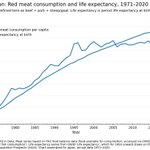
Meat consumption and life expectancy are both in decline in the U.S., but there is one country where life expectancy is rising fast.


Why do professors of cell biology agree about the negative consequences of dietary carbs?
One of the reasons I focus so much on dietary carbohydrates is that no nutrient in the blood is as volatile as glucose. It can climb sharply within minutes of a meal and fall just as quickly. And as much as the blood sugar spike after a meal gets most of the attention, when it comes to hunger, the drop that follows may matter more.
In a study of more than a thousand people wearing continuous glucose monitors, researchers looked at what happened to blood sugar in the hours after eating and how hungry people felt afterward. The size of the spike wasn't the best predictor of hunger. The dip was.
Some people's glucose rose after a meal and then settled back to where it started. Others rose and then fell below their starting level about two to three hours later. That second group, the "big dippers," got hungrier sooner, ate their next meal earlier, and took in more calories over the rest of the day.
This helps explain a common experience. Someone eats a breakfast of cereal, toast, or a pastry, feels fine for a while, and then by mid-morning is hungry again and looking for a snack. It isn't a lack of willpower. Their blood sugar went up quickly and then came down below where it began, and the body responds to that drop by pushing them to eat.
It also shows why the same meal can affect people so differently. One person's glucose barely dips after a bowl of oatmeal, while another's crashes. This is one more reason a glucose monitor is so useful. It shows not only how high a meal sends your glucose, but how far it falls afterward.
Meals built around protein and fat, with fewer refined carbohydrates, tend to produce a smaller rise and a gentler return, which means less of a dip and steadier hunger.
If someone keeps feeling hungry a couple of hours after eating, it's worth looking at whether that meal is sending their blood sugar up and then down below where it started.

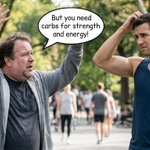
I'm told by several folks on X that without carbs you have no strength. 5 years ago I could barely manage to walk across the room to the bathroom. I could do maybe 1 pushup. Chinups, forget about it. Since cutting way down on carbs and ramping way up on protein, 50 pushups, 20 chinups. Maybe I have a little bit of strength.
Since 2005 the records show zero deaths from bacteria from raw milk, 3 from almond milk, 5 from pasteurized milk.
Quote all the studies and opinions you want, it's real life that actually counts.

Baywatch is returning. Lifeguards who live in 10 million dollar mansions and drive $100,000 sports cars. My buddy was a lifeguard one summer. He got $50 a day plus free sodas.

Your brain accumulates harmful "junk" particles as part of cognitive functioning.
*Tau proteins-misfolded proteins
*Beta-amyloid-which can form neurotoxic plaques associated with Alzheimers
*Lactate and oxidative debris.
But they can be cleared out by the glymphatic system which relies on DHA.
DHA cannot be efficiently synthesized from plant sources. Reliable sources are fatty fish like salmon, mackerel, sardines, and my favorites -- kippers. Friday is my fish day. What's yours?
🤖 Made with AI

A carnivore diet can be cheaper than the standard American diet. You throw out 1/3 of your veggies from spoilage, but you never let meat spoil. Today, Oct 31 2026, hamburger is still under $4 a pound at Walmart

A new study in the "blue zone" of Sardinia found that those who lived longest were associated with a diet involving high amount of animal fats, milk, and cheese
pmc.ncbi.nlm.nih.gov/article…

There is only one statement regarding longevity that I can agree with, from Dr. Gabrielle Lyon "muscle is the currency of longevity"


I decided to actually go to a Mensa meeting. I usually skip them. It was a very diverse group, several races, young and old, about even men and women. We seemed to have nothing in common. At the end of the meeting, we ate dinner. Every single person had steak.


"Limit red meat and salt for longevity "
For almost 5 years now I eat only eggs, red meat, cheese, and occasional kippers, liver, and salami, unlimited salt, age 72.
"It's genetics"
Father died at 69 ( despite limiting red meat and salt), grandfather 65
"You must take a lot of medications and on your last leg"
No meds. Doctor sees no need. 20 chinups and 50 pushups.
"You must be a little guy."
6'1 and 195 lbs
"Well, um, you see, um, uh..."
The recommendations are all flawed and corrupted by food and drug corp money

As I senior, I know this for a fact. I do whey protein powder because I just can't eat enough for my protein needs
Older muscle needs more protein at a meal to get the same building response as younger muscle. When the two were compared, older men needed about 1.7 times as much protein per kilogram of body weight before muscle building reached its peak.
This is part of why people lose muscle with age even when they think they're eating enough, because a serving that works fine for a younger person can fall short for an older one.
After about 60, I'd aim for a generous serving of protein at every meal, roughly 30 to 40 grams for most adults, and I'd pair it with lifting.
