

I advise and write from inside the intelligence transition. When capability is abundant, standing gets scarce. https://teapaw.org/t.co/m9kfJiM0XB
Arizona, USA
Joined April 2025
- Tweets5.2K
- Following3.6K
- Followers2.8K
- Likes8.9K






Doug Standley retweeted

Buzz 1.0 is now available!
I know a lot of Buzz users who are going to like this update for one reason alone.
Push notifications!!
But there are more reasons...
- The agents run in the cloud
- Solo Mode
- Faster
You don't even need a desktop and there is no subscription needed.
$10 credit for tokens at signup.


Doug Standley retweeted

Announcing Perplexity Frontier Research. We are committing at least 10,000 GPUs to work on multi-agent orchestration and continual learning systems with the goal of building an automated researcher. We will publish evals, papers, blogs and open source our models and tooling. We’re actively hiring!

Today we're launching Perplexity Frontier Research.
The goal of Perplexity Frontier Research is to create a system that can perform autonomous research.
The work will focus on multi-agent orchestration, reinforcement learning, continual learning, systems, and pre-training.
We will develop algorithms, models, and evaluations, released openly, and tested in Perplexity products. Our work will be supported by more than 10,000 GPUs.
The Frontier Research team will regularly publish papers, models, data, and benchmarks.
We're actively hiring researchers and engineers for Perplexity Frontier Research in San Francisco, Palo Alto, New York, and London.
research.perplexity.ai
Doug Standley retweeted

“No one you love is ever dead.”
Hemingway on loss and the meaning of life themarginalian.org/2024/05/2…

Doug Standley retweeted

Episode dropping tomorrow with @paulfchristiano.
He thinks there’s a 1 in 3 chance of extreme superintelligence within a year (absent any slowing down).
And he'll explain what labs and governments should do right now given that possibility.
Doug Standley retweeted

a16z is one of the largest investors in the artificial intelligence cycle, and it just released State of Markets II, its 100+ chart view on where tech, AI, and capital are heading.
It makes one big argument: the AI boom is real, it’s earnings-backed, and still super early.
We analysed the whole 90-page deck and listened to the partners’ accompanying podcast (so you don’t have to!), and turned it all into a strategy guide for anyone building, working, or investing in AI.
At the core, two numbers essentially frame the whole deck. Hyperscalers will spend about $780B on capex in 2026, nearly double last year, as they race to build AI capacity. Yet only 2% of S&P 500 companies track an AI metric over time, even though 69% run AI live.
That gap between investment and adoption is exactly where the next decade of AI value will be created and captured.
And which side of it you sit on decides whether you build a category leader or a feature, and whether you back a winner or simply overpay.
Full analysis here: linas.substack.com/p/a16z-st…


Doug Standley retweeted

At Perplexity we are still hiring across the world, especially in New York. Perplexity was founded remotely and to this day we still believe in finding the best people wherever they are. Agency and ownership over location.

Tech jobs are concentrating in the Bay Area
15% of all open tech roles are now in the Bay Area, about one in seven and a record high.
It’s even more concentrated for product roles. One in four open PM and design roles is in the Bay Area, and one in five engineering roles. All three are at or near record highs, and each has nearly doubled its share since 2022.
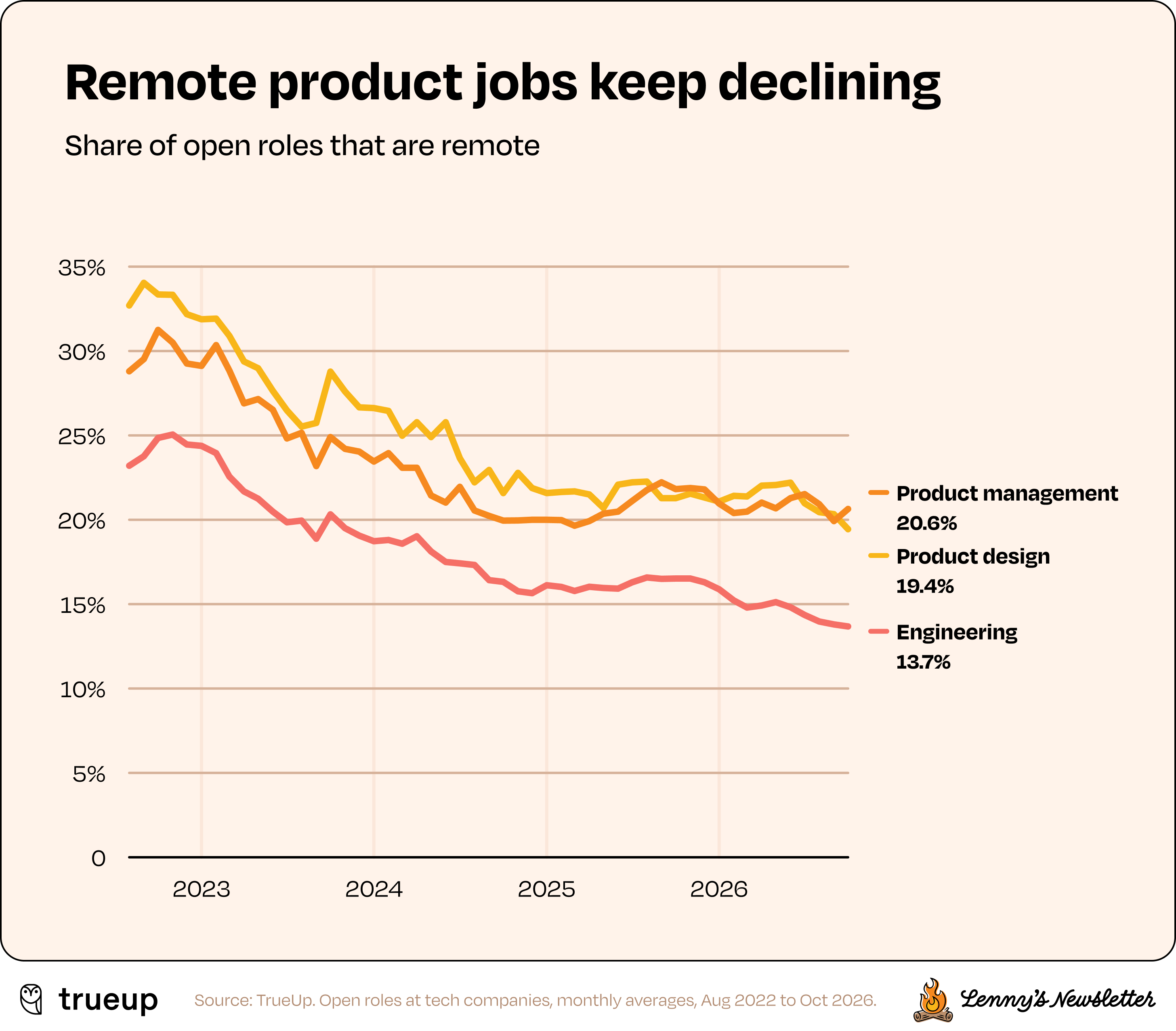
Meanwhile, remote roles keep shrinking. Just 14% of open tech roles offer a remote option, the lowest on record and down from 21% in late 2022.
Remote share by role:
• Engineering: 14%, down from 25%
• Design: 19%, down from 34%
• PM: steady at about 21% for two years, still near its low
Put it all together: sometime last year, open PM, eng, and design roles in the Bay Area overtook remote roles worldwide. Three years ago, remote led almost 2 to 1.



Doug Standley retweeted
We're open-sourcing our latest versions of Decision Models: Decider v1.3 and Decider Flash v1.3, and making them free on @OpenRouter for a week.
The new capability in v1.3 models is "locate". This lets you describe what to find, and the model returns the matching text with character offsets.
This is useful for batch-mode decision + evidence/entity extraction. On 17 out-of-domain NER, PII and extractive QA tasks, Decider models significantly outperform the best general extraction model.
And, on 63 of our own production classification tasks, v1.3 is 6.54 points more accurate than the classifiers we run today.
Weights are open on Hugging Face: perplexity.ai/hub/blog/perpl…


We're rolling out pplx-decider-v1.3 and pplx-decider-flash-v1.3, the latest version of our open-weight decision models.
v1.3 adds locate, a new feature that extracts spans based on type or instructions.
Now available in our Decisions API, @huggingface, and @OpenRouter.
perplexity.ai/hub/blog/perpl…
Doug Standley retweeted

"To be free, you must eliminate two things: the fear of a bad future, and the memory of a bad past.”
— Seneca

Doug Standley retweeted

My conversation with @jonmcneill, the former President of Tesla and the co-founder and CEO of DVx Ventures.
0:00 Introduction
0:57 How to Impress Elon Musk
4:07 What Happens When You Overstep Elon
8:49 Building Tesla’s Culture of Speed
9:46 The Power of Battlefield Promotions
10:24 Three-Sentence Emails
11:45 Sheryl Sandberg’s Weekly Meeting
16:40 Elon’s Approach to Capital Allocation
18:32 Why Tesla Ships Autopilot Updates Weekly
23:37 Cheat Sheet for Better Decision-Making
29:15 Shut Off Failure
30:44 Running a Product Meeting
39:23 The Framework Behind All Great Products
43:16 Why Steve Jobs Blew Off Elon
46:30 Building Tesla with 0 Marketing Budget
52:45 How a Toy Car Solved an Eng Problem
54:05 Neuralink Origin Story
56:36 The Algorithm
1:12:40 The “Fire Yourself” Leadership Exercise
1:16:33 Identifying World Class Talent
Enjoy!
Doug Standley retweeted

New paper❗
Does understanding how AI models work actually make them safer?
This assumption often underlines interpretability research, but different subfields operationalise this intuition in very different ways. Our survey of mechanistic interpretability (MI) for safety provides an opinionated guide to the field of MI, detailing conceptual approaches and techniques under this broad banner and how different types of work relates to the mission of making AI model safer. 🧵
Doug Standley retweeted

i'm happy to share some recent work on safely scaling a team of 1,000 Fable 5.2 agent to tackle ambitious, long-horizon work. the team was able to formalize a proof of Fermat's Last Theorem through coordination within our safety boundaries.
read it here:
claude.dev/blog/safely-scali…

Doug Standley retweeted

@crosbylegal has secured a $5m malpractice insurance policy for our agents. As far as we know, this is the first of its kind.
9 months ago we began to notice our agents were getting extremely capable. In some cases, they did better work than our lawyers.
We are a law firm. We needed to invent a safe way for our agents to do client-facing work without human oversight. It took a lot of work, but this is it.
As soon as the policy went into effect on Nov 3, we removed lawyer oversight from any task that doesn't legally require licensed attorney oversight - what we call "paralegal tasks."
This is ~20% of our work. It frees up our lawyers to focus on what they're best at: thinking, exercising judgment, advising our clients.
This is just the beginning. Once regulations change, we see no reason why our agents can't do excellent legal work too.
Read more in the NYT: nytimes.com/2026/11/07/busin…


Doug Standley retweeted

This week on Complex Systems: walking through the Anthropic S-1 (pre-IPO filing) with @TheZvi
complexsystemspodcast.com/ep…

Doug Standley retweeted

Victoria Mapplebeck’s MOTHERBOARD #controversial #raw #motherhood #rollercoaster #adolescence #breastcancer #unromanticised #unfiltered #unforgettable #womeninfilm #microbudget #nuascannan

Doug Standley retweeted

I want to risk hitting my head on the ceiling of my talent. I want to really test it out and say, 'Okay, you're not that good. You just reached the level here.' I don't ever want to fail, but I want to risk failure every time out of the gate.
— Quentin Tarantino
Doug Standley retweeted

I'm Sam, one of Anthropic's co-founders, and I lead much of our safety work. I'm going to have more to share on that work over the coming months.
I thought I'd start by sharing a few thoughts on the latest report from @METR_Evals.
The speed of progress in model capabilities is one of the most important questions in AI safety, and METR’s work here provides the public with an independent, external view into how this is happening inside Anthropic. I’ll talk more about some of the details below, but first some context for those new to this work.
How quickly AI progress is accelerating has many important safety implications, since it determines how quickly the risks from advanced models increase. But, because most research happens within the frontier labs, it’s difficult for external observers and policy makers to get a strong sense of what that rate is. We kicked off the process with METR that led to this report earlier in the year, in anticipation of progress continuing to accelerate.
For this report, we gave METR access to a range of sensitive internal data, including benchmark scores for unreleased models, estimates of how models are progressing, and interviews with our researchers. They had complete independence to form their own conclusions.
Many of their conclusions match my own. AI is speeding up our research, but it’s hard to say exactly how much. While they conclude AI can't yet make the most important contributions to model training on its own, they think the pace of development could, by default, accelerate further.
This work began well before and is separate from the embedded third-party evaluators that are part of our commitment to pacing the frontier, but it’s a good illustration of why we think evaluators are a good idea. The more access reviewers have, the clearer a picture they can form of the situation and the better-positioned they are to highlight situations like this one.
We redacted a lot, and I accept that this makes it harder for others to check METR’s work. But we determined that sharing exactly what is driving the speedup isn’t the right thing to do, both because it’s commercially sensitive and because it risks handing out a roadmap for others to go faster. That would make the risks METR is worried about worse. That’s a tradeoff. I think we made the right call, though we’re continuing to assess the pros and cons here.
In the coming weeks, we plan to share a report with our own analysis of the speed of AI progress within Anthropic, including where we stand against our Responsible Scaling Policy, plus new steps we’re taking to strengthen our safety and security practices as AI keeps improving quickly.


Doug Standley retweeted
This is an interesting and actually pretty bold move by Vance. Don’t know any VP (since Henry Wallace?) has tried to do something like this. We’re in uncharted waters in so many ways over the next two years…

One of the things the data analysts on our side obsessed over was "composition"—whether the electorate looked close enough to 2024 for Republicans to win. And despite polls that showed a Democrat blowout, the data kept on telling us the same story: in some states turnout was merely OK, in other states it was downright amazing, and in no state was it catastrophic. There was a genuine sense of optimism on our team: our people were showing up.
So, I asked the smartest data guy I know, does that mean we're going to shock the world? "No," he told me. "We might do better than the polls suggest. But the data is telling us that a lot of Trump/Vance 2024 voters are pissed and planning to vote for the other guys. Our voters are turning out, but they may not vote for us."
Well, that looks prophetic now. Our voters did show up. In Florida, for example, the electorate was 9 points more Republican than Democrat, just a couple points worse than 2024. Undoubtedly there were places we could have done better on turnout. But the main problem is not turnout. The main problem is that many people who voted for Trump/Vance in 2024 voted for Democrats in 2026.
There will be a lot of infighting and arguing over what happened and why that is. One of the pollsters I really respect told me that our economic messaging wasn’t sharp enough down the stretch. I’m sure that’s true.
But the real reason we lost is obvious to almost everyone.
Another pollster—one of the smartest people I know in politics, told me yesterday we’d lose the generic ballot by 13 points. I felt negative going into Tuesday, but even I was shocked by this. In his polling, he saw that a lot of Trump 2024 voters were angry and planning to vote for Democrats. He asked those voters who had abandoned us what would cause them to come back on our team. The top four answers, accounting for nearly all of the responses were:
1) End the war
2) Focus on cost of living/inflation
3) Put America First
4) Change our relationship to Israel
Our voters showed up. And the above four reasons are why many of them voted for Democrats. This is according to a pollster who nailed the results. While many spent Monday attacking Rachel Campos Duffy for calling for a diplomatic resolution to the conflict, it turns out her political advice was sound. (She’s also a great person.)
In the next few months, there's going to be a lot of gaslighting. Expect to hear any number of establishment politicians say the solution to our woes is amnesty. I'm open to the idea that we should change enforcement—by focusing more on businesses that hire illegal labor, for instance. But anyone pushing amnesty is lying to you.
The reason we lost is the war. The president himself said so last night.
If you'd like to argue it was worth it, that losing the Senate for the next 6 years was worth it, then do so. Argue it was a worthwhile cost to pay. Agree or disagree, that's at least honest.
But everyone knows why we lost. And any honest conversation about where we go from here must start there.
I remain hopeful about our country. To the people who are pissed off and want to say, “I told you so”: you’re right, you did tell us so. Take that energy into electing Republicans who share your worldview. To the people who are just pissed at the results, you should be. Let’s take that anger and get back to the work of saving our country.
Doug Standley retweeted

“Writing comes from reading, and reading is the finest teacher of how to write.” —Annie Proulx buff.ly/UDMyyAy
