

Expert insights on pharmaceutical economics and the drug distribution system.
Philadelphia, PA
Joined March 2009
- Tweets9.2K
- Following3
- Followers19K
- Likes3.8K






Your PBM could soon help pay for your groceries through your pharmacy benefit.
---
@true_rx just announced a partnership with Instacart Health to incorporate grocery benefits into its employer pharmacy benefit offerings starting in January 2027.
Here's how the program works:
🥦 Eligible foods: Fresh produce, meat, seafood, dairy, and other nutritious groceries.
💵 Monthly allowance: Employers can offer $50 or $100 per participating member for up to six months.
💊 Eligibility: Employees enrolled in True Rx's weight management or diabetes management programs.
🛒 How it works: Members receive Instacart Fresh Funds credits after participating in qualifying clinical sessions. Employers pay for redeemed grocery funds.
This is the first time I've seen a PBM incorporate grocery allowances directly into an employer pharmacy benefit offering.
---
Food-as-medicine programs aren't new.
For example
↳ BCBSNC's Feed Your Health program provides groceries, meals, and nutrition counseling to eligible commercial members with Type 2 diabetes.
↳ Several Medicare Advantage plans also offer grocery allowances for eligible members.
However, those programs operate through health plans or supplemental benefits rather than through a PBM's employer pharmacy benefit offering.
To be clear, True Rx isn't processing grocery purchases as prescription claims. It's integrating food assistance into its existing clinical programs.
---
PBMs already manage drugs for diabetes and obesity. Adding nutritional support could give employers another way to improve treatment outcomes and potentially reduce overall healthcare spending.
The question is whether PBMs can demonstrate that the additional spending on groceries generates meaningful clinical and financial returns, or it's something employers can use for differentiation to attract talent.
Could groceries become a standard part of PBM diabetes and weight management programs?
🔗 Source: prnewswire.com/news-releases…


Here are several things that I think are absolutely worth the money:
🔵 Acumobility balls
🖱️ Vertical mouse + split keyboard
🎡 The N.C. State Fair (went last week!)
📚 Paying to accelerate learning in a specific skill
🗼 Going to the top of the Space Needle in Seattle (with Patrick Baiza)
🤖 ChatGPT Plus AND Claude Pro, but for different tasks
🏠 Buying a house (if used for house hacking*)
🔧 A basic toolbox plus one serious drill
💪 Creatine monohydrate
Bonus! The Drug Channels newsletter, which only costs entering your email address 😉drugch.nl/subscribe-Bryce
Any others you think I should look into?

From RIS Rx: Copay + GTN Revenue Protection = Better Together
Get a custom gross-to-net assessment from RIS Rx: drugch.nl/3UrmGyr
Read the article: drugch.nl/4sio4je
#sponsored

Plan sponsors are not choosing their PBM primarily based on service quality, technology, or clinical programs.
They're choosing on price.
---
A new PSG customer satisfaction survey asked plan sponsors to rank what drives their PBM selection decision, using a MaxDiff analysis.
MaxDiff is a survey method that forces tradeoffs instead of asking people to rate everything as "important." Respondents see sets of 5 factors at a time and have to pick the one that matters most and the one that matters least in each set. Do that across enough sets, and you get a forced ranking of what really drives the decision, instead of a list where everything scores a 4-5 out of 5.
Here's how PBM selection factors ranked in 2026:
🥇 Pricing/Cost
🥈 Honors guarantees and commitments
🥉 Transparency
4️⃣ Member experience/customer service
5️⃣ Formulary and clinical programs
Pricing wasn't just the top factor--nothing else was even close as you can see in the infographic.
---
Further breaking down by PBM size:
↳ non-Big 3 PBM customers ranked transparency #2, while Big 3 PBM customers ranked it #4
↳ Big 3 customers were even more pricing-focused than non-Big 3 customers, 74% vs. 63% naming it most important
Plan sponsors aren't (currently) choosing PBMs primarily on service capability or technology. It's all about the cost to the plan.
(At least to the best of their knowledge at the time of selection--net cost analyses are a topic covered in this blog! drugch.nl/4sklmtS )
---
This data provides more evidence for the affordability narrative of plans that has been compounding the last few years.
Will new federal and state PBM legislation help?
🔗 Source: PSG 2026 PBM Customer Satisfaction Report psgconsults.com/industry-rep…

RICYMI: The DCLF 2027 agenda is live.
Affordability. Federal reform and 340B. GLP-1 access. The changing economics of drug channels.
Explore the agenda and request your invitation:
hmpglobalevents.com/drugchan…
March 15–17 | Miami
#DCLF2027

Provider access in Medicare depends on whether you choose Original Medicare or a Medicare Advantage plan--and which network model the plan uses.
---
The Medicare Annual Enrollment Period (AEP) is the time when people with Medicare can make changes to their coverage for the next year.
AEP runs from Oct 15th - Dec 7th each year--just started!
It's important to compare the options before making a decision, since plan costs, benefits, provider networks, and general coverage can change each year and vary between plans.
---
The attached infographic covers the major differences in provider networks for major Medicare options.
With Original Medicare, you can generally see any doctor or hospital that takes Medicare, anywhere in the U.S. Specialist referrals usually aren’t required.
Medicare Advantage plans vary:
↳ HMO: Use in-network providers for most care and referrals are often required.
↳ HMO-POS: An HMO that allows some out-of-network care, usually at higher cost.
↳ PPO: Out-of-network care is generally covered at a higher cost.
---
For Medicare beneficiaries, these differences can matter when they’re checking whether their doctors are in the network, planning care with specialists, or getting care while traveling.
A plan’s premium and extra benefits are a major part of the annual enrollment decision, but the provider directory and out-of-network rules deserve some more attention so there aren't surprises later.

The decisions shaping drug channels deserve candid conversations.
Request your invitation to DCLF 2027. Senior leaders. No press. No recordings.
📅 March 15–17, 2027 | Miami
hmp-global.swoogo.com/dclf27
#DCLF2027 #DrugChannels

Alternative PBMs still have slightly higher customer satisfaction than the Big Three.
But the gap nearly disappeared in 2026.
---
In PSG’s latest survey, satisfaction among non-Big Three PBM customers fell from 7.9 to 7.3 on a 10-point scale.
↳ Big Three customers’ ratings rose from 6.8 to 7.1.
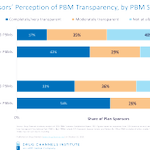
Perceptions of PBM transparency are improving across all areas covered in the survey (except sources of revenue--flat).
Plan sponsors are giving non-Big Three PBMs more chances to compete.
Getting invited to bid is one thing.
Delivering value after the contract is signed is another.
Our new blog looks at the shrinking satisfaction gap, what plan sponsors are considering for 2027, and why comparing PBM proposals means looking beyond guarantees to the plan’s total net cost and ability to deliver.
Read the full analysis on why enthusiasm appears to be declining for non-Big Three PBMs: 🫴🏻 drugch.nl/4sklmtS 👈🏻
Can alternative PBMs deliver on their promises now that more plans are giving them a chance?

I've seen a GAO report cited as proof that PBMs aren't paying affiliated pharmacies more.
We can't say that from the data provided.
---
The Government Accountability Office (GAO) analyzed 2023 Medicare Part D data for four vertically integrated plan sponsors covering over 40% of enrollment.
Owned pharmacies had lower gross payments per 30-day supply in:
💊 94% of comparisons involving the 100 highest utilization drugs.
💰 68% of comparisons involving the 100 highest spend drugs.
Those findings need some more context to show they aren't that useful to answer questions about vertical integration reimbursement.
---
1️⃣ The drug sample may miss where differences are concentrated.
The high utilization basket included 92 generics. The high spending basket included 99 brands.
Specialty generics (as an example) often have substantial reimbursement differences and fall outside both groups.
2️⃣ The analysis couldn't measure what pharmacies ultimately kept.
Pharmacies returned a net 7% of gross payments to these sponsors through post-sale adjustments. GAO couldn't determine how those amounts differed between owned and non-owned pharmacies.
An outside pharmacy could receive more at the counter and keep less after reconciliation. The study couldn't test that. This same issue came up in the TRICARE hearing in July.
3️⃣ The headline changes when you separate plan types.
For the highest spending drugs, owned pharmacies had lower payments in 68% of comparisons across all plans.
Among non-employer plans, that fell to 46%.
That is a materially different finding for the plans most Part D beneficiaries use.
4️⃣ A lower/higher threshold doesn't describe how much lower or higher the payments were.
From 3 above, just because 68% of payments were lower, that doesn't mean total spending was lower. The 32% that were higher could have extreme markups...for example, 77x higher: ftc.gov/system/files/ftc_gov…
5️⃣ Pharmacy channel and ownership are mixed together.
Owned pharmacies were primarily mail order and specialty. Non-owned pharmacies were primarily retail.
Converting payments to a 30-day equivalent doesn't eliminate differences in channel contracts or discounts for longer fills. Lower mail order pricing could mask a payment advantage tied to ownership, plus there are benefits to post-sale adjustments like number 2 above from the higher PDC scores.
---
GAO acknowledges many of these limitations in the study. The stronger claims about the study I've seen go beyond what it really answers.
I'd like to see final reimbursement after all pharmacy fees and adjustments, matched within the same plan and dispensing channel, and most importantly--with all drugs included!
If we really want to answer this question, we can't show partial samples of drugs and extrapolate the findings.
🔗 Source: GAO gao.gov/assets/gao-26-107393…


From @InformaConnect 👉🏻 𝗜𝗻𝗳𝗼𝗿𝗺𝗮’𝘀 Trade and Channel Strategies
December 8-10, 2026 | W Philadelphia
*** Promo code for discount: 26DC10 ***
Details ==> drugch.nl/3VxyaRk
#sponsored

Part D spending grew 22% in 2025 to $351 billion.
2/3 of that spending happened in the catastrophic phase where there's no cost sharing at all.
---
Gross Part D spending: $276 billion (2023) → $289 billion (2024) → $351 billion (2025).
@medicarepayment shared in a recent presentation that they found the catastrophic phase's share of that spending jumped from 43% for two years to 66% in 2025.
The enrollees driving it:
📈 22% of all enrollees reached the out-of-pocket limit in 2025, up from 8% in 2024
📈 Among non-LIS enrollees specifically, that share more than quadrupled from 4% to 18%
💰 Average spending per non-LIS enrollee rose 26% in one year
Most of Part D's growth is now happening in the catastrophic phase with no cost sharing.
That spending is also getting more concentrated. The top 6% of enrollees by spending accounted for 60% of all Part D spending in 2025, averaging $63,601 each.
---
Nearly every major therapeutic class grew double digits in a single year:
💊 Antineoplastics: $43B → $56B (+32%)
💊 Injectable antidiabetics: $35B → $44B (+27%)
💊 DMARDs: $15B → $18B (+26%)
Anti-obesity agents grew 577%, from $0.3 billion to $2 billion.
GLP-1 spending crossed into the catastrophic phase earlier in the year than it did in 2024. Patients were hitting the no-cost-sharing threshold by around March instead of the 3rd/4th quarter.
---
The redesigned benefit did what it was built to do: cap what the sickest, highest-spending enrollees pay out of pocket.
But the tradeoff is plans (and Medicare/taxpayers) are absorbing more of the cost.
The feeling I got from the MedPac presentation was they think the IRA was TOO effective at reducing OOP costs, so now it needs to be dialed back.
Do you agree?
🔗 Source: MedPAC staff presentation to the Commission medpac.gov/wp-content/upload…
