

General and robust AI robots that power the future of the physical economy.
Joined January 2025
- Tweets127
- Following15
- Followers14.1K
- Likes335





Pinned Tweet
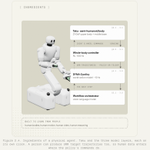
We are releasing Dyna-2.1, the first Physical Agent that achieves reliable super long-horizon whole-body autonomy. It combines our brand-new semi-humanoid hardware with an agentic system built around Dyna-2 to handle ultra-long real-world workflows.
Here is an uncut footage of Dyna-2.1 completing an entire hour-long laundry room workflow, just like a human does.
A proud moment for the team behind Taku!
Thank you @RoboStrategy for bringing us together at Nasdaq.



Dyna Robotics retweeted

Robots That Predict the Future: Dyna-2, Million-Hour World Models, & the Bitter Lesson of Robotics
@DynaRobotics’s @JasonMa2020 explains how world-action models predict the future to guide physical robot actions, why training on over a million hours of human video lets robots adapt to new tasks with as little as 45 minutes of demonstrations, how synthetic data and self-improving world models could accelerate robotics, why agentic harnesses are enabling hour-long autonomous workflows, and how the Bitter Lesson of scaling, full-stack hardware, and real-world deployments at Din Tai Fung are turning physical AI from impressive demos into useful robots.
AI runs on compute. Compute needs scaled infrastructure.
We are teaming up with @LambdaAPI to give AI infrastructure some helping hands.
Dyna Robotics retweeted

When the New York Post calls your robot “the world’s most boring robot”, you know you are doing something right. 😭😂
This is actually the highest praise ever: when robots actually work, they are supposed to be boring, just calmly and reliably getting the job done.


Dyna Robotics retweeted

Dyna-2.1 is the first Physical Agent that can complete an entire job.
Customers care about getting work done, not video views.
A robot that performs a stationary task but needs a human to bring it the next item, carry away the finished work, and clear every jam isn’t completing a whole job. It’s creating a new one: robot babysitter.
The real benchmark isn’t how fast your robot moves. It’s how long you can walk away. Customers don’t buy an impressive step in a workflow. They buy the whole job getting done.

We are releasing Dyna-2.1, the first Physical Agent that achieves reliable super long-horizon whole-body autonomy. It combines our brand-new semi-humanoid hardware with an agentic system built around Dyna-2 to handle ultra-long real-world workflows.
Here is an uncut footage of Dyna-2.1 completing an entire hour-long laundry room workflow, just like a human does.
Dyna Robotics retweeted

When we released Dyna-2 at the beginning of August, one of the most common reactions was: why? So what? Fair question. People are tired of PR releases saying “we trained on XXX hours of data” while the robots still aren’t doing meaningful work in the real world or creating enough ROI for customers. We deeply understand that. Technology is ultimately just a way to make people’s lives better, and behind every technology there needs to be a clear why.
The goal of Dyna-2 was never to pile up data for attention. The goal was to build a System-1 model that can understand high-level instructions and execute them end to end in the physical world. Embodied AI has been stuck on isolated tasks for a very long time. But when our BD team talks to customers, the ask is actually very consistent: give me something that requires little to no babysitting, so humans can spend their time on what humans are actually good at. If a robot can only do one isolated task at a time, humans still need to coordinate around it, move things between steps, handle exceptions, and constantly supervise it. At that point, the robot hasn’t removed babysitting. It has just changed who is babysitting whom. That completely defeats the purpose of embodied AI, and that is definitely not the world we want to build.
So we trained our foundational world-action model on 1M+ hours of human video and language supervision. The point was never that “1M hours” sounds impressive. The point was to let the model understand what people want, understand how the physical world evolves, and turn an instruction into a sequence of actions that actually finishes the job. That is the why behind Dyna-2. Today, Dyna-2.1 is carried by Taku to turn that intelligence into an end-to-end physical agent that can take on complete workflows and deliver real value to customers. We want to bring this everywhere as fast as we can.
The second question we hear all the time is: why build another robot? Isn’t hardware and low-level control basically solved? I hear this surprisingly often. I think a lot of the misunderstanding comes from the amazing demo videos we all see online. Robotics can look so impressive that it is easy to feel like hardware already had its “iron man moment,” the body is solved, and now all that is left is the brain. Once you actually deploy robots into the physical world, you learn very quickly that this is not true. We have enormous respect for traditional robotics because we understand how hard anything physical becomes once you care about reliability, precision, lifetime, recovery, maintainability, and cost. Not for a five-minute demo, but day after day in a real operation.
Taku was carefully designed and tuned around loco-manipulation, which is still a very underdeveloped domain. A robot that needs to move through the world while manipulating it continuously has very different requirements from locomotion alone or stationary manipulation alone. There are a lot of bitter lessons here that you can only learn by getting into the details. I’m really proud that our team did exactly that and turned those lessons into a real system with the right technologies instead of assuming those problems were already solved.
Finally, it’s all about people. No matter how shiny a company looks from the outside, the people inside are what we take the most pride in. The photo below is one of my favorite Dyna photos: 4:30am in the Dyna office, with such a talented and dedicated team happily crafting Taku together. What I love about this photo is not the late hour itself. It’s that the energy, diligence, and hard work come from genuine love for what we are building and pride in the craft. Nobody creates something great just by being told to work harder. The best work comes when people deeply care about the thing they are building, enjoy building it together, and want to make it better. That’s the culture I’m most proud of at Dyna.
We dislike bullshit. We just cook and ship. And hopefully, piece by piece, bring humanity forward.
For more technical details on Dyna-2.1 and Taku:
dyna.co/dyna-2.1

We are releasing Dyna-2.1, the first Physical Agent that achieves reliable super long-horizon whole-body autonomy. It combines our brand-new semi-humanoid hardware with an agentic system built around Dyna-2 to handle ultra-long real-world workflows.
Here is an uncut footage of Dyna-2.1 completing an entire hour-long laundry room workflow, just like a human does.
With just 30 minutes to a couple hours of on-robot data, Taku can complete new whole-body tasks that require vastly different motion primitves.
Dyna-2.1 makes significant strides in making general-purpose robots useful in the real world. Our next milestone is to take this brand new system to real-world customer sites and establish a deployment flywheel, in which every piece of deployment data improves the full system. Our long term vision is to build a self-improving physical agent. And Dyna-2.1 is just the beginning.
Read our full technical report for deep dives and additional details: dyna.co/dyna-2.1

Made for the details and the demands of real work. Built for craft and mastery.
A first look at our new robot. Coming soon.
Dyna Robotics retweeted

Two and a half weeks ago Dyna Robotics published that their model is actually working, and now they are lifting the curtains on some of their deployments.
Dyna-2 is a world-action model pre-trained on 1 million hours of first-person human video, which equates to training on about 170 years of hands. They unlocked transfer. With the same checkpoints, scored on robot data the model never saw, zero fine-tuning, their scaling curve holds. They hit a human-to-robot scaling law. Somewhere between 10k and 100k hours, the embodiment gap starts closing on its own.
At a customer site neither has seen, Dyna-1 passes 46%. With Dyna-2 scaling successfully, it passes 87%, enabling Dyna to finally start scaling their deployments.
Din Tai Fung, one of the highest revenue-per-location chains in the US, is rolling Dyna robots across its network, with hundreds of robots by H1 2027.
After so many demos, models, pilots, robots are still struggling to land real deployments with real customers. Until now.
Today we’re excited to share that our robots have successfully crossed the ROI threshold, and Din Tai Fung, one of the highest revenue per location restaurant chain in the US, is rolling out Dyna robots across its extensive restaurant network.
This brings our rollouts across hotels, logistics, data centers, and many other use cases to a fleet that reaches hundreds of robots by the first half of 2027. And we’re just getting started.
It’s been a wild year, and today we’re double clicking on the battlefield stories and sharing a few learnings about scaling robot deployments. We are just scratching the surface.
Read the full blog post: dyna.co/news/scaling-custome…