

Insights, analysis and other news from @ecb researchers. Authors' views are their own, and not necessarily those of the European Central Bank.
Frankfurt am Main, Germany
Joined October 2022
- Tweets2K
- Following55
- Followers11.8K
- Likes15


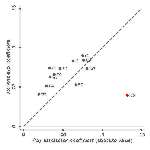
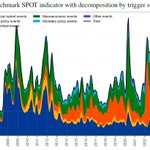
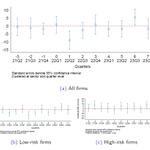
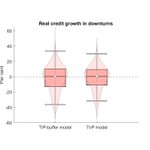


🧵New @ecb Working Paper by L. Nocciola & S. Scaglioni “Learning probability of default and stress testing” ecb.europa.eu/pub/pdf/scpwps… 1/5
Scenario severity matters nonlinearly. Higher funding costs and weaker GVA growth raise firms’ PDs at different rates and thresholds. Random Forests capture this acceleration more strongly than logit, especially as scenarios become more severe. 4/5

Tune in on 22-23 October for the WE_ARE_IN Macroeconomics and Finance Conference, hosted by @bancaditalia with @BIS_org, @cepr_org & @ecb. Programme & info on online attendance 👇ecb.europa.eu/press/conferen…
New @ecb Working Paper by F. Wagner & J. Metzler “When the Crowd Speaks: AI-based retail investor sentiment indicator with Reddit data” ecb.europa.eu/pub/pdf/scpwps…
The starkest finding: young workers (15–24) are hit hardest. Their participation drops after a growth shock and doesn't recover for up to 8 years – scarring that can mark an entire generation's attachment to the labour market. #EconTwitter 4/5
First causal estimate of EU participation cyclicality: a shift-share IV + local projections on EU-LFS microdata (15 countries, 114 regions, 2000–2020). Policy punchline: a stable participation rate can still hide real labour market slack. #MonetaryPolicy #EconTwitter 5/5
🧵New @ecb Working Paper by D. Sondermann & C. Petrakis “Hidden in the aggregate: the cyclicality of EU labour force participation” ecb.europa.eu/pub/pdf/scpwps… 1/5
The EU's aggregate labour force participation rate is remarkably resilient to recessions. Unlike in the US, where it slumps for years after a shock. But that steady headline number hides a lot. A thread on what's #HiddenInTheAggregate 2/5
🧵New @ecb Working Paper by G. Spanò & J.M. Figueres “Banks’ funding structures and pass-through in the euro area” ecb.europa.eu/pub/pdf/scpwps… 1/2
🧵New @ecb Working Paper by C. Mavrogiannis & N. Zorell & C. Zwick “Can structural reforms unleash private investment?” ecb.europa.eu/pub/pdf/scpwps… 1/4
Major labour and product market reforms are found to increase the level of real private investment by up to 5% cumulatively within six years. 3/4
New @ecb Working Paper by M. Groiss & D. Sondermann “Monetary policy and the rigidity of firm employment expectations” ecb.europa.eu/pub/pdf/scpwps…
🧵New @ecb Working Paper by A. De Sanctis, S. Gebauer, F. Holm-Hadulla & M. Sirani “Financial frictions across the production network and the transmission of monetary policy” ecb.europa.eu/pub/pdf/scpwps… 1/5
The indirect channel decomposes into two opposing forces. Downstream: constrained customers contract intermediate input demand, reinforcing the fall in prices and output. Upstream: constrained suppliers raise prices to protect margins, partially offsetting disinflation. 4/5