




Jesus Christ, my God, I adore You and thank You for all the graces You have given me this day. I offer You my sleep and all the moments of this night. I place myself and all my loved ones, wherever they may be, in Your sacred side and under the mantle of Our Blessed Mother. Let Your holy angels stand watch and keep us in peace. Amen.
Anthony Van Dyck 1599 – 1641
The Descent of the Holy Spirit
oil on canvas (265 × 221 cm) — 1618-1620


EOB 🇺🇸 retweeted

“The Rosary is a powerful weapon to put the demons to flight and to keep oneself from sin. If you desire peace in your hearts, in your homes, & in your country, assemble each evening to recite the Rosary. Let not even one day pass without saying it, no matter how burdened you…

I’m going to @GrainneMcD92925’s upcoming Space. Will you join too? teapaw.org/i/spaces/1AMLEmvnkzROV…
4
72
Father Burke’s homily for today’s Mass
November 18, 2026 – Optional Memorial of St. Rose Philippine Duchesne, Virgin
Have you ever stopped to think about how blessed you really are? Sometimes it takes traveling to a third-world country to realize how much we have been given. We can be rich in material possessions but poor in spirit. Mother Teresa reminded our government officials of this truth when she spoke to them many years ago.
Where do our blessings come from? Sometimes we begin to think that we deserve everything we have. We work hard, put in our time, and believe we have earned it all. But don’t forget that God has given you every talent, every gift, and every opportunity you have. Even the desire and ability to work hard are gifts from Him. Everything is grace!
In today’s Gospel, Jesus tells the parable of the servants who are entrusted with gold coins and are expected to put them to work while their master is away. The servants who use what they have been given are rewarded, while the servant who buries his coin out of fear loses even what he has. Jesus is teaching us that our gifts are not meant to be hidden or kept for ourselves. They are meant to be shared.
Think about sports for a moment. A talented athlete doesn’t become great by sitting on the bench and refusing to practice. God-given ability must be developed, exercised, and put to use for the good of the team. The same is true in our spiritual lives. God has given each of us unique gifts. Am I using them to build up His Kingdom, or am I keeping them for my own comfort and pleasure?
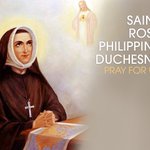
Today we also celebrate the optional memorial of St. Rose Philippine Duchesne (1769–1852). Born in Grenoble, France, she entered religious life with the Visitation Sisters but was forced to leave during the French Revolution. She later joined the Society of the Sacred Heart and traveled to the United States in 1818. She established schools for girls and worked tirelessly to bring the Gospel to Native American communities, particularly the Potawatomi people. Even at the age of 72, she went to live among the Potawatomi in Kansas, where she became known as the woman who prays always. She died on November 18, 1852, and was canonized by St. John Paul II in 1988. She is remembered as a patron of perseverance in adversity and those who work with Native Americans.
St. Rose Philippine Duchesne didn’t bury her gifts. She gave her life generously in service to God and others. Her example challenges us to do the same. We cannot outdo God in generosity. The more we give away our time, talent, treasure, and love, the more He fills us with His grace so that we can continue giving.
Let’s not sit on the sidelines of the Christian life. Let’s get in the game! God has entrusted us with much, and He wants us to use those gifts for His glory and the good of others.
Reflection Questions
1Do I recognize that every good gift, talent, and opportunity I have comes from God?
2Am I developing and using my gifts for the glory of God, or am I burying them out of fear, comfort, or selfishness?
3What is one concrete way I can give away my time, talent, treasure, or love today?
Have a blessed day!
Fr. Burke
=================================
Fr. Burke’s video for November 18 – youtu.be/jXauXXdf2_o


Saint Rose Philippine Duchesne
Patron Saint of: Native Americans, missionaries, and educators
Feast Day: November 18
Saint Rose Philippine Duchesne (1769–1852) was born in Grenoble, France, to a wealthy and prominent family. At the age of 18 she joined the Visitation nuns against the wishes of her family, taking her religious name after St. Rose of Lima and St. Philip Neri. During the anti-religious fervor of French Revolution, the "Reign of Terror," her convent was shut down. She then took up the work of providing care for the sick, hiding priests from the revolutionaries, and educating homeless children. When the tensions of the revolution subsided, she rented out her old convent in an attempt to revive her religious order, but the spirit was gone. She and the few remaining nuns of her convent then joined the Society of the Sacred Heart of Jesus. Since childhood, St. Rose Philippine had had a strong desire to do missionary work in the New World, especially among the Native Americans. This was realized in 1818 when she and four nuns traveled across the Atlantic, a journey of eleven weeks, and another seven weeks up the Mississipi river to serve in one of the remotest outposts in the region in St. Charles, Missouri. St. Rose Philippine was a hardy pioneer woman ministering in the Midwest during its difficult frontier days. She opened several schools and served the Potawatomi Indians who gave her the name "Quah-kah-ka-num-ad," meaning, "Woman-who-prays-always." Her feast day is November 18th.

Jesus Christ, my God, I adore You and thank You for all the graces You have given me this day. I offer You my sleep and all the moments of this night. I place myself and all my loved ones, wherever they may be, in Your sacred side and under the mantle of Our Blessed Mother. Let Your holy angels stand watch and keep us in peace. Amen.
The Crowning with Thorns is an oil painting on canvas created ca. 1618–1620 by the Flemish artist Anthony van Dyck.

I’m going to @DavidStein22’s upcoming Space. Will you join too? teapaw.org/i/spaces/1mdqqXjegvOlg…
3
126

EOB 🇺🇸 retweeted

Is Jesus welcome in every part of my heart and my home? Am I willing to let Him reveal my sins, heal my wounds, and change the areas of my life that need conversion?
November 17, 2026 – Memorial of St. Elizabeth of Hungary, Religious frburke23.wordpress.com/2026…

Father Burke’s homily for today’s Mass
November 17, 2026 – Memorial of St. Elizabeth of Hungary, Religious
We can learn so much from Zacchaeus in today’s Gospel. He was a tax collector and a wealthy man, but something was missing in his life. He had heard about Jesus and wanted to see Him. His curiosity and desire were so strong that he was willing to climb a tree just to get a glimpse of the Lord. Something deep in his heart told him that Jesus was someone special.
Jesus saw Zacchaeus in the tree and invited Himself to his home. What a beautiful moment! Jesus did not wait for Zacchaeus to clean up his life before entering his house. He met him where he was, loved him, and invited him into a deeper relationship. Zacchaeus received Jesus with joy, and his life was never the same.
When Jesus enters our hearts, He begins to change us from the inside out. Zacchaeus recognized his sinfulness and immediately wanted to make things right. He promised to give half of his possessions to the poor and repay anyone he had cheated four times over. His encounter with Jesus led to conversion, generosity, and a new way of living.
Today we also celebrate St. Elizabeth of Hungary (1207–1231). She was born into a royal family in Hungary and married Louis IV of Thuringia. Although she lived in a position of great wealth and privilege, she had a special love for the poor and suffering. After her husband’s death in 1227, she devoted herself even more completely to serving those in need. She built a hospital, personally cared for the sick, and gave away much of her wealth. She died at just 24 years old and was canonized in 1235, only four years after her death. She is the patron saint of Catholic charities, bakers, hospitals, widows, and the homeless. Her life reminds us that holiness is not measured by what we possess, but by how generously we love.
In our first reading, Jesus warns the Church in Laodicea about being lukewarm. He wants us to be fully committed to Him. Like Zacchaeus and St. Elizabeth, we are called to put our faith into action. In sports, we know that champions do not become great by giving half-hearted effort. They dedicate themselves to the goal. The same is true in our spiritual lives. Are we giving Jesus our very best?
Let us reflect on three questions:
1Am I willing to climb the tree like Zacchaeus? Do I make seeking Jesus a priority each day, even when it requires sacrifice or stepping outside my comfort zone?
2Is Jesus welcome in every part of my heart and my home? Am I willing to let Him reveal my sins, heal my wounds, and change the areas of my life that need conversion?
3Am I living my faith generously like St. Elizabeth? Do I use the blessings God has given me to serve the poor, care for those who are suffering, and make a difference in someone’s life?
Jesus wants to enter our homes and our hearts today. He is not looking for perfection; He is looking for an open door. May we never settle for being lukewarm, but receive Him with joy and allow His love to transform us.
Have a blessed day!
Fr. Burke
=======================
Fr. Burke’s video for November 17 – youtu.be/iPL78aWZhH8

Saint Elizabeth Of Hungary
Patron Saint of: Bakers, charities, and the poor
Feast Day: November 17
Saint Elizabeth of Hungary (1207–1231) was born in Hungary, the daughter of King Andrew II of Hungary and his wife Gertrude. As a child she was sent to Thuringa (now Germany) to be brought up with Prince Ludwig of Thuringa, whom she was to marry at the age of 14 in order to solidify a political alliance between the two nations. Their marriage was a very happy one, and they had three children together. Although Elizabeth was a princess surrounded by a magnificent court, she lived a humble life serving the sick and poor outside her castle walls. No amount of disapproval from those who considered this behavior beneath her royal status could dissuade her from her faithfulness to this task. One day, on her way to feed the poor, her husband stopped her and asked to see what she concealed beneath her mantle. The food she carried was miraculously replaced by roses, signifying God's approval of her charity. When her husband, after six years of marriage, tragically died on his way to join the crusade in Jerusalem, Elizabeth was grief-stricken. She vowed to never remarry, and eventually left her life of nobility to join the Secular Franciscans as a penitent. She continued her charitable works to an even greater degree, and helped Thuringa recover from a famine by giving them a huge gift of grain. It was this act, along with her habit of distributing bread to the poor, that made her the patron saint of bakers. She is also the patron of hospitals, the homeless, widows, charities, and nursing homes. St. Elizabeth of Hungary's feast day is November 17th.


Jesus Christ, my God, I adore You and thank You for all the graces You have given me this day. I offer You my sleep and all the moments of this night. I place myself and all my loved ones, wherever they may be, in Your sacred side and under the mantle of Our Blessed Mother. Let Your holy angels stand watch and keep us in peace. Amen.
Adoration of the Kings by Giuseppe Chiari (1564-1727), an Italian painter of the late-Baroque period, active mostly in Rome.

Prayer of St. Gertrude the Great for the Holy Souls in Purgatory:
Eternal Father, I offer Thee the Most Precious Blood of Thy Divine Son, Jesus, in union with the masses said throughout the world today, for all the holy souls in purgatory, for sinners everywhere, for sinners in the universal Church, those in my own home and within my family. Amen.

Saint Margaret of Scotland, pray for us!
Today is also the Optional Memorial of Saint Margaret of Scotland (c. 1045–1093). She became Queen of Scotland when she married King Malcolm III around 1070. She was known for her deep prayer life, generosity to the poor, care for orphans, and efforts to renew the faith and worship of the Church in Scotland. She helped establish churches and monasteries and encouraged education and works of charity. She died on November 16, 1093, and was canonized by Pope Innocent IV in 1250. She is the patron saint of Scotland and is also invoked by large families and those seeking a holy family life.
St. Margaret reminds us that holiness is lived in the ordinary responsibilities of life. She used her influence to serve God and others. May she help us see the people around us with greater love and generosity.
From Father Burke’s homily

Father Burke’s homily for today’s Mass:
November 16, 2026 – Optional Memorial of St. Margaret of Scotland
The blind man in today’s Gospel couldn’t see with his physical eyes, but he recognized Jesus in a way that many people who could see did not. By calling Jesus “Son of David,” he was giving Him the Messianic title, recognizing Jesus as the promised Messiah who would come from the line of David.
Others who could see with their eyes did not recognize Jesus for who He was. They followed Him and were amazed by His powerful teaching, preaching, and miracles. They were mesmerized by the miracle-worker but failed to see the Messiah. The blind man saw clearly.
Jesus was moved by this man’s faith. Despite the crowds and the people trying to silence him, he called out even louder. This was his opportunity for healing, and he was not going to let it pass. Jesus called him forward and asked, “What do you want me to do for you?” It might seem obvious that the blind man wanted to see, but Jesus wanted him to express his desire. The Lord asks us the same question. He wants us to bring our specific needs, hopes, and intentions to Him in prayer.
The man asked for his sight, and Jesus immediately granted it, saying, “Have sight; your faith has saved you.” The man then followed Jesus, giving glory to God, and the people who witnessed this miracle began praising God as well.
Jesus wants to fill us with the gifts of the Holy Spirit so that we can see life more clearly through His eyes. We may have physical sight, but do we really see? When we walk by faith and not by sight, the Lord illumines our minds and guides our paths.
I used to think I was pretty smart. I did well academically and scored well on standardized tests. However, I was spiritually blind. It wasn’t until I began giving my life to the Lord toward the end of high school and into college that I started seeing things differently. The Holy Spirit began helping me see people and situations through God’s eyes. He helps us recognize the emptiness of pursuing material things, notice the pain in the eyes of others, and understand that our restless hearts are ultimately seeking Jesus. Most importantly, He helps us see every person as a beloved child of God.
Today is also the Optional Memorial of St. Margaret of Scotland (c. 1045–1093). She became Queen of Scotland when she married King Malcolm III around 1070. She was known for her deep prayer life, generosity to the poor, care for orphans, and efforts to renew the faith and worship of the Church in Scotland. She helped establish churches and monasteries and encouraged education and works of charity. She died on November 16, 1093, and was canonized by Pope Innocent IV in 1250. She is the patron saint of Scotland and is also invoked by large families and those seeking a holy family life.
St. Margaret reminds us that holiness is lived in the ordinary responsibilities of life. She used her influence to serve God and others. May she help us see the people around us with greater love and generosity.
Where am I spiritually blind?
If Jesus asked me, “What do you want me to do for you?”, what would I tell Him?
Do I see others with the eyes of God?
Have a blessed day!
Fr. Burke
================================
Fr. Burke’s video for November 16 – youtu.be/0P6oZ7aa8Xk


Saint Gertrude The Great
Patron Saint of: West Indies, souls in purgatory, and mystics
Feast Day: November 16
Saint Gertrude the Great (1256-1302), also known as Gertrude of Helfta, was born on the feast of Epiphany in Thuringia (modern Germany). She was sent to be educated at the Benedictine monastery in Helfta at the age of four or five, possibly as an orphan or as a child dedicated to God by her parents. She proved to be an extremely bright and determined student who became engrossed in her secular studies, but was negligent of her prayer life. She remained in the monastery and made her profession as a nun. At the age of 26 she entered a time of spiritual crisis, after which she began to receive visions of Christ who chastised her for not leaving room for God in her academic pursuits. This caused Gertrude to abandon her secular studies in total devotion to Sacred Scripture and the works of the Church Fathers. These theological studies, along with continued visions and messages from Jesus, became the basis of her work as one of the great writers and mystics of the 13th century. St. Gertrude had a lasting impact on the Church in an age where academic and religious literature was dominated by men, and she is the only female saint to earn the title "The Great." She was one of the early saints who, along with her companion in the monastery, Saint Mechtilde of Hackeborn, spread devotion to the Sacred Heart of Jesus. St. Teresa of Avila chose St. Gertrude the Great, the patron saint of nuns, as her model and guide. Her feast day is November 16th.
