
We counter Kremlin information warfare, one claim at a time | Not official EU position
Brussels
Joined November 2015
- Tweets6.3K
- Following768
- Followers81.9K
- Likes1.3K




Pinned Tweet
OTD in 1956, Hungarians rose up against Soviet-backed communist rule. Students demanded free elections, a free press and the withdrawal of Soviet troops. On 4 November, the Soviet Union launched an invasion to brutally crush the uprising.
Seven decades later, Russia is seeking to rehabilitate the Soviet Union’s actions by portraying the uprising as the result of ‘Western provocations’, whitewashing the brutal intervention that killed and wounded thousands and forced 200,000 into exile.
Just a very quick look at the social media feed of Dmitry Medvedev, Deputy Chairman of Russia’s Security Council, makes it abundantly clear who is threatening whom.

The Kremlin wants the world to forget who started the war. On 24 February 2022, Putin ordered an unprovoked full-scale invasion of Ukraine, unleashing the largest war in Europe since the Second World War.
The war was not ‘forced upon’ Russia.
Russia chose to invade.

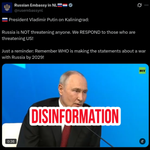
According to Kremlin propaganda, Poland has been assigned the task of starting an all-European war.
Assigned by whom? Based on what evidence? The propaganda narrative doesn’t say.
It does, however, find a way to portray Russia as the victim of yet another imaginary invasion.

Read Russia’s official account of its latest attacks on Kyiv and you’ll find a detailed list of alleged ‘military targets’.
What you won’t find is any mention of the civilian killed, the homes damaged or the metro station hit during the attacks, as documented by independent observers.

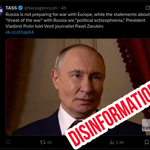
From acts of sabotage across Europe to near-daily drone incursions into EU airspace and relentless nuclear threats, the Kremlin provides ample evidence that the Russian threat is real.

Kremlin propaganda: ‘military targets were hit’
Reality: subway stations, residential buildings, and critical infrastructure were struck by Russia and civilians were injured.

Behind every Russian missile striking Ukraine is a supply chain that makes its production possible.
The EU’s latest sanctions target 1,569 individuals and entities linked to Russia’s military-industrial complex, aiming to disrupt weapons production and limit Moscow’s ability to sustain its attacks.
Throughout its illegal invasion, Russia has damaged or destroyed 155 churches, more than 4,200 educational institutions, and over 1,800 medical facilities in Ukraine. Last month alone, 328 civilians were killed and 2,105 injured as a result of Russian attacks.

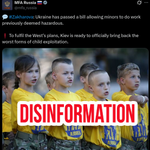
Ukraine already prohibits under-18s from heavy and hazardous work. Russia is now falsely portraying Ukraine’s new occupational safety law as child exploitation, when its aim is to strengthen worker protections and align Ukrainian standards with those of the EU.
If the Kremlin had any genuine concerns about the welfare of Ukrainian children, it would end its invasion and stop the indiscriminate attacks that have killed and injured over 3,500 children.

Russia’s Defence Ministry insists it strikes only military and related infrastructure.
Its latest target list includes residential buildings, medical facilities, a shopping mall, and a civilian metro station.
Propaganda does not erase the harm imposed on civilians.

Kremlin-affiliated outlets continue to circulate claims that US investigators have uncovered links between Ukraine’s Armed Forces and Mexican drug cartels.
In reality, no US agency has made such claims or published any such findings. The false allegation originates with Russia’s Foreign Intelligence Service.

Footage of civilian burials in Mariupol is being repackaged as evidence of recent Ukrainian military losses.
The footage is real. The alleged context is false.
Recycling images of civilian suffering to manufacture a new battlefield narrative is cynical disinformation, not reporting.

Ukraine has carried out its first-ever evacuation of a wounded soldier by drone.
While the Kremlin invents new ways to target civilians and justify it through propaganda, Ukraine invents new methods to save lives.

In a press statement yesterday, Russian MFA spokesperson Maria Zakharova mockingly asked what it is that Russia has ever done to the Netherlands.
On 17 July 2014, a Russian missile downed MH17 over eastern Ukraine. All 298 people on board were killed, including 80 children. Among the victims were 196 Dutch nationals.

Russian outlets promote a proposed BRICS Grain Exchange as evidence of Moscow’s commitment to fairer global food trade.
At the same time, they portray Russian strikes on Ukrainian ports and grain infrastructure as justified, despite their impact on agricultural exports destined for countries around the world.
Moscow presents itself as a champion of global food security while its own attacks disrupt Ukraine’s ability to help feed the world.

Russia struck Ukraine’s energy infrastructure 76 times during the US-declared truce. In the past week, it launched nearly 2,700 drones, 1,700 guided aerial bombs, and 66 missiles at Ukrainian cities.
The Kremlin’s understanding of a truce appears to be that Russia can continue striking Ukraine with impunity while Ukraine must refrain from defending itself or retaliating.

Russia’s latest strikes have damaged residential buildings in cities all across Ukraine.
Moscow repeatedly insists it does not target civilians.
The damage and casualties are there for all to see, regardless of how Moscow describes its strikes.

Russia continues to target Ukraine’s culture, identity, and heritage, with publishing houses and printing presses among the prime targets of Russian strikes.
Russian missile and drone strikes have destroyed around 13 million Ukrainian books this year, roughly a third of the country’s annual print output.

Kremlin spokesperson Peskov claimed Ukraine had opened ‘Pandora’s box’ by attacking Russian infrastructure, presenting Moscow’s strikes on Black Sea shipping as a response.
That is a political justification, not an explanation of why international food shipments should be targeted.
The ships carry grain that feeds millions. The Kremlin rhetoric carries excuses.
