
Associate Professor @kstateagecon
Manhattan, KS
Joined January 2019
- Tweets17
- Following47
- Followers109
- Likes13
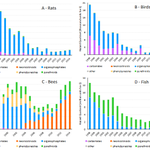

New paper on the impacts of GE crop adoption on applied pesticide toxicity in U.S. corn and soybeans. @kstateagecon
authors.elsevier.com/c/1h1jx…
Birds versus bees: Here are the winners and losers in the great pesticide trade-off sciencemag.org/news/2021/04/…
1
Paper on neonicotinoids is now out in JEEM: authors.elsevier.com/a/1ax2E…
Thread below still applies.


Recent work w/GianCarlo Moschini on #neonicotinoid use in U.S. maize. Using ~89K surveys from '98-'14, we assess the impact of neonic adoption on trad. #insecticide use. We find a ban, as in EU, would not be a risk-free answer to falling #bee pop. Thread https://teapaw.org/t.co/ShxAxJ8vi4
Recent work w/GianCarlo Moschini on #neonicotinoid use in U.S. maize. Using ~89K surveys from '98-'14, we assess the impact of neonic adoption on trad. #insecticide use. We find a ban, as in EU, would not be a risk-free answer to falling #bee pop. Thread https://teapaw.org/t.co/ShxAxJ8vi4
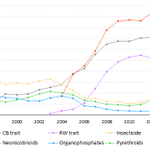
1) Neonic seed treatments intro'd in maize in '04. Rapidly adopted, along with GE insect resistant traits (CB & RW). We estimate that neonics reduced #pyrethroid & #organophosphate use by 52% & 47%, resp. GE maize also reduced insecticide use, but by less than neonics.

1
Great synopsis by @mattsclancy on my recent paper w/G. Moschini & D. Hennessy in JEBO. After glyphosate went off patent in 2000, products w/higher concentration levels entered. We study how farmers used these products & find evidence of historical inertia
doi.org/10.1016/j.jebo.2018.…

Very cool paper from @EdPerry285, David Hennessy, and GianCarlo Moschini forthcoming in JEBO. Are firms (specifically farms) as rational as we like to assume? Maybe not! Thread: sciencedirect.com/science/ar…
