

Connecting people and Materials. Cui bono? Transformation, innovation & design. For prosperity w/ nano technology.
🇨🇭🇩🇪🇪🇺🇺🇸🌍🌞🌌
Joined July 2019
- Tweets4.4K
- Following1.8K
- Followers398
- Likes2K
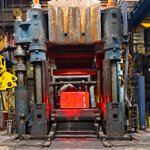




GMH has put one of Europe’s larger open-die presses back into service in Wetzlar.
80 MN at Buderus Edelstahl. Extra capacity for the large, high-integrity forgings that nuclear, turbine shafts, shipbuilding and energy infrastructure actually order. Think steam and gas turbine power shafts.
Asia runs the biggest units. Europe is bringing dormant capacity back online where the order books are real.


So the city of exquisite high paying banks focusing on ultra high net worth individuals is becoming to expensive for those very banks.
And robotics is really here to take over control.
I just wonder what that means for the notoriously tight housing market.
Most investment cases name their risks. Far fewer name the observation that would end the investment.
The difference is not semantic. A risk is something that might happen. A stop condition is a decision rule:
a specific, observable event that, if it occurs, ends or redirects the allocation without requiring a new argument. Risks get managed. Stop conditions get triggered.
They are rare for structural rather than intellectual reasons. Naming the condition that would kill a proposal, inside the document that asks for approval of that proposal, reads as arguing against yourself.
The incentive runs the other way, and it runs that way for competent and honest people.
Two things make it easier.
First, write it before approval rather than after. Once capital is committed the same sentence changes meaning: it stops being a criterion and starts being an accusation. Stage-Gate practice puts explicit go, kill, hold and recycle criteria at each gate for this reason: the decision rule is agreed while all the outcomes are still open.
Second, separate writing the condition from owning the outcome. In cross-functional teams it’s not uncommon to find different functions hold different standards of proof, and that difference is not irrationality. That diffenrces is the job.
Someone whose performance does not depend on the project continuing will write a cleaner condition than the sponsor, and will still believe it a year later.
Gary Klein's premortem is the cheapest version: assume the project has already failed, then ask the room to say why. It works because it converts a disloyal question into an assigned task.
A usable stop condition has four parts:
- the observation, stated so that two people would agree it had happened;
- the date or milestone at which it is checked;
- the person who checks it, and who does not carry the outcome;
- what follows on the trigger: stop, resize, or hand to a different route?
Anything missing one of the four is a sentiment rather than a condition.
The failures that get remembered are rarely failures of foresight. In most of them somebody named the condition, on time, in writing. It was read as pessimism, or as a threat to a plan that had already acquired its own momentum, and the ride continued.
A crossroads is not a place of despair. It is the last point at which turning is still cheap.
Who is allowed to write the stop condition, and do they own the outcome?
Image: Woman Holding a Balance, c. 1664, Johannes Vermeer.

Seeing a lot of labor/wage arbitrage in 2026.
Looks like it sits somewhere between
- operational excellence aka cost cutting,
- economic-aid aka sending money to lower wage / developing countries,
- ...
Pretty confident there are higher order effects that are being neglected by many. Best of luck to you.
The miracle of an interdependent economy machine creates is frankly unimaginable by so many.
teapaw.org/macyagilliam/status/20…


Heterogeneous integration across the scales. Integrated industrial complex’ and integrated (heterogenous) circuits share a few concepts.
Let’s dive into metaphors for a moment.
Photons are like rail cars, they can’t get around very tight corners, it takes quite some extra effort to load and unload them, the further you can integrate them into your infrastructure, the more effective and efficient they become, they can carry vast amounts on thin lines — so businesses go to great lengths to utilize them businesses.
And analogous: electrons are like automobiles, they just need general pavement, which also is much easier to maintain, on that pavement they can get to where they are needed not ultra fast but with a good enough combination of speed and flexibility.
It’s all helicopters!
Choppers are back!


Jona Engel retweeted

If DefendTex can pass the DARPA course, they will likely win
Their drone is 12lbs with a 112 lb payload weight (9.63:1)
The top teams don't want to crash out of competition before graded runs, so there are a lot of test flights