

Sports Law Program Mgr., Tulane Center for Sport. Thoughts are my own on sports & the law.
New Orleans, LA
Joined June 2025
- Tweets1.2K
- Following1.1K
- Followers988
- Likes1.1K




Pinned Tweet
The question is whether it makes sense to treat college sports as a 500,000 athlete monolith, with the same governance for football as for swimming & golf.
In practice, college sports has developed into two versions: revenue-generating and not.
Why not treat non-revenue differently, and truly tied to the educational experience? While big-time college sports (an amazing tradition) carries on with a revenue-based model.
We wrote more about the legal benefits of this model here:
journals.law.harvard.edu/jse…

Patterson is a big one in the world of eligibility cases- potentially billions (with a B) of dollars at stake.
Trial is set for over 2 years away, but there’s not the same urgency as in most other eligibility cases.
That’s because Patterson is no longer seeking extra seasons for the plaintiffs, it now seeks only damages. In other words, the money athletes claim they lost out on because they were denied additional seasons under NCAA rules.
Patterson is a class action for potentially thousands of athletes who played from 2020 onward, so IF (big if) the case actually makes it to trial and the athletes win, the award could be enormous.


Eric Blevins retweeted

An eye-raising new lawsuit filed this evening: two former and one current NCAA Division III athletes filed suit against the NCAA over Division III rules barring athletic scholarship, claiming that the restriction amounts to illegal price fixing under antitrust law.


Eric Blevins retweeted

UPDATE: Oral arguments in the Georgia five-for-five appeal, Godfrey v. NCAA, are scheduled for January 12, 2027, well into the college basketball season.
With the injunction currently stayed, sources familiar with the case tell SBI that the plaintiffs are considering additional avenues for relief if the Georgia Supreme Court does not lift the stay.
Separately, SBI has confirmed that Texas Tech's Jamichael Stillwell is withdrawing from the Georgia lawsuit. According to an attorney involved in the case, the withdrawal process is underway, although the paperwork's completion has not yet been confirmed.
If Stillwell's withdrawal is finalized without prejudice, it could open the door to pursuing separate legal relief in Lubbock, where teammate Donovan Atwell recently secured a temporary injunction against the NCAA.


Eric Blevins retweeted
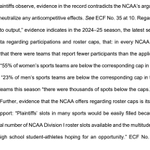
Some pretty mind-blowing numbers from an NCAA brief filed today (in the Daley case in Indiana).

The Wells case in Kentucky continues to move fast with another TRO for the athletes today. This is a "class of 2022" case with athletes seeking a 5th season under the new 5-in-5 rule.
These athletes won an injunction in August, which got reversed 2 weeks ago and sent back to the trial court, which today granted a TRO.
Not surprised the court made a quick ruling here. The appeals court reversed largely on technical grounds (there was a dispute over the type of injunction the trial court granted in august, and whether it had sufficient evidence in the record to grant it).
But the reasoning is extremely interesting. Quick🧵

Breaking . . .Judge Edwards grants a temporary injunction. The athletes can play. The NCAA loses another one today. The opinion (18 pages in PDF)
juryverdicts.net/NCAATempInj…
@samcehrlich @WinterSportsLaw
The appeals court- which this court has to follow- rejected the argument that the new 5-in-5 rule gives the athletes another season on its face. The appeals court said the rule doesn't apply retroactively (in the athletes' favor) under rules of legislative interpretation
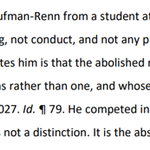
But check out the excerpt below from this new decision. The trial court essentially says "I respect that, but..." the court still thinks the rule works in the athletes' favor.
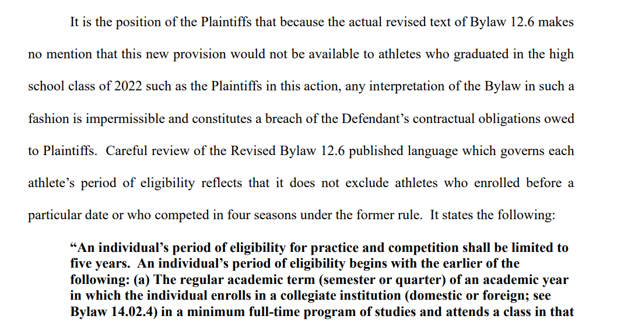

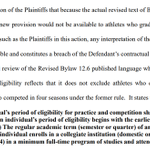
And just in case the appeals court still believes the rule doesn't give the athletes another year under its plain language, the court goes on to rule in the athletes favor for a 2nd reason.
It's this 2nd excerpt below: the court found that the NCAA's treatment of the class of '22 is inconsistent with others who received waivers for 6th and 7th years for other reasons.
A bit of a belt & suspenders approach. Trial courts don't like to be reversed.

Big news this morning and here's a quick breakdown of the NCAA's claims in their lawsuit against the Ohio governor:
1. Commerce Clause
The U.S. Constitution generally forbids state laws that favor in-state economic interests over external, or that overly burden interstate commerce without justification.
The NCAA argues that the governor's EO puts out-of-state schools/athletes at a competitive disadvantage against Ohio schools who use the EO to roster more-experienced players. It also argues there's a financial impact, if the Ohio teams earn bigger $ distributions from NCAA bball tournament success aided by these athletes.
The NCAA won a major 1992 case on this issue, NCAA v. Miller, which held that a Nevada law usurping the NCAA's infractions committee violated the Commerce Clause because it "severely restrict[ed] the NCAA from establishing uniform rules" to govern college sports. The NCAA cites it and presses a similar argument here.
But expect the Ohio defendants to argue that, unlike the Nevada law in Miller, the Ohio EO does not alter the NCAA's procedures or burden other states, but instead only directs Ohio schools on how they should act (allow the c/o '22 athletes to play). Unclear how the court will rule on this.
2. First Amendment
This is similar to the SEC's argument in its pending lawsuit against LSU, with different facts.
The First Amendment gives a right to voluntary associations like the NCAA to decide who it does, and doesn't, want to associate with.
The NCAA argues here that the Ohio EO forces NCAA members to associate against their will with Ohio schools who don't follow NCAA eligibility decisions. The EO likely confers standing (which is a question in the SEC v. LSU case). But there's more to the analysis.
The First Amendment only protects "expressive activity," and there's a question whether the NCAA's eligibility rules qualify as protected expression. The NCAA spends a lot of ink in their lawsuit on this question, suggesting they know it's a novel issue.
3. The EO violates Ohio state law
Lastly, the NCAA argues that the Ohio governor's EO exceeds his authority and is invalid under Ohio state law.
The first two are the more intriguing arguments and would have widespread implications since they involve the U.S. Constitution's application to the NCAA.
In a landmark moment, the NCAA is suing a sitting state governor, Ohio’s Mike DeWine, over his executive order on eligibility. NCAA calls the EO a “misguided attempt” to give Ohio colleges a “hall pass to break rules,” per docs obtained by @YahooSports.
bit.ly/4ytwzK2

Eric Blevins retweeted
Big news and there are potential legal implications to the format (the last thing anyone wants to hear).
Specifically, antitrust issues.
Keep an eye on any new rules for non-P4 teams to access the playoff. I wrote back in 2011 on antitrust issues with the old BCS format (below).
My conclusion then was actually that a playoff was a less-restrictive (read: more likely legal) alternative to the BCS, but one might craft an argument that overly-restrictive playoff access for certain schools raises a potential antitrust flag too.

Eric Blevins retweeted

Sources: The College Football Playoff is nearing a deal to expand to 24 teams, per sources. The new format will start in 2027 and is expected to come together in the near future, pending final approvals.

Eric Blevins retweeted
The Ohio Supreme Court has ordered briefing on the impact of Governor DeWine's executive on the Borovicanin five-for-five case.
In the meantime, it has stayed the decision of the Ohio Court of Appeals -- restoring the lower court's injunction and making those players eligible.

A federal appeals court will hear argument on one of the most significant eligibility cases this morning at 11a ET. Thousands of athletes' eligibility to play this season is at stake in Wisne v. NCAA.
The plaintiffs are the "class of 2022" D1 athletes who the NCAA has denied a 5th season under the new 5-in-5 rule.
It's a complicated antitrust case with lots of moving parts, but it may come down to 2 big-picture issues. I think it will be a close call.
A quick 🧵breaking them down:

First, a threshold issue is whether the plaintiffs released their Wisne claims as part of the House settlement.
Recall that House itself was a class action lawsuit in which all D1 athletes from June 2020 onward settled in exchange for the new revenue-sharing system with the ~$20M annual cap (and other damages). Importantly, the Wisne plaintiffs are part of the House class.
The question is, does the House settlement's language encompass their current claims against the 5-in-5 rule?
The district court said no. It found that the House settlement released *monetary* benefits claims, but not the *eligibility* claims at issue in Wisne.

One of the judges is really pushing the athletes' counsel on the evidence of the relevant market. The judge sounds skeptical that the athletes have offered enough evidence required to define the market.
You don't want to read too much into judges' questions, but the emphasis on this issue overall across this hearing probably suggests that the court considers this a significant issue.
Not surprising since it's been the biggest issue for other federal appeals courts.
/3
That's it for oral argument. There are several different issues that could decide this case, but the argument really revolved around just 1:
Did plaintiffs offer sufficient evidence of the relevant market?
The judges asked a lot of questions on this. At least one sounded skeptical of plaintiffs argument (don't want to read too much into that).
Just based on oral argument, it sounds like the decision may turn largely on this issue. /4
Really interesting question from the court just now, who observed that the PCSA- which contains an antitrust exemption- has passed the Senate:
The court asks if they should hold off on deciding this case until Congress acts or doesn't on the PCSA.
Plaintiff's counsel unsurprisingly disagrees.
/2
Eric Blevins retweeted
And as I was writing, @EricJBlevins posted a thread that focuses much more on the legal issues at play, so read that too. :) xitter.cf/EricJBlevins/status/21…

A federal appeals court will hear argument on one of the most significant eligibility cases this morning at 11a ET. Thousands of athletes' eligibility to play this season is at stake in Wisne v. NCAA.
The plaintiffs are the "class of 2022" D1 athletes who the NCAA has denied a 5th season under the new 5-in-5 rule.
It's a complicated antitrust case with lots of moving parts, but it may come down to 2 big-picture issues. I think it will be a close call.
A quick 🧵breaking them down:
But this evidence question is only the starting point for their antitrust claim.
For the athletes to win, the 10th Circuit must then find that they actually showed that the 5-in-5 rule has caused anticompetitive harm to the relevant market under the "Rule of Reason" test.
The district court found that the plaintiffs satisfied that test (excerpt below).
But another federal district court (Cruz) recently ruled the opposite.

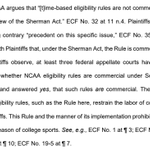
One further issue at play here, but that I am comfortable making a prediction on: whether the new eligibility rule is "commercial in nature." The 10th Circuit will almost certainly find that it is.
Rules that aren't commercial are not subject to antitrust scrutiny at all, so the NCAA has made that argument in all these cases.
But every other federal appeals court to consider this question has ruled against the NCAA (as highlighted by the Wisne district court below) and I expect the 10th to do the same.
