
Senior Macro Strategist & Head of Flows of Funds @vandaresearch Views my own.
Washington DC
Joined July 2013
- Tweets5K
- Following2.9K
- Followers5.3K
- Likes9.3K









Alex Etra retweeted

THE PERKINI REPORT: THE 2028 REALITY CRISIS
What if the most obvious financial bubble in all of history turns out to be.... a bubble... and what if that is just really.... bearish?
there were signs, there are always signs 🤣
free link:
hub.tslombard.com/the-perkin…
inspired by @citrini


Alex Etra retweeted

Tearing down the East Wing and ruining the Reflecting Pool are bad, but symbolically so. This makes the experience of living in DC as a normal person – turning a place for cycling, fishing, birding, picnicking, and cheap golf into a playground for the rich – materially worse.


And to 🤔, we used to do valuation adjusted change in holdings to *estimate the flows.* Think about what a repo/prime brokerage book + valuation effects on a growing [nominal] stock of liabilities would do to such estimates...


"God, grant me the serenity to accept the things I cannot *understand*, the courage to *understand* the things I can, and the wisdom to know the difference."

New blog on the Treasury cash-futs basis: Contract design, higher yields make basis trade alternatives attractive
1/n
As many of you are already aware, the basis trade has plateaued over the past year (CFTC data and sponsored repo volumes show it). Two most common explanations offered:
(i) trade has become too crowded competing returns down.
(ii) SLR relief has allowed dealers to warehouse more Tsys, which they hedge by shorting futures - displacing HFs/reducing returns available
We argue both fall short: (i) might explain which HFs might be in the trade but not aggregate positioning and (ii) does little to explain why asset managers (AM) longs plateaued. Instead we argue the long-end basis has narrowed for reasons tied to the mechanics of the futures contract and the level of yields, and HFs now have a comparable alternative.


Alex Etra retweeted

New blog on the Treasury cash-futs basis: Contract design, higher yields make basis trade alternatives attractive
1/n
As many of you are already aware, the basis trade has plateaued over the past year (CFTC data and sponsored repo volumes show it). Two most common explanations offered:
(i) trade has become too crowded competing returns down.
(ii) SLR relief has allowed dealers to warehouse more Tsys, which they hedge by shorting futures - displacing HFs/reducing returns available
We argue both fall short: (i) might explain which HFs might be in the trade but not aggregate positioning and (ii) does little to explain why asset managers (AM) longs plateaued. Instead we argue the long-end basis has narrowed for reasons tied to the mechanics of the futures contract and the level of yields, and HFs now have a comparable alternative.

According to new analysis asset managers have increasingly found the cash-futures basis trade less attractive relative to alternatives, including swaps linked to new debt issuance tied to data center construction in support of artificial intelligence (AI). dallasfed.org/research/econo…

Great way to end off the week with the indomitable @jstatistic acknowledging he *might* have learned something from my cocktail napkin 18 months ago. 🤣
Well Jay, I think we are overdue for another Negroni! Shall we convene the brain trust?
Alex Etra retweeted

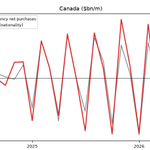
What’s behind the saw-tooth in Canadian Treasury holdings and money-fund repo to Canadian banks? Mostly the well-known window-dressing by dealers around reporting dates. But I think it masks the bigger takeaway.


First, while I do note the increase in the holdings of LT UST & Agency bonds by Canadian residents in TIC, I also have previously shown that the month to month variation in these holdings is a function of US MMF repo lending to Canadian residents...2/n
xitter.cf/EtraAlex/status/194597…
...with dealers intermediating flows between real money investors (including SWFs, pensions and reserve managers) and NBFIs? cc @jstatistic 8/n imf.org/-/media/files/public…
federalreserve.gov/econres/n…
Or perhaps as the @cepr_org Geneva 29 Report on Global Imbalances (cc @AngelUbide) put it (more elegantly than I could have), there is a new "trilemma" in global finance.../end
cepr.org/publications/books-…

This remains the case, as it has since roughly early 2025...but while this relationship is particularly striking in the case of Canada it is not only Canada...3/n

That Euroclear launched a new DVP UST repo service and the first transaction involved TD Bank (London)...? All of which is to say, yes, it could be China, but then it might not only be Canada but other European custodial and financial centers too...? 6/n
xitter.cf/EtraAlex/status/196909…
Too many coincidences here...?
"The first trade was completed on 6 February 2025 between Euroclear Bank and *Toronto Dominion Bank London.*"
euroclear.com/newsandinsight…

If China was merely shifting its holdings from US custodians to foreign custodians, its not obvious why we would observe this pattern of repo/sec lending. I do note however that it is an interesting coincidence that around the time Canada's repo borrowing/TIC buying picked up 5/n
We see a similar pattern also in the case of Spain and to a lesser though still notable extent in the case of France and the UK....4/n

@xieyebloomberg et al have a nice piece also featuring @Brad_Setser on one of my white🐳
cc @AitkenAdvisors @dismaleconomist
bloomberg.com/news/articles/…
I don't want to pooh pooh the China hypothesis, but I also think it may be a bit more nuanced. Let me try and explain why...1/n
First, while I do note the increase in the holdings of LT UST & Agency bonds by Canadian residents in TIC, I also have previously shown that the month to month variation in these holdings is a function of US MMF repo lending to Canadian residents...2/n
xitter.cf/EtraAlex/status/194597…
It reflects repo activity of Canadian banks. I am reasonably confident when we get June data we will see a decline in LT UST/Agency flows from Canada 😉
The bigger question is: Just how much of foreign private LT flows are funded on repo? cc @Brad_Setser @jstatistic @aRishisays


