

TRUSTED BY WATCH ENTHUSIASTS SINCE 1993
Boston, MA
Joined January 2012
- Tweets18.2K
- Following4.2K
- Followers9.2K
- Likes1.9K


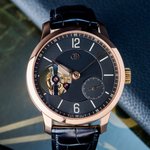

The famous Daniel Roth double-ellipse case is back. It's full of detail but so subtle you have to look closer to really get it. The new guilloché dial finish is tremendous, the hands are stunning, and nothing else in the watch world looks like it.
Turn it over and you'll find the manual-wind Caliber DR002, developed from scratch for this collection. Simplicity at its finest. From design to execution, it's a 10 out of 10.
Is this the best independent-style dress watch of the year?
Ten hours of guilloché go into this dial, and one of the machines doing it dates from the mid-1800s.
The dials are all engraved by hand on engine turning lathes, not milled. One artisan turns both components of the dial, with the border pattern on the chapter ring coming off that 1850s machine. The two tones are two different golds, a solid white gold base, unplated, with a 5N rose gold ring laid into it.
The movement was designed around the case rather than dropped into it. The DR002 is shaped to the double ellipse, built from scratch for this watch by Michel Navas and Enrico Barbasini, the two watchmakers who made Laurent Ferrier’s calibres. One watchmaker finishes and assembles each one.
It is thicker than the watch it revives, which was a deliberate decision. The 1990 original was 6.7mm. This is 7.7mm, because going thinner would have broken the symmetry of the moulding running around the case.
One thing the name on the dial doesn’t tell you. Daniel Roth is alive, in his eighties, and has no hand in the brand that carries his name. He is asked for his opinion and that is where it ends. He does still build watches himself, three or four a year, under the name Jean Daniel Nicolas.
Available now on our website!


The Lange Datograph is recognizable from across the room, thanks to that oversized big date and the German silver chronograph sub-dials. When it came out, it was a milestone for Lange and for German watchmaking. Its in-house chronograph movement raised the bar for every Swiss and European manufacturer.
Each detail adds to the rarity. The Datograph is special. The rose gold Dufourograph with the black dial is more special still. On the original bracelet, it's dream-collection material for both of us.
Which Lange would you add first: the Datograph, the Lange 1 or the Zeitwerk?
Moser spent ten years making fun of the smartwatch...and then debuted this
.
They are not pretending this is anything other than what it is. Asked whether it is mechanical or smart, the brand's own answer is that it is neither. They say that it has one foot in each category without belonging to either.
One wireless charge runs it for a year in time only mode. The charger is barely bigger than a coin because you will almost never need it.
What it deliberately will not do is count your steps, read your heart rate, or tell you an email has arrived. Instead, it offers a perpetual calendar, a moonphase programmed for the next hundred years, sunrise and sunset to within a minute and a half, and a split seconds chronograph to a hundredth. Press the button at 9 and it gives you ten essential words in any of 21 languages.
Take a look at the dial. The electronics aren’t hidden, they're the decoration, framed under a skeletonised dial.


Philips Auction starts TOMORROW! Here is Justin and Rob's guess for the Roled 6062.
Phillips is calling the "Time Capsule Stelline", was launched at Basel in 1950 and is reportedly from the original owner. It's untouched, as it left the factory. It's an automatic triple calendar with moonphase in a waterproof Oyster case, the kind of vintage Rolex find that comes up once in a generation.
The minute hand on this watch travels 240 degrees over the course of an hour, then resets and flies back in one hundredth of a second.
URWERK normally uses a 120 degree arc, but for this watch they doubled it, specifically so you would be able to see the jump happen. As a bonus, in the same hundredth of a second, the three hour satellites rotate 270 degrees underneath it.
There are no hour hands at all. Three discs each carry four numerals, and the open minute hand frames whichever one is in play rather than pointing at it.
To do it, they threw out the mechanism they had used for decades and replaced it with a cam and rack, which needed a spring so specific they had to machine it themselves. Then they had to figure out how to stop the hand from tearing itself apart. The brake is a speed regulator of the kind normally used to govern the chiming sequence of a minute repeater, which is why the jump looks controlled rather than violent.
The name comes from the shape that 240 degree track makes on the dial. With a tail, curved and raised at the end, URWERK named it after the stinger.
Coming to our website soon..


Guess what... Justin picks a CARTIER
For the upcoming Phillips watch auction this weekend, Justin wanted to discuss Lot 217, which is an early-'90s Cartier Cloche: full guilloché dial, Breguet numerals all the way around, blued hands. It's a shot-for-shot remake of the original 1920s Cloche. Justin's guess is $85K. Too high or too low?
Before Franck Muller was Franck Muller, the dial just said "Franck Genève."
Lot 105 at the Phillips watch auction is a very early Franck Muller perpetual calendar minute repeater in a J.P. Hagmann case, with a hand-guilloché dial. It's a piece unique, and it's number one. One of us says $400–500K, the other isn't so sure. Where do you think it lands?
There is a bubble blown into the sapphire on the back of this watch, specifically placed there because the tourbillon would not fit without it.
The cage sits at 25 degrees. Tilted that far it breaks through the plane of the movement bridges, so Greubel Forsey domed the crystal to give it somewhere to go. The cage turns inside what the brand calls a light well.
The 24 seconds isn't random, it's a gear ratio. The cage turns two and a half times faster than a conventional tourbillon, which is also why the watch needs a separate seconds hand. The cage moves too fast to double as one.
Tilting the cage also meant the teeth had to be cut on an angle to meet it. Greubel Forsey had to develop an inclined gear profile and a cage light enough to carry it. 86 parts, just 0.38 of a gram.
Look at the lower bridge through the dome. Hand polished to a shape the brand compares to a Romanesque vault, and so difficult to finish that the artisan who does it signs each one.
Greubel Forsey built 55 of these in total. Not 55 a year, 55 across five years and three metals, before the model was retired.
Coming to our website soon..


Shipping this down the street would cost us $1,000 😂
A platinum Omega Seamaster James Bond 007 edition that came with an actual Globetrotter suitcase. Take the stuffing out and it's a weekend bag. Craziest Watch Extras, Part 3: imagine putting this on the TSA conveyor belt.
Only 15 ever made, which is why you've probably never seen one.
Lot 82 at the Phillips watch auction is the Patek Philippe 5950R-010, a rose gold split-seconds chronograph in Patek's TV-shaped cushion case, with that Western motif. Rob's guess is around 630k. Is this the direction Patek Philippe should be going?
For fifteen years, the only way to get a Patek world timer this small was with a diamond bezel.
The 36mm world time arrived in 2011 and Patek only ever offered it with a gem-set bezel. This is the first one without. Same case, 36mm across and 8.83mm thick, and nothing on the bezel at all.
Patek calls the color of this dial “Carmine red”, and it’s used on the dial, the city disc and even the strap. Look closely at the centre and you’ll find hand guilloché in a traditional basket weave pattern, cut first and then lacquered over. The city names on top of it are transfer printed in white. Two completely different crafts on one dial.
Press the pusher at 10, and the city disc, the 24-hour ring, and the hour hand all step to the next zone together. The minute hand never stops, and the movement doesn’t lose a second doing it. Patek spent four years developing the complication and patented it in 1999.
The man who invented the world time system never worked for Patek. Louis Cottier built his in 1931, having grown up around the idea, since his father had presented a version of it back in 1885. Between 1937 and 1965 he supplied Patek with around 380 movements, and often made the gold hands for them himself.
One detail worth noting on this model - the city ring features Beijing while earlier watches in the line listed Hong Kong.
Available now on our website!


This upcoming weekend at the Phillips watch auction, lot 107 is the Harry Winston Opus One by F.P. Journe. It's one of only six Opus One tourbillons, every one a piece unique, and this is the turquoise dial, made right as François-Paul Journe was launching his own brand.
One of us said 3.5. The other said 1.8–2 million. Who do you think is closer? 👀
Drop your hammer price guess in the comments! We wanna see what you think it'll go for
The dial on this Lange 1 forced the brand to develop a new caliber.
Mother of Pearl is thicker than the German silver that Lange normally uses, meaning the hands sat too low. Lange lengthened the pinions to lift the hand stack clear and called the resulting caliber the L901.4. Same movement as every other Lange 1, adjusted for this specific dial. The case had to grow too. Diameter stayed at 38.5mm, but thickness went up about half a millimetre, entirely to make room for a slice of shell.
And it isn't solid shell. Lange describes its own mother of pearl dials as a very thin layer laid over a solid silver base, which is why the watch still behaves like a Lange 1 underneath.
It arrived in 2001 as one of a pair. This one on a strap, and a second reference, the 160.029, on an integrated white gold bracelet built for Lange by the jeweller Wellendorff. At launch the strap version was 18,700 euros and the bracelet version 29,100, so the bracelet alone cost more than half the watch again.
The plain Mother of Pearl version had the shortest run of the family. Gone from the catalogue by the middle of the decade, while the guilloché version carried on to 2009. And Lange has no Mother of Pearl in the collection at all today.
Available now.


We had the honor to see this beautiful new piece from Ferdinand Berthoud, shown to us at NYC WatchTime.
Pull the crown and the tourbillon stops. Push it back and it resets itself. Flip it over and you can see the lever and snail cam that force it to always move in the same direction.
You can check out the full NYC WatchTime Recap on our YouTube!
There’s a window cut into the side of the case so you can watch the hairspring “breathe”.
That hairspring is cylindrical, something almost nobody attempts outside of in a tourbillon, because standing the spring upright makes it misbehave in the flat positions. Berthoud sent it to COSC anyway, and it came back as the only mechanical movement with a cylindrical hairspring ever to pass.
Getting there took two more years of regulating after the movement was already finished. Both terminal curves are formed by hand and checked at twenty times magnification.
There’s no dial. The mainplate sits in the middle of the movement rather than behind a dial, with six bridges in front of it and ten behind, so the thing you read the time off is the mechanism itself.
It isn’t a limited edition, but the workshop in Fleurier simply cannot build more than 25 of them in a year.
The round case is a tribute. It comes from a decimal watch Louis Berthoud made in 1793, which the company owns and keeps at Fleurier.


EP 20 of ranking EVERY watch brand... G-SHOCK!
Can a hundred dollar watch be ranked against Patek and Lange?
That was Justin’s problem with G-Shock Not where it lands, but whether it belongs on the list at all.
Rob had no such hesitation. He wanted it between A and B and said so straight away. Justin countered with C tier.
But Rob just isn't having it...
Where would you have G-Shock?
The disc that spells out the day on this watch has seven holes punched through it.
It has to. That disc runs almost the full width of the dial, so left solid it would cover the date disc underneath completely. Seven apertures, evenly spaced, mean the correct date is always sitting in the window at 3 no matter which day is showing at 12.
Rolex patented that design in 1955, and it left a fingerprint. Every Day-Date caliber since has ended in -55. The 1055, then the 3055, then the 3155, and the one in this watch, the 3255.
Now look at what those two windows are cut out of. The crystal pattern in meteorite forms as the material cools by a few degrees every million years, and it cannot be recreated on earth. The Day-Date is the only Rolex that has to take two openings out of a single slice of it.
The Day-Date has never been sold in steel. Not once since 1956. Gold or platinum only, which is why a factory diamond bezel reads as standard equipment here rather than as an addition.
The word President belongs to the bracelet, not the watch. Rolex built the Presidential bracelet in 1956 for the Day-Date launch and has never used the name for the watch itself. That came from somewhere between the bracelet and Lyndon Johnson wearing one.


There is SO MUCH, yet it's so subtle. A split seconds chronograph and a perpetual calendar, in a movement 7.3mm thick.
That’s the whole argument for this watch. The base caliber is 5.25mm, the perpetual calendar module adds another 2.05mm, and Patek has never built a thinner rattrapante perpetual. The case lands at 37mm across and 12.35mm thick, which is small for a grand complication and remarkably small for this one.
Rob’s point was that nothing about it announces any of that. One button runs the chronograph, the dial is black, and the platinum case is something you’d have to pick up to identify. Justin agreed, and it’s already one of his favorite modern Pateks.
This watch is named after the month in which the tourbillon was patented.
Abraham-Louis Breguet patented the tourbillon on 7 Messidor, Year IX, in the French Republican calendar. (Or the 26th of June 1801 for those of you not familiar with revolutionary French calendars…)
Now look at how the cage is held, because it isn’t. There’s no visible connection to anything at all. The drive wheel is sapphire and the upper pivot sits in a sapphire bridge, so the whole mechanism appears to be turning in air.
Breguet filed the patent for that idea in 2004 and launched this watch in 2007. Cartier, the other manufacturer known for this kind of complication, was still six years away from making a mystery wristwatch of any kind.
There’s no seconds hand either. The seconds come off the tourbillon shaft, so the cage turning once a minute acts as the seconds hand. The dial is sapphire, so there’s nothing between you and the mechanism.
The model has never been a limited edition, Breguet simply never made very many. Nineteen years after it launched the watch is still in the catalogue.
Available now on our website!


