
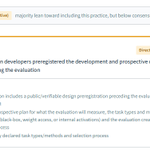



This is exactly why it's important to be transparent about the details of an evaluation, including what is being evaluated, and how.
teapaw.org/kimocode/status/207960…

Yes — model makers quietly went from benchmarking LLMs to benchmarking LLM+harness, without relabeling. Same leaderboard, different system under test. teapaw.org/kimocode/status/207943…
1
3
294
Important points about automated evaluations, which (unsurprisingly) align with our consensus recommendations around how to deal with LLM-judges, design with expert input and human review of failures, and the need to investigate and document failure patterns in your evaluations.

New Blog Post: Do Automated Evals Work?
There has been a rise of tools that look through your traces with AI and identifies issues. We tested these tools with real production data to see how good they are.
Where they shine
- They often spot issues human miss
- Integrate into your workflow: viewing traces, creating LLM judges etc.
Where they fall short
- They miss problems that require domain expertise and taste
- Don't have great mechanisms to learn from human feedback
- You can get similar results from using your coding agent
So you should use them? Yes, BUT do so iteratively with you in the loop. We describe how in the post: parlance-labs.com/blog/posts…
It's also a good idea to try using your coding agent with you in the loop, which we discuss in the post.
This was written with @doesdatmaksense , who led the research and collated the results.

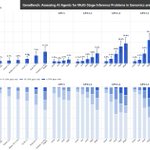
GeneBench-Pro is a fantastic, well thought out benchmark... which makes it a great choice for reviewing what it does and does not do from our consensus practices.
And it does a fantastic job on construct clarity and many other points - but falls somewhat short a few places. 🧵

We’re introducing GeneBench-Pro, a research-level benchmark for a harder kind of AI progress: how well agents can navigate messy biological data, choose the right analysis path, and make judgment calls that real computational research depends on.
openai.com/index/introducing…

Building your own benchmarks is very valuable, but it can also be done poorly.
Our consensus process was mostly for developer and reported benchmarks, but if you want to build your own, it's very worth looking at @AnkaReuel et al's BetterBench Design criteria.


We promised a consensus statement with endorsements once we had something real to endorse, so we couldn't quietly bail later.
Now, the work is done, and we have results - which means endorsement is open! And a cross-sector crowd signed on before we even hit publish. 🧵
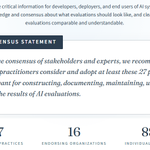
For months we've been saying AI eval results are load-bearing, and that the field quietly agrees with itself more than the chaos lets on.
We ran the numbers, and it turned out we were right! (Which is nice, since we preregistered and need to share the results either way.) 🧵
There’s a remarkable level of consensus already about AI evaluation practices - not universal, but broad. We’ll be sharing the results broadly soon, but we want to discuss a few places where consensus doesn’t exist, and our approach. 🧵
As a preface and methodological reminder for those who haven’t read our riveting 36 page pre-registered protocol, there are four groups included; academics + civil society, AI labs + industry, Auditors + third party evaluators, and AISIs + regulators. evals-consensus.ai/protocol
1
16
Everyone says we need better evals - but why does a consensus process help?
The short answer is that common knowledge encourages coordination, and makes bad practices more costly.
The long answer is a thread.🧵
The hard work of understanding what practices should be used, was done.
It was done by @GSCollins’ TRIPOD+AI / @TRIPODStatement, @AnkaReuel’s BetterBench, @kevinlwei & @prpaskov’s baselines work, @percyliang & @RishiBommasani's HELM, @teganmccaslin2 & @lucafrighetti’s STREAM…
1
20
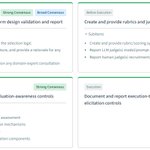
In our round 1, many participating AI evaluation experts noted that typical methods for addressing evaluation awareness are not reliable, thus not (yet) recommended.
@GeorgeBalston, @Miles_Brundage, @charlotte_stix; it's great to see this, as fixing this gap will be critical!

In the coming weeks, anyone interested in endorsing the results should be in touch; we’ll be sharing results with potential endorsers, then will open endorsement widely to labs, auditors, industry, organizations, academics, and civil society groups.

Preliminary results are starting to make that picture clearer. The interim results about what the process is surfacing are available to participants; if your organization has a stake in how AI evaluations are performed, your input is still welcome!
teapaw.org/EvalConsensusAI/status…
Last week, @davidmanheim argued that AI evaluation results are becoming load-bearing.
But that creates a problem:
How do we arrive at better common practices without first deciding who is in charge, or trying to dictate it ourselves? 🧵
teapaw.org/davidmanheim/status/20…
