

research fellow at Gonville & Caius College, Cambridge University. they/them. transing grammar; transing the climate.
- Tweets557
- Following531
- Followers477
- Likes1.1K


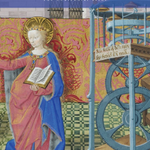




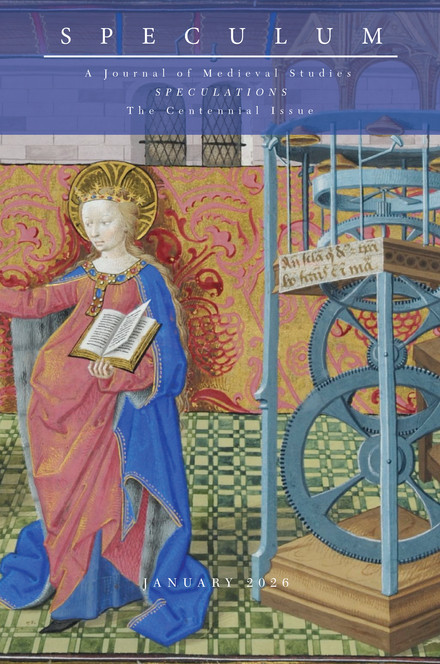
ALT The cover image for the centennial issue of the journal Speculum. It is illustrated by a detail from a fifteenth-century manuscript illumination, depicting Wisdom as a richly clothed woman, who holds open a book in her left hand. On the right of the illustration is an elaborate timekeeping device.


ALT A screenshot of my article in postmedieval, Nonbeenary gender: Bees and grammar in monastic culture circa 800-1070. Abstract: At the interface of grammar and nature, bees served as a figure of transgender identification for monks in England, France, and Germany circa 800–1070. Monks recognised bees as essential nonhuman participants in monastic life. Bees were associated with chastity, and communal life, but also with the arts of grammar and poetry. They were also known for their divergence from human sexual difference. Monastic writers used bees to conceptualise their own status in the sexual economy of their society, by experimenting with the grammatical genders used to refer to bees, identifying bees with monks, and rewriting the genders of monks in the process. This process of nonbeenary identification unfolds in Old English and Latin bee charms, and in the works of monastic writers including Rainerus of Blandin, Bern of Reichenau, and Wulfstan of Winchester.

ALT An illustration from Munich, Bayerische Staatsbibliothek, Codex gall. 16 (the Psalter of Isabelle of France), folio 57r. It shows a man collecting bees as they fly out of their skep.


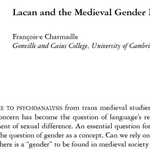
ALT Screenshot of my essay, "Lacan and the Medieval Gender Metaphor", showing the title and opening sentences. Said opening is as follows: "I come to Psychoanalysis from trans medieval studies because my primary concern has become the question of language's relation to the establishment of sexual difference. An essential question for transgender studies is the question of gender as a concept. Can we rely on the assumption that there is a "gender" to be found in medieval society and culture?

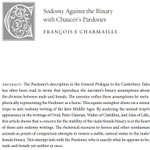
ALT A screenshot of the title and abstract of an article in The Chaucer Review. Sodomy Against the Binary with Chaucer’s Pardoner. Abstract: The Pardoner’s description in the General Prologue to the Canterbury Tales has often been read in terms that reproduce the narrator’s binary assumptions about the division between male and female. The narrator reifies these assumptions by metaphorically representing the Pardoner as a horse. This equine metaphor draws on a minor trope in anti-sodomy writing of the later Middle Ages. By analyzing the animal trope’s appearance in the writings of Ovid, Peter Damian, Walter of Châtillon, and Alan of Lille, this article shows that a concern for the stability of the male/female binary is at the heart of these anti-sodomy writings. The rhetorical recourse to horses and other nonhuman animals as points of comparison attempts to restore a stable, natural status to the male/female binary. This attempt fails with the Pardoner, who is exactly what he appears to be
