

Nonpartisan foreign policy think tank. Join the conversation: https://xitter.cf/t.co/gpEOozFWxj
Philadelphia PA USA
Joined August 2009
- Tweets26.8K
- Following473
- Followers34.1K
- Likes1.1K




Fall is a busy season for FPRI. Keep an eye on our events page for updates on in-person and virtual events. buff.ly/aNMtcyM

🆕 Ülle Madise: Could a Lawyer Unify Estonia? by Samuel Kramer buff.ly/v5djt57

In the latest episode of #ShiftingGround, @AmyJNelsonPhD describes her decade-long process in writing her book, The Arms Control Paradox: Managing Uncertainty in an Insecure World. The project solidified following multiple treaty violations, withdrawals, and increased nuclear saber-rattling.
Amy's experience in cognitive neuroscience, where she tested behavior under conditions of uncertainty, led her to her work in political state behavior and arms control (10:50). buff.ly/nO2XyLg

In Phil Wasielewski's latest analysis, he outlines the history of geopolitics in the Persian Gulf, primarily focusing on the relationship between the United States and Iran to provide context to the present-day war.
He details the beginning of the US-Iran conflict starting in 1979, the evolution of concerns over Iran's nuclear program, and where control over the Strait of Hormuz came into play. The piece emphasizes that the war is a part of an ongoing struggle to establish Iranian dominance in the region within a US-supported system or without it.
Check out the full analysis for more details: buff.ly/qHBOs9i

The latest #BearMarketBrief details an executive order Donald Trump signed that contradicts the Graham Act, which codifies sanctions on Russian energy, the military, and the shadow fleet. Trump signed the order two days before the Graham Act took effect. buff.ly/MSgJCqC

In a report for the Middle East Policy Council, Mohammed Salih breaks down Iraq's fasail—Iran-backed factions—and their influence network. He explains that the fasail operate both inside and outside of Iraq, with fasail groups maintaining ties to nearly a quarter of Iraq's parliamentary representatives as well as Iran's Axis of Resistance.
Read the full report here: buff.ly/yemcdsD

If you missed today's panel on Central Europe, catch the full discussion on our YouTube channel. FPRI was joined by New Eastern Europe to highlight the growing importance of the Visegrád Group countries. buff.ly/TqLCpaK

🗓️ Virtual Event | Thursday, October 29 | 10:30 AM EDT
In 2022, Haiti requested an international armed force to help it deal with armed gangs. Kenya volunteered to lead a police response, and the two countries signed a mutual security agreement in 2024. By 2026, Kenya began a phased withdrawal of its forces.
Join us for a panel discussion focusing on the lessons that senior decision-makers should take from Kenya's police deployment into Haiti. buff.ly/vn3Eqlo

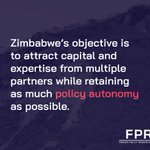
Zimbabwe’s mineral resources make its external relationships' economic dimension particularly consequential. Yet mineral wealth alone does not translate into strategic economic value. buff.ly/A6njf5Y

In their latest commentary for the #OrbisJournal, Junyang Hu and Jiayu Lai break down the dangers of miscalculating financial de-risking.
As US firms move their supply chains away from China, they detail the success of the United States in looking behind the "final-origin" claim—where the tag on an item says it is from—to factor in capacity, input sourcing, local value added, and shipping patterns.
However, even if a supply chain is considered diversified, in a crisis it may become clear that critical tools, minerals, and process knowledge heavily originate from China-linked networks. buff.ly/qyOl6by

Drawing on her distinguished career spanning academia, think tanks, and government service, Dr. Tamara Cofman Wittes offers unique insights on bridging the gap between scholarship and practice, navigating Middle East policy, and the ongoing struggles facing global democracy.
🟡 Listen to the full episode of #ShiftingGround buff.ly/a3tl6oW
A factory leaving China does not mean its supply chain has escaped China, and a product shipped through a connector economy may look different in trade statistics while important upstream dependencies remain tied to Chinese suppliers.
In such cases, interdependence is being redirected instead of severed, a pattern we call “triangulated interdependence.” #OrbisJournal buff.ly/qyOl6by

From the latest #BearMarketBrief
- US executive order waiving sanctions and tariffs under the Graham Act
- Russian government reshuffle, with changes across several ministries and regions
- Business leaders pushing against windfall and profit taxes buff.ly/MSgJCqC

🆕 The Geopolitics of the Persian Gulf and War with Iran by Philip Wasielewski buff.ly/qHBOs9i

Zimbabwe's shift to build deeper economic ties with the United States comes at the same time as US-Zimbabwe negotiations over US funding of health programs in the country failed.
The move reflects a desire to move beyond humanitarian assistance to focus on trade and investment opportunities. Read more by Simba Ruwodo buff.ly/A6njf5Y

In Episode 11 of #ShiftingGround, @LPRubin73 and @RachelWhitlark sit down with guest @AmyJNelsonPhD.
The conversation explores the concept of “phantom signaling,” the role of intelligence and evidentiary support in maintaining nuclear credibility, and insights from her book, The Arms Control Paradox: Managing Uncertainty in an Insecure World. buff.ly/nO2XyLg

Following Ukrainian strikes on Yandex data centers, international observers noticed a drop in Russian online bot activity across global social platforms. Not only did the strikes disrupt disinformation operations, but they also disrupted general Russian telecommunications and digital infrastructure, as Yandex houses over 64,000 clients.
Read more in the #BearMarketBrief: buff.ly/TzaKCY3

⏰️ Last Chance to Register | October 20, 12:00 PM EDT | 18:00 CET
New Eastern Europe will join FPRI for a virtual panel discussion spotlighting Central Europe. The panel will explore the political trajectories of the Visegrád Four (V4)—Czechia, Hungary, Poland, and Slovakia—and how their internal politics will impact regional solidarity and the broader transatlantic alliance. Register here: buff.ly/idFlN0U

Can the United States participate in Zimbabwe’s economic expansion without demanding exclusive alignment? This would require a different conception of influence.
Rather than asking whether Zimbabwe is “with” or “against” Washington, policymakers might ask whether American engagement can create sufficient economic and diplomatic value to make the relationship mutually beneficial. buff.ly/A6njf5Y

Every Monday, András Tóth-Czifra and Lee Block offer insights on Russia's economy, political environment, regional updates, and more in the #BearMarketBrief. Subscribe here for weekly updates: buff.ly/CW3umJs
