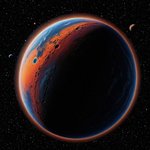
Kepler-22b is thought to be a super-Earth water world. This exhilarating exoplanet is located 587 light-years from Earth.
22b was the first exoplanet ever found to orbit in the ‘habitable zone’. Imagine the incredible creatures that could exist in its immense ocean.
Amazing.
The cosmic web is the structure of the Universe. Colossal filaments of hydrogen gas form a web-like structure containing immense galaxy clusters. These filaments are separated by voids of space that are unimaginably vast.
This is what the cosmos looks like on a grand-scale:
Vampire stars are matter hungry monsters.
These cosmic vampires prey on their companion stars, slowing draining them of their material.
As the vampire star accumulates enough material, a runaway thermonuclear explosion occurs in the form of a Type Ia supernova.
📽️ Credit: ESO
A ringworld is a colossal planet-like ring that completely encircles a star.
This hypothetical structure orbits in the habitable zone of its star, creates its own gravity by rotating rapidly, and provides a vast living area for potential inhabitants.
Awesome.
📽️ Simon Terrey
The largest structure in the observable Universe is a galaxy filament known as the Hercules-Corona Borealis Great Wall.
It measures roughly 10 billion light-years in length, a size the human brain can’t comprehend. In it, there’s estimated to be millions of galaxies.
Amazing.
Kepler-69c is a super-Earth exoplanet located roughly 2,430 light-years from Earth.
This rocky world is 1.7 times larger than Earth in terms of radius. It’s situated outside of the inner edge of its star’s habitable zone, and thus is probably more like Venus than Earth.
Centaurus A is the 5th brightest galaxy in the sky. It’s located around 12 million light-years away and has a diameter of about 60,000 light years.
This incredible radio galaxy has an active galactic nucleus with a supermassive black hole at the center.
Incredible.
📸 ESO/WFI
Europa is immensely intriguing.
This notable moon of Jupiter has the smoothest surface of any celestial object in the solar system. Under that flat surface lies a saltwater ocean roughly 62 miles deep.
There could be crazy creatures swimming around in that ocean right now!
Haumea is a distant, egg-shaped dwarf planet located in the Kuiper Belt. It is similar in size to Pluto, and in 2017, it was discovered to contain a small ring system, as well as two moons. Haumea’s unique shape is due to its exceptionally fast rotation. An intriguing object.
The Moon is the only natural satellite of Earth and has played an integral part in Earth’s history.
At only 1.2% the mass of Earth, the Moon still controls ocean tides, helps stabilize Earth’s tilt and influences Earth’s rotation.
The moon is truly magnificent! 🌔