




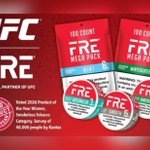



Very interesting to see $TPB trying to replicate their Stoker’s playbook, on online shops we can already see these FRE “mega packs” gaining popularity.
- First establish an entirely new format, leaning into the value proposition offering (one pack = 100 pouches)
- Go all in on retail distribution, expand shelf space beyond traditional cans, pioneering and dominating the new category
- Lastly category familiarity, consumers become accustomed to the new format, competitors entering later have to displace an existing product rather than introduce the concept themselves

In the US market I have only seen it with Sesh (a venture backed player, not included in the PMTA fast track pilot), that copied FRE with 200 pouch refill packs.
From what I have seen in Europe the category is entirely non-existent. There are only some brands selling these over-dimensional cans, but they are not that popular.


LULA WON IN BRAZIL
Don’t know anyone else who played the Brazil election trade that well.
Bought before the crowd w/ Bolsonaro doing better than expected in the first round and sold into the euphoria regardless of outcome.
FDA announced four new voting members of the Tobacco Products Scientific Advisory Committee:
- Kim Murray, longtime tobacco harm reduction advocate, former vape shop owner, co-founder of the Safer Nicotine Wiki, mentioned nicotine pouches positively for harm reduction
- Holger Behrsing (PhD): Respiratory toxicologist comparing cigarette smoke vs. next-gen aerosols, focuses on comparative toxicity from non-combustibles, risk-comparison oriented
- Margaret Nolan (MD): Focus on preventive medicine, chronic disease, and tobacco harm reduction, FDA explicitly groups her expertise with harm reduction
- Andrew Strasser (PhD): Traditional tobacco regulatory scientist, works on smoking behavior, biomarkers, risk perceptions, advertising effects, and low-nicotine products
The market thinks it’s positive for $TPB

Very logical dynamic, state incompetence gets outsourced to the private sector.
My pick is $SPCB
Prison overcrowding + tight budgets → house arrest has no limits + is ~4-10x cheaper, very long growth runway


Never go full retard.
When his portfolio ticked down to $7M, half of Fintwit begged him to take the money and run.
The buy and hold forever mindset poisoned so many investors.


Brazil fintech basket worked out great, the odds for Bolsonaro were widely mispriced, taking a big chunk off the table the euphoria will fade $INTR $PICS $XP

Pro business RW candidate now leads ahead of Socialist Lula (according to betting markets), really nice short/medium term setup for beaten down Brazilian equities.
I like the smaller fintech names $INTR & $PICS got bid down a lot, also the broker/exchange side $XP & $BOLSY to capture potential flows and volume.
A homebuilders / real estate bucket:
- $CYRBY homebuilder for potentially cheaper mortgages outside subsidized housing
- $MLTTY shopping malls, sensitive to rates, consumption, and property valuations
- $EZTC3 residential developer, Sao Paulo area
- $DIRR3 homebuilder for mid income and subsidized segments
- $LAVV3 high-end developer, high operating leverage to a rate cut
Also interesting $HAPVY mass market health insurer/hospital operator, will benefit if employment and payroll credit stabilize.
$SAPR11 state water company, privatization/governance option if the political map shifts.
$TTEN3 southern agribusiness (inputs, grain, biodiesel), fits a more agri-friendly policy mix.

This is how I monitor the Brazil situation currently

Pro business RW candidate now leads ahead of Socialist Lula (according to betting markets), really nice short/medium term setup for beaten down Brazilian equities.
I like the smaller fintech names $INTR & $PICS got bid down a lot, also the broker/exchange side $XP & $BOLSY to capture potential flows and volume.
A homebuilders / real estate bucket:
- $CYRBY homebuilder for potentially cheaper mortgages outside subsidized housing
- $MLTTY shopping malls, sensitive to rates, consumption, and property valuations
- $EZTC3 residential developer, Sao Paulo area
- $DIRR3 homebuilder for mid income and subsidized segments
- $LAVV3 high-end developer, high operating leverage to a rate cut
Also interesting $HAPVY mass market health insurer/hospital operator, will benefit if employment and payroll credit stabilize.
$SAPR11 state water company, privatization/governance option if the political map shifts.
$TTEN3 southern agribusiness (inputs, grain, biodiesel), fits a more agri-friendly policy mix.
Some anecdotal evidence here, while some trash $TPB FRE’s marketing spend compared to ALP’s strategy, stuff like this is really clever, simply supply niche influencers with tons of your pouches, to end up organically appearing in videos of a NYC watch dealer to a 2.5M audience


This is probably one of the worst things you can do in investing, ‘getting married to a stock’.
Ruthlessly cutting losers drives excess returns, the buy & hold forever mindset is a pitfall, avoid at all costs.


Initiated a position in $TPB here, decent opportunity to enter on the CEO change news, a stock with a credible path to become a multibagger if they can execute on their targeted market share.
What weighs on the stock comes down to the PMTA fast track, which isn’t so fast after all since the youth/new users
FDA concerns, therefore stalls the start of the domestic production.
However the market prices a way too binary scenario for the approval of FRE & ALP, we have seen approvals for 'risky' flavors on low nicotine mg’s (Rich Berry, Cappuccino, Autumn Spice), approvals for up to 11mg (unflavored) and up to 9mg on low risk flavors (Citrus, Mint, Wintergreen etc.).
Sure some of FRE’s value prop is higher 12-15mg strengths on some riskier flavors (mainly Watermelon & Lush + the new FRE Labs line), while using synthetic nicotine vs. others w/ natural derived nicotine, although that’s not the whole story. However while I assume synthetic nicotine is simply a matter of more rigorous testing by the FDA that takes time, I think the higher mg pouches (+riskier flavors on higher mg pouches) on the other hand won’t get rejected out right but kept pending in the gray legal status just like we have seen with the other brands for now.
So the base case should be partial approvals on par with approvals of peer pouch flavors + strengths, and the rest left pending. (Otherwise it should be an approval through a legal battle win for $TPB).
The main problem I see is how the legal mechanism w/ domestic production onshoring can work, they should be able to produce future authorized SKUs domestically with some hassle, the issue is more on the gray legal status pouches. Because pending SKUs can be made there only if the pending application also names that site. If it only named India, they need an amendment. Mid review manufacturing amendments reset the already long review process.
The playbook for $TPB will probably be:
• Leave pending SKUs on the India file, preserves discretion on the gray catalog
• Qualify Louisville quietly (engineering lots, stability, HPHCs)
• Onshore first the SKUs that get MGOs, via sPMTA or because the granted order already named Kentucky
• Add Louisville to leftover pending files after that, knowing it’s a major amendment or keep gray volume in India until each SKU is granted or denied
So I think with the growth + legal limbo, the margin improvement through domestic manufacturing is/was widely exaggerated, they need the Indian production way longer than expected is my guess. So higher shipping costs and bad rep from 'made in India' will plague them for a while.
Other than that the talk about competing profits away or getting crushed by big tobacco is bullshit, they have proven before that they can take on the big guys w/ Stoker’s, that narrative is around since they IPO’d 10 years ago, FRE is a great positioned brand and ALP is an incredible brand, both with a product that ranks on the higher end against the other brands. (The situation is different in Europe, that’s where ALP can shine with their unique anti woke positioning, FRE will have a harder time if they try to enter, much more competition and no regulatory barrier to entry)
