

Servidor Público Federal (EPPGG) // Mestre em Políticas Públicas e Desenvolvimento // Especialista em Planejamento e Estratégias de Desenvolvimento
Joined December 2017
- Tweets4.4K
- Following902
- Followers8K
- Likes4.7K




Felipe Augusto Machado retweeted

China’s Fifth Plenum decision is out.
Beijing wants the Party to have more influence in private tech firms.
“Strengthen Party-building efforts in platform companies, technology-innovation enterprises, and other such firms; establish a mechanism for dynamically adjusting the elevation of Party organizations within internet companies to higher administrative levels of management; and ensure that responsibilities for Party-building are fulfilled.”

Felipe Augusto Machado retweeted

China’s Industrialization Did Not Begin in 1978
How the Soviet-Backed 156 Projects Built the Heavy-Industrial Skeleton for China’s Post-Reform Manufacturing Boom
leonliao.substack.com/p/chin…
Felipe Augusto Machado retweeted

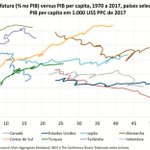
People often say: "Why focus on economic growth and GDP per Capita? Other things are much more important than money."
Here is the thing: many of those other things correlate strongly with GDP per capita.


Felipe Augusto Machado retweeted
Why is China so obsessed with holding on to traditional industries? Aren’t they focused on high-tech growth?
Key reasons as laid out by NDRC:
1. They’re the foundation of the “real economy” and enable new high-tech industries.
2. Traditional industries may have started earlier but innovation and progress in them continues.
3. Employment—they can provide high-quality jobs through industrial upgrading.
Quote from a Q&A with reporters:
Reporter from Singapore’s Lianhe Zaobao:
Amid the wave of high-tech development, how can China’s traditional industries transform themselves while continuing to create jobs?
Fu Jiuling, Director-General of the Department of Industrial Development, National Development and Reform Commission (NDRC):
The Outline of the 15th Five-Year Plan lays out a blueprint for industrial development over the next five years, and it has attracted a great deal of attention. When we talk about technological revolutions and industrial transformation, it is easy to think of emerging industries and industries of the future while overlooking traditional industries. Some even believe that cultivating new growth drivers means traditional industries are no longer important.
At the same time, many people are concerned about the impact of industrial upgrading on employment. I would like to make three points.
First, the transformation of traditional industries toward newer and higher-quality development has always been underway and has never stopped.
We often say that each generation of manufacturing processes, materials, and equipment represents a new stage of technological iteration and industrial upgrading. Experience shows that there are only outdated products, not outdated industries.
Although traditional industries have been around for a long time, they should not be equated with low-end or backward industries. Consider people’s everyday needs for clothing, food, housing, and transportation. Today’s clothing fabrics are incomparably better than those of the past. Bicycles are also becoming lighter, with some now incorporating carbon fiber.
It is fair to say that the so-called traditional industries we see today are very different from what they were several decades ago, or even just a few years ago. The vitality of traditional industries—like old trees sprouting new shoots—is evident everywhere in our daily lives.
Second, traditional industries are the foundation of the real economy, and all three of China’s “new three” industries have emerged from traditional industries.
For example, although the three core systems of new energy vehicles—batteries, electric motors, and electronic controls—have replaced the conventional internal combustion engine powertrain, the manufacturing processes used to produce vehicles remain fundamentally continuous with those of traditional gasoline-powered cars.
The solar photovoltaic industry originated in polysilicon, which belongs to the nonferrous metals industry. The subsequent production of silicon wafers, solar cells, and modules all relies on mature processes from the electronics industry.
Lithium-ion batteries originated in traditional electrochemistry and materials manufacturing.
These industries did not emerge out of thin air. They were built on the strong foundations of traditional industries and sustained technological innovation.
Third, we must proactively understand and respond to the impact of new technological developments on employment.
Looking at manufacturing, during the 14th Five-Year Plan period, employment rose in some industries and fell in others, but overall manufacturing employment remained stable at around 110 million people.
Throughout human history, new technologies have continuously affected employment. The replacement of physical labor by machinery and equipment, and of certain forms of cognitive labor by information technology, has been an ongoing process.
We can see this in our daily lives. Some jobs are disappearing, while new …

Felipe Augusto Machado retweeted

This report has some good charts on the evolving composition of Chinese manufacturing and exports.
reuters.com/graphics/CHINA-E…


Felipe Augusto Machado retweeted

A indústria deveria ser uma prioridade central do Lula 4 para fazer o país crescer de modo continuado, desenvolver tecnologia, exportar valor agregado, vital para a soberania nacional e bons empregos. Chega de desindustrialização!

Felipe Augusto Machado retweeted

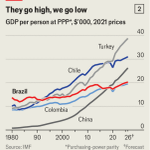
GDP per capita remains a very informative measure of wellbeing. And that the reason I think developing economies should be utterly obsessed about economic growth.


Felipe Augusto Machado retweeted

The @OECD's new 2026 Ownership and Governance of State-Owned Enterprises report, released today, finds that SOEs' economic footprint has doubled over the past decade, based on data from 58 OECD member & partner economies tinyurl.com/rsz2kr7 @OECDgov

Felipe Augusto Machado retweeted

A Folha publicou em português a excelente reportagem do Financial Times sobre a expansão do trabalho precário como motorista de Uber no Brasil (país que mais usa o aplicativo), e como isso ajuda a entender o mal-estar na economia e a eleição presidencial. www1.folha.uol.com.br/mercad…

Felipe Augusto Machado retweeted

The problem with this argument is it rests entirely on the widely misunderstood concept of labor productivity.
Many people, especially non-economists, hear calls to "increase the average labor productivity of Brazilian workers" and think that means the reason Brazil is so much poorer than Switzerland is because Brazilian workers are supposedly lazy and don't work as hard as Swiss workers. But that is false and absurd.
Labor productivity is simply defined as worker contribution to real GDP per hour of labor.
The reason labor productivity is low in Brazil, and in the periphery in general, is because of the productive structure of the economy.
Brazil, like most of Latin America (and the periphery as a whole), has an economy centered on exports of agricultural goods, minerals, energy, and other commodities. These are very low value-added, labor-intensive sectors with lots of international competition (and therefore low profit margins).
The reason Switzerland's labor productivity is so high is because it has monopolistic "moats" in some very high value-added sectors like specialized financial services (ie, banking for global oligarchs) and advanced manufacturing.
A Swiss banker working on a computer in an air-conditioned office will have an exponentially higher labor productivity than a Brazilian farmer or miner (or even a Brazilian banker), not because the Swiss banker works harder (they objectively don't), but because they work in specialized high value-added services and can simply charge exponentially more for their labor.
These high value-added industries can't just be magically recreated in the periphery. Every country in Latin America and Africa would love to be the next Singapore (and many have tried), but you can't skip stages of development.
Not everyone in the world can just work in the high value-added service sector -- especially when the high labor productivity in the advanced economies fundamentally depends on cheap energy, food, and minerals produced by workers in the periphery.
When we talk about the global value chain, we're really talking about a highly stratified global division of labor. And it is very, very difficult to move up it. That takes years of careful planning, investment, education, training, infrastructure build-out, technology transfer, etc. -- which in turn requires political stability and the ability of the state to implement long-term planning without significant disruption.
Neoliberalism was never as simple as "the government must spend less". It was about the state giving power to markets and the investor class to decide what the priorities of political-economy policymaking would be.
This investor class (consisting of both foreign investors and the domestic compradores) prioritizes maximizing return on investment, not developing the productive capacity of the local economy. That's why it primarily invests in the extractive commodity export sector.
This also explains why Brazil (and most of Latin America) significantly deindustrialized during the neoliberal period, and has become even more dependent on the low value-added export of commodities.


In Brazil the situation is even more extreme:
1. There are 39 million formal private sector employees.
2. There are 20 million families on government welfare, with nearly 60 million people, plus 37 million people that are retired and receiving government pensions (however, in Brazil many "retired" people continue working in the informal sector).
Brazil is a country of 210 million where 39 million formal workers produce 85-90% of GDP. The inequality in productivity is even more pronounced if you consider that the 270 major public companies in the Brazilian stock market produce 18% of Brazil's GDP while employing 2.8 million workers (portal.fgv.br/noticias/estud…). That means that 1.3% of the total population and 2.7% of the labor force produce 17.9% of output in the nation.
This shows the enormous but so far unexploided growth potential in Brazil: if we increased the average labor productivity of Brazilian workers to the standard of the 270 major public companies, GDP would be 6.6 times the current figure, higher in per capita terms than in the US or Switzerland.

Felipe Augusto Machado retweeted

SUL GLOBAL: O DESAFIO DA REINDUSTRIALIZAÇÃO
Sul Global: reindustrializar exige empresas públicas, planejamento estatal, quebra de patentes e integração Sul-Sul. O Estado à frente, contra a ultradireita
outraspalavras.net/descoloni…

Felipe Augusto Machado retweeted

Estatal italiana assume controle da Telecom Itália e se torna controladora indireta da Tim no Brasil
c-level.folha.uol.com.br/neg…

Felipe Augusto Machado retweeted

3/13 - 20 anos de desindustrialização
A indústria de transformação saiu de um pico de 35,9% do PIB em 1985 para um mínimo de aproximadamente 11% em 2020. Enquanto isso, a média dos países de renda média manteve um patamar estável: o gap não para de crescer.

Felipe Augusto Machado retweeted

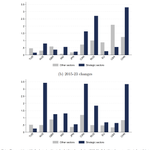
The post-war conversion of the publicly-owned Finmeccanica and its privatisation-militarisation (from the 1990s) into Leonardo, in a chart 👇
From my essay for @TransitionSec / @Cmmonwealth:
transitionsecurity.org/leona…

Felipe Augusto Machado retweeted

1/ A Maioria dos brasileiros rejeita o neoliberalismo e prefere um Estado com atuação forte no desenvolvimento e bem-estar social.
É o que mostra a pesquisa da IPSOS encomendada pelo Fundo Global para uma Nova Economia. 🧶
Felipe Augusto Machado retweeted

1/3
New paper published: “Sustained exchange rate misalignments and long-run growth.”
We study sustained episodes of real exchange-rate under and overvaluation in 124 countries over 1950–2019, focusing on long-run effects on growth, investment, and structural change.

Felipe Augusto Machado retweeted

Quanto maior a complexidade da atividade, maior o salário. Atividades industriais são na média mais compelidas. O Brasil emprega a maioria das pessoas em atividades de baixa complexidade. As atividades agro são na média de baixa complexidade.


Felipe Augusto Machado retweeted
Pesquisa que acaba de sair
Parece não colar no Brasil, a ideia de que “o que é bom para o mercado é bom para o país”.
1/

Felipe Augusto Machado retweeted
“China is becoming a factory for factories. No longer just a producer of low-value consumer goods, China is now exporting more of the higher-value intermediate and capital goods that underpin global manufacturing, such as chips, precision machinery and robotic arms.” @hannahmiao_ wsj.com/economy/trade/chinas…

Felipe Augusto Machado retweeted

The IMF finds “China is backing strategic businesses, like green tech, while the west props up old sectors with political clout, like agriculture.”
In the west, capital disciplines the state to prop up high profits in old industries.
In China, the state creates markets and steers capital towards new strategic industries.
State-capital relations are key in understanding the China-west competitiveness divergence. Real industrial policy is not throwing subsidies at corporations but leveraging and creating public and private capacity towards goals like a green transformation.
