
@UCBerkeley econ PhD. Won @PKU1898 teaching award. Fighting against fuzzy Reform Math that stultifies global children & imperils civilizations. ** https://teapaw.org/t.co/qV4sa2JPl2
California
Joined July 2013
- Tweets6.9K
- Following3.3K
- Followers2K
- Likes12K
Pinned Tweet
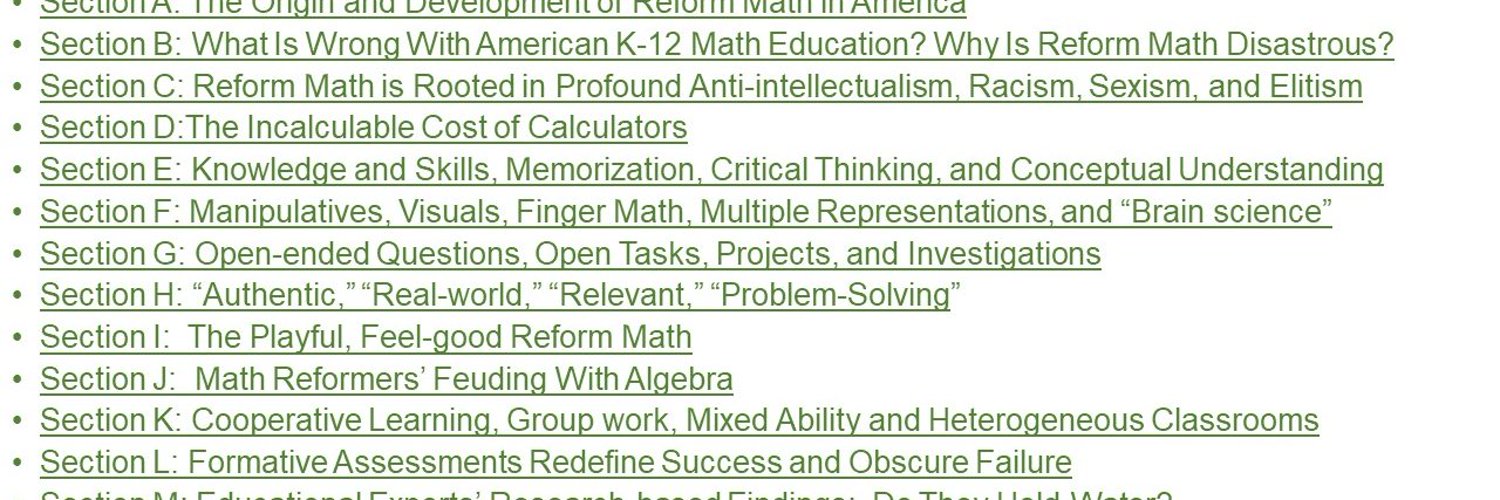
My articles and presentations on how progressive education dogmas have corrupted K-12 math education in the US and beyond:
•Jo Boaler’s Fame, Stanford’s Shame; Students’ Gloom, America’s Doom: rb.gy/amoc52
•Jo Boaler's Reform Math Fallacy: bit.ly/38oASeE
•Stanford Professor Jo Boaler’s Math Revolution and War Against Algebra 2: nonpartisaneducation.org/blo…
•Why Have American Schools Failed in Closing the Achievement Gap? A Case Study of California’s Palo Alto School District: nonpartisaneducation.org/Rev…
•Letters from Mathematicians: nonpartisaneducation.org/Rev…
Letters from R.James Milgram and Wayne Bishop on the deterioration of K-12 math education.
•是谁夺走了美国人的数学能力? 美国百年数学战争演义 (Who Deprived Americans of Their Math Ability? A Saga of Century-long American Math Wars) rb.gy/xvg3cf


Ling Huang retweeted

This really is landmark educational journalism. So rare to see such an in-depth, well studied and extended exploration of one of the most under discussed but vital parts of the education sector- how we teach.
It's remarkable how this was also so absent from my own teacher training, and that of so many of my peers. I never encountered this. Instead I encountered chapters and chapters of navel-gazing, pointless theories of constructivism and phenomenalism. Poster making sessions, making PowerPoints. Getting-to-know-yous, ice-breakers, clueless investigations where we were supposed to come up with novel observations about how to be an expert without guidance of how to do so.
But not a scrap of cognitive load theory; Rosenshine; Direct Instruction; assessment processes; behaviour management; reading instruction; practical pedagogy. No Project Follow Through, no research, no evidence.
We had a sector that wanted to be professional, without creating the circumstances of professionalism.

We did more than 175 interviews, dug through 34 boxes of records at the National Archives, collected more than 70 hours of old video, read dozens of books and research papers, visited eight schools in five states. Here's how we reported Sold a Story 2.
apmreports.org/story/2026/11…

Ling Huang retweeted

A college professor who says she's taught for 12 years says most of her incoming students read at a FIFTH or SIXTH grade level..
"Many of them are functionally illiterate." She says they can't focus for more than five minutes and know almost nothing about history, politics or culture.”
"I no longer feel like I'm teaching college courses. I feel like I'm teaching middle school classes, and many students still fail."
She's a millennial and admits every generation says this. Her answer is that this time "feels very different."
What in the world has happened to our education system in America..!?
Ling Huang retweeted

American teachers: did you know that England’s schools are now outshining the rest of the world because their education secretary read E.D. Hirsch? Never heard of Hirsch? Blame the schools of education —they long ago blackballed him.
Ling Huang retweeted

📚 Why do students sometimes forget everything after a test? And what can we do about it? Retrieval practice and spaced practice help make learning last! Here more in my latest episode with Hector Ruiz Martin. @hruizmartin
🔗 Episode link below.
Ling Huang retweeted

Most people do not realize just how easy the AP exams have gotten. They are not college level.
Why/how have they become so easy? What's going on?
This might shock you... A brutal new piece in Education Next just dropped, saying the decline in rigor of the AP in the last two decades is, in large part, because the content has been GUTTED. For example:
— AP Biology cut 40% of its material
— Required lines from the Aeneid in AP Latin halved
— Spanish Lit reading list cut from 56 works to 38
Then the questions themselves have become absurdly easier. Readability measures show English passages have fallen multiple grade levels, and some now include footnotes defining basic words...
A 2025 AP English prompt included footnote definitions for words like "optimism" and "pessimism."
At the same time, scoring was recalibrated so that more students pass: guessing penalties disappeared, rubrics grew more generous, readers were told to give students the benefit of the doubt, etc. — "no one at College Board had any incentive to maintain rigor."
College professors are now seeing students arrive with AP credit who lack basic content knowledge and writing ability. The College Board insists the exams have not become easier, but everybody familiar with them knows they've become an absolute joke.
Advanced Placement is no longer advanced. This is not college level.
It must be replaced.

Ling Huang retweeted

The relentless watering down of standards led by university professors of Education Departments in the 2020s needs to be studied

Most people do not realize just how easy the AP exams have gotten. They are not college level.
Why/how have they become so easy? What's going on?
This might shock you... A brutal new piece in Education Next just dropped, saying the decline in rigor of the AP in the last two decades is, in large part, because the content has been GUTTED. For example:
— AP Biology cut 40% of its material
— Required lines from the Aeneid in AP Latin halved
— Spanish Lit reading list cut from 56 works to 38
Then the questions themselves have become absurdly easier. Readability measures show English passages have fallen multiple grade levels, and some now include footnotes defining basic words...
A 2025 AP English prompt included footnote definitions for words like "optimism" and "pessimism."
At the same time, scoring was recalibrated so that more students pass: guessing penalties disappeared, rubrics grew more generous, readers were told to give students the benefit of the doubt, etc. — "no one at College Board had any incentive to maintain rigor."
College professors are now seeing students arrive with AP credit who lack basic content knowledge and writing ability. The College Board insists the exams have not become easier, but everybody familiar with them knows they've become an absolute joke.
Advanced Placement is no longer advanced. This is not college level.
It must be replaced.
Ling Huang retweeted

I feel this article is well worth reading. It helps dispel the myth that critical thinking can be applied to all situations. Many educational programs and business leaders have advocated for learning “higher-order thinking skills,” assuming these skills will then be++

Ling Huang retweeted
Was a true honor to sit down with @WalterIsaacson for The Builders podcast out this morning
We are at an unusual inflection point in history and there are so many reasons to be excited for the future with superintelligence almost here


Ling Huang retweeted

SAT's reading test isn't necessarily easier, says report. It's just different. But it sure seems easier. tinyurl.com/2c8zdyre
@VodkaPundit @MichaelPetrilli @MrDanielBuck @edpolicyjunkie @gtmom @karenvaites @natwexler @tomloveless99

Ling Huang retweeted
You cannot replace knowledge-rich with learning-lite
‘These portraits replace with vague aspirations the concrete, measurable, academic benchmarks that allow for higher-level cognitive functions. Consequently, students are likely to develop neither.’ thehill.com/opinion/educatio…

Ling Huang retweeted

'their KIP Program revealed that many of these low income students could achieve just as much as affluent suburban kids...'
A deeply unfashionable view but it will always be my north star.
Highest Expectations
Knowledge Is Power
Work Hard, Be Nice
More Time
No Shortcuts
100%


Ling Huang retweeted
"during the last school year, a council of educators at both Palo Alto high schools rejected the [advanced math] course, arguing it would serve few students and set back equity and students’ well-being"
Right, math is harmful. Come on! What are we doing?
“If teaching math can harm students, then we have a lot bigger issues to talk about than whether to offer this course,” Nguyen told the Chronicle.
Indeed.
Brian Conrad, a Stanford mathematician, told the Chronicle that he felt math was treated as a “punching bag” for equity and mental health concerns.
“The school doesn’t cut sports teams simply because some kids are far more talented at sports,” he said.
“Why is it that the teaching of math generates much more controversy than other subjects?”
sfchronicle.com/bayarea/arti…

Ling Huang retweeted
Kris Boulton's pitch is simple: we can accept classrooms where some students succeed and others struggle, or we can be much more systematic about designing instruction so that all students have the opportunity to succeed at a high level.
🎧 The episode is a must listen! Link below
@Kris_Boulton
Ling Huang retweeted
If you can't raise the floor, lower the ceiling? Schools are trying to close achievement gaps by cutting honors classes, and parents aren't happy.
tinyurl.com/4thze3e3
@ProfTDee @ycinnewyork @neetu_arnold @SFParents @rickhess99 @MichaelPetrilli @Dale_Chu @0Beanie05923291

Ling Huang retweeted

É bom que por todo o país se discuta o desastre educativo a que a política seguida de 2016 a 2024 nos conduziu
Há 10 anos, escrevi no meu "Eduquês", que o ensino é uma questão demasiado séria para ser confiada exclusivamente aos ideólogos dogmáticos.
Obrigado pelo convite!

Ling Huang retweeted
Look at the magnificent turnout for researchED Santiago today. LOOK #rEDchile So proud of Rodrigo and his team at @Aptus_org for bringing the dream to LATAM

Ling Huang retweeted
It was great to do the math panel this morning with @Kris_Boulton in Chile. Tomorrow is researchED Chile. It will be the largest researchED in the world, with over 1400 people registered!
This post is from an account that no longer exists. Learn more
Ling Huang retweeted
🚨 New episode now live!
In this episode of Chalk & Talk, I talk with @Kris_Boulton about the science of clear math teaching.
How can we reduce confusion in math class? What is atomisation and why does it matter? And how can we help more students succeed in math?
🎧 Listen to the full episode - link below
