

Oncology, Drug Discovery & Neuroscience, London. Lapsed Canadian. Labrador via Vancouver Island. Multiomics, Epigenetics, & Computational Biology.
London, England
Joined March 2011
- Tweets7.9K
- Following4.7K
- Followers1.1K
- Likes38.5K


Ron Finn retweeted

What kind of data do we need for DNA foundation models?
At @RelationRx, we have developed a new protocol for prime-editing perturb-seq to help generate training data.
biorxiv.org/content/10.64898…
CC @JensBagerChris1 , @j_opzoomer (other authors not on twitter!)
Thread below..

Ron Finn retweeted

I'm writing an interactive book about cells, and how they work.
The latest installment, out today, is about why we are unable to create life from scratch despite knowing exactly what cells are made from.
In one part of the essay, I write about a thought experiment in which DNA is scaled up to a width of one meter. In that scenario, DNA polymerase (the enzyme responsible for copying DNA) would be the size of a FedEx truck. Replicating the E. coli genome to prepare for cell division would require two of these trucks, each moving in opposite directions at speeds of 375 miles per hour. Over the span of 40 minutes, these trucks would deliver five million packages and make just one error every 106 miles.
At the same time the FedEx truck is speeding by, thousands of ribosomes are busily making proteins, enzymes are converting millions of molecules each second, and the membrane is adding lipid molecules to expand, preparing to make a daughter cell. All of this movement offers thousands of opportunities for something to go wrong! At this scale, and these speeds, even rare errors can accumulate and kill the cell.
And yet life persists. A cell remakes itself even when things inevitably go wrong. If human builders are ever to rival the complexity and dynamism of a cell, then, we not only need to find the ingredients, but also arrange them in ways suited to extreme speeds and turbulent noise.
The full, interactive essay is at @AsimovPress: press.asimov.com/books/burri…


Ron Finn retweeted

🎉 Our tissue clocks paper is now out in Nature Medicine!
We quantified biological age from ~25k histology images of 983 GTEx donors and showed the signal can be read from blood. 📄
nature.com/articles/s41591-0…

Ron Finn retweeted

🧬 Meet TissueFormer, a new multimodal foundation model that enables digital pathology at single-cell, whole-slide resolution.
A key novelty: it can model both long- and short-range cell-cell interactions, something that used to be computationally out of reach at this scale.

Ron Finn retweeted

Essentially it is impossible to truly build universal "virtual cells" or "cellular world models" with the data collection strategies & model design approaches that everyone making those claims are using. It's decades (far more IMO) away unless we rethink how we go about it.

Machines still don’t speak biology.
A new Cell Perspective argues that bigger datasets, larger models, and more GPUs won’t automatically produce a universal model of life.
The missing piece: process-aligned, causal world models connecting molecules, cells, tissues, space, and time.
Biology is not just sequence. It is history, dynamics, and emergence.
cell.com/cell/fulltext/S0092…

Ron Finn retweeted

Introducing Biomni-Tuso, a new recipe for auto-research in biology AI model.
We asked Biomni to develop a genetic perturbation prediction model and let it run for five days. It explored 500 configurations and discovered a new method that outperformed the leading methods across multiple benchmarks.
We've since applied the same recipe to protein structure representation learning, enhancer–gene linking, ligand binding, and more, consistently discovering new leading models.
Biomni-Tuso doesn't just tune hyperparameters. It works like an AI bio researcher for you: reading literature, thinking about orthogonal bio data sources, and testing fundamentally different modeling ideas.
We believe this is where bio AI model research is headed. Instead of spending months building models by hand, researchers can describe a problem in natural language and let Biomni explore hundreds of ideas on their own data, while handling all the ML infra.
Biomni-Tuso is now available as an auto-research skill (under "tusoskill") in Biomni Lab for all enterprise users. On the public platform, it is available to all users on CPU-based tasks. As we prepare for a broader rollout for GPUs, we're giving 500 GPU hours each to 100 Biomni Lab users to start building today. Apply here: forms.gle/ZzMsChN8ByqWSRGW9
Amazing work led by Alistair Turcan with @martinjzhang
Example replay: biomni.phylo.bio/replay/shar…
Open sourced genetic perturbation model: github.com/phylobio/TusoPert…
Learn more: phylo.bio/blog/biomni-tuso
Ron Finn retweeted
Rarely does one get to really think about designing automation *specifically* to generate data for AI models, but @GSK have been a fantastic partner and saw the opportunity ahead. Congratulations team!

Today is a major milestone for Relation.
We're expanding our collaboration with GSK to deploy MORGAN, our flagship cellular foundation model, at a new scale. This deal will bring up to $110 million in upfront and success-based milestone payments to Relation.
The patient is waiting.
bloomberg.com/news/articles/…

Ron Finn retweeted

Today is a major milestone for Relation.
We're expanding our collaboration with GSK to deploy MORGAN, our flagship cellular foundation model, at a new scale. This deal will bring up to $110 million in upfront and success-based milestone payments to Relation.
The patient is waiting.
bloomberg.com/news/articles/…
Introducing openauc-io: open-source Python tools for analytical ultracentrifugation data.
CSV/TSV ingestion • validation • plotting • AUCX archives • CLI • synthetic data
github.com/ronfinn/openauc-i…
#AUC #AnalyticalUltracentrifugation #Biophysics

Roadmap: vendor-format readers, richer batch and plotting workflows, stronger metadata linkage, more conversion options, and a public alpha release.
It does not yet perform sedimentation fitting or scientific QC.
Docs: ronfinn.github.io/openauc-io…
Ron Finn retweeted

For my first post, I’m sharing a letter @NVIDIA signed on why open models matter.
AI will transform every industry, power every company, and be built by every country.
Open models strengthen safety and cybersecurity, accelerate innovation and diffusion, and enable sovereignty.
The world needs both frontier closed models and frontier open models.
images.nvidia.com/pdf/Open-W…


Ron Finn retweeted

Two years ago the best virtual cell model was ridge regression and yesterday the best virtual cell model was ... ridge regression. But sure, throw a billion more parameters at the problem, no one is stopping you.


18 months after posting this tweet, the AI for science commentariat is still proclaiming the death of single-cell scaling laws on the basis of... {checks notes}... a model sweep ranging from 1 million to a whopping 10 million parameters. (but unlike 18 months ago, these proclamations now come wrapped in premium AI-written slop, giving them a glittering verisimilitude of rigor)
left as an exercise for the reader: generalize from this example to a meta-update about how epistemically adversarial the scientific environment we're operating in is (for extra credit, partial out the effects of mood affiliation and status deferral)


Ron Finn retweeted

No scaling laws for single-cell foundation models: when bigger atlases stop teaching the model anything
In language and vision, the recipe has been simple: more data, bigger models, better performance. Single-cell biology borrowed that playbook. Foundation models for transcriptomics jumped from 1 million cells to atlases of over 100 million, on the assumption that scale would unlock the same gains. Alan DenAdel and coauthors put that assumption to the test, and the result is sobering.
Working from a 22.2-million-cell corpus, they pretrained 400 models across five architectures (from PCA and a variational autoencoder up to the Geneformer transformer) and ran 6,400 evaluation experiments. They varied not just dataset size (1% to 75%) but also diversity, using cell-type re-weighting and geometric sketching to deliberately enrich rare cell types and transcriptional states.
The finding: performance saturates almost immediately. On cell-type classification, batch integration, and perturbation prediction, most models hit their ceiling at roughly 1% of the corpus, about 200,000 cells. Beyond that, adding millions more cells changed essentially nothing. More diversity didn't help. Even spiking in genome-scale Perturb-seq data, to give the models perturbed phenotypes rather than just healthy ones, failed to move the needle. Larger models did score better overall, but they too plateaued early on data.
Two points stood out. Simple baselines (PCA, logistic regression) often matched or beat the transformers. And the strongest model, SCimilarity, won not because of size but because its contrastive training objective is aligned with the downstream task. For single-cell data, what you train on and how you frame the objective matters far more than how much you collect.
This reframes a quiet but expensive habit. In drug discovery, biotech, and any pipeline leaning on cell atlases, the instinct to keep scaling pretraining corpora may be burning compute for no return. The real leverage sits elsewhere: curating high-quality, task-relevant data and matching the training objective to the actual question you're trying to answer.
Paper: DenAdel et al., journal license | doi.org/10.1038/s41592-026-0…

Ron Finn retweeted

A study investigates sources of noise in Xenium spatial transcriptomics data and introduces a method to resolve mixed signals and enhance cell type specificity.
nature.com/articles/s41592-0…

Ron Finn retweeted

SpatialQuery: scalable discovery and molecular characterization of multicellular motifs from spatial omics data biorxiv.org/content/10.64898…

Ron Finn retweeted

Reference-free discovery with barcoded single-cell sequencing - @SalzmanLab @sdeorowicz go.nature.com/4cqxwLp

Ron Finn retweeted
SpaFlow depicts the dynamics of ligand-receptor interaction in spatial transcriptomics data biorxiv.org/content/10.64898…


Ron Finn retweeted
SpaNiche: spatial niche analysis to explore colocalization patterns and cellular interactions in spatial transcriptomics data link.springer.com/article/10…

Ron Finn retweeted

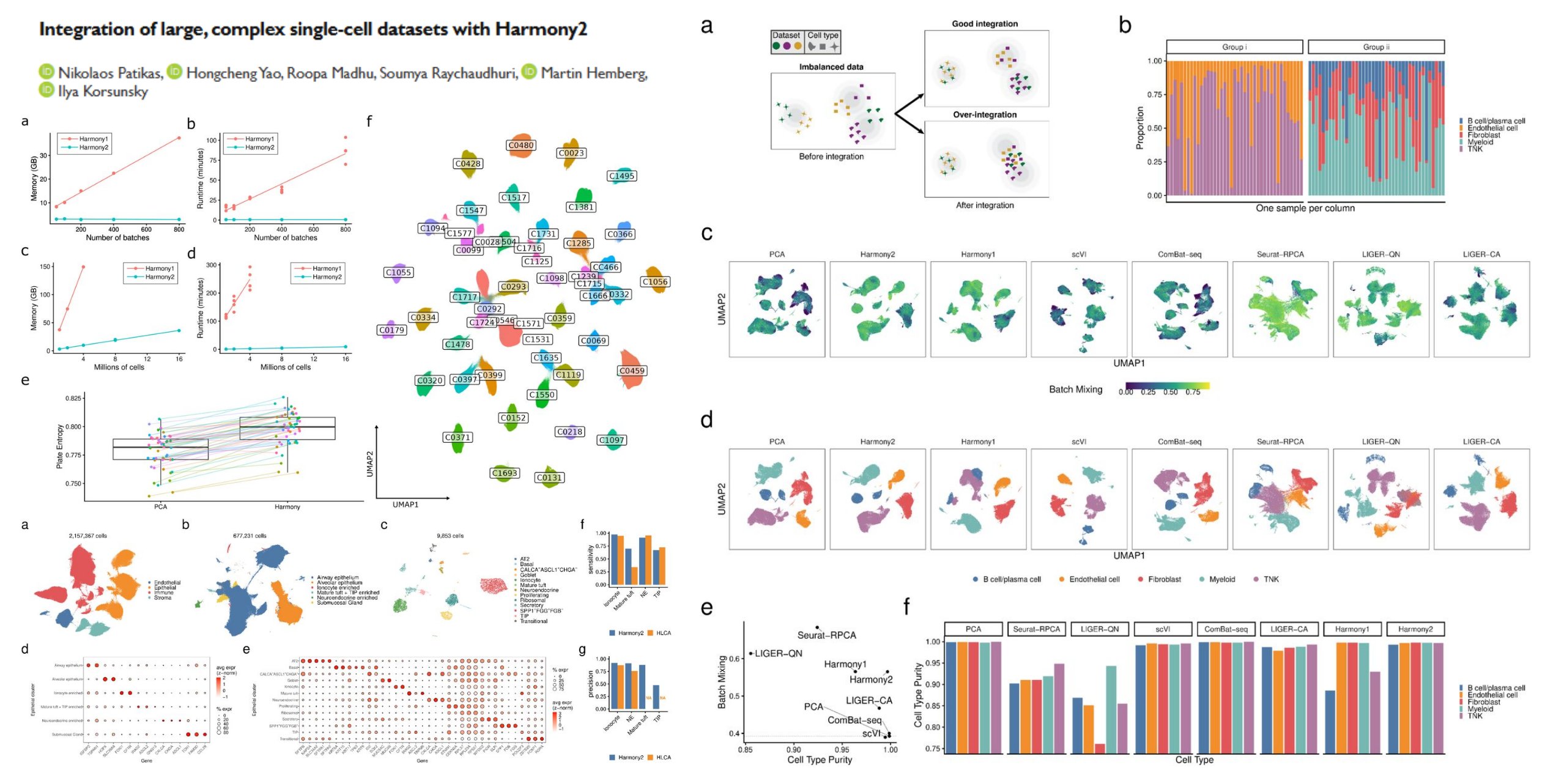
Harmony2 required only 2.1 GB and 1.3 minutes per million cells, and "scales linearly", and can integrate the full Tahoe-100M dataset & Human Lung Cell Atlas (Hierarchical integration)
vs Harmony scVI ComBat-seq Seurat-RCA LIGER-Quantile Normalization/-Centroid Alignment
@m_hemberg @ilyakorsunsky bioRxiv 2026
biorxiv.org/content/10.64898…
Ron Finn retweeted

Big news: Our Virtual Embryo project has been selected as a Laude Institute Moonshots Seed Grant winner — chosen from 125 proposals evaluated by 600+ leading researchers.
I’m deeply honored to be recognized alongside a remarkable community that includes Fields Medalists like Terence Tao, Nobel laureates like Michael Kremer, Turing Award winners like Raj Reddy, and creators of transformative tools such as Jupyter Notebook.
We are now building (1) the largest time-resolved organism-level 3D perturbation atlas of mouse embryogenesis; (2) what could become the first digital twin of mammalian embryogenesis — a predictive model of development designed to uncover the mechanisms of congenital disease and ultimately help ensure that every newborn has the healthiest possible start in life.
If this vision excites you, come build with us — alongside Emily Fox, James Zou (@james_y_zou), and Marinka Zitnik (@marinkazitnik).
Thank you to @LaudeInstitute for believing in this vision. We also welcome industrial and philanthropic partners who want to help shape the future of developmental biology and human health.
