

The Forest Condition Monitor (FCM) is supposed to visualise the condition of forests in Germany and Europe.
Freising, Germany
Joined June 2020
- Tweets93
- Following114
- Followers226
- Likes85





Der X-account des Waldzustandsmonitors wird ab heute nicht weiter aktualisiert. In Zukunft erfahren Sie alle Neuigkeiten auf unserem Bluesky-account @waldzustand.bluesky.social, so z.B. die Rundumerneuerung unserer interaktiven App sowie den Beginn der Monitoring-Saison 2025.
19
The X-account of the European Forest Condition Monitor will not be operated any longer. Instead, we will post news on our bluesky-account @forestmonitoring.bluesky.social, like the major update of our interactive app which combines forest monitoring and tree-species projections.
19
After the dry early summer, the forest canopy condition reached a negative record beginning of July but largely improved until end of July due to wetter conditions. #ForestCondition
(left: quantiles, right: proportions)
More info: shorturl.at/hoIQ9

Beginning of July, the #ForestCondition Monitor showed a stark increase in lowest quantiles, likely as a result of ongoing drought in that period. It'll be interesting to analyze canopy changes in July after repeated rainfall ended the #drought.
(left: quantiles, right: proportions)
More info: waldzustandsmonitor.de

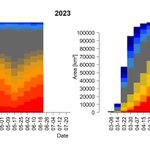
In mid June, forest canopy greenness declined in many parts of Germany due to emerging drought conditions. In particular, the Thüringer Wald, the Schwarzwald, the Eifel, and the majority of Bavaria and Baden-Württemberg were characterized by low canopy greenness #forestcondition

(left: quantiles, right: proportions)
More info:
waldzustandsmonitor.de
52
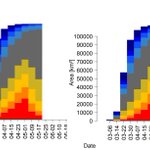
The late phenology as observed over the cool and wet spring period seems to catch in May as indicated by a reduction of low quantiles. Studying the development of #ForestCondition 2023 over the next weeks will be interesting due to increasingly drier conditions. #climatechange

The #ForestConditionMonitor season 2023 has started with relatively low quantiles in several parts of Germany. However, this might be caused by the relatively cool and moist spring conditions, which have delayed #phenology and the onset of the growing season.
#climatechange

After a record summer with respect to canopy greenness decline, the situation is slowly improving, yet extreme.
#ForestConditionMonitor #climatechange
(left: quantiles, right: proportions)
More info: bit.ly/38Tjx2u

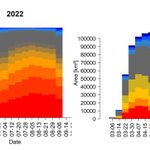
The recent development of the #ForestCondition Monitor (current state July 4th) indicates a thrice as large area (in total 18,000 km² corresponding to roughly 1/6 of forest area in Germany) to feature lowest quantiles in comparison to same period in 2018 (see fig.). #Drought2022

The German #forestcondition monitor has experienced a major revision. It is now possible to interactively select dates and municipal districts within Germany to visualize NDVI quantiles in conjunction with #Sentinel2 🛰️optical imagery. The new app can be found at:
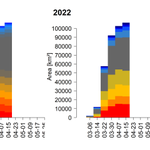
1) Start of the #Forestconditionmonitor season 2022: relatively high share of Germany's forests featured low quantiles at the onset of the growing season. The picture is heterogeneous though. However, given the high share of low quantiles despite an average to early greening

The European #forestconditionmonitor shows a heterogeneous year 2021: the late season-start entailed low greenness values in large parts in spring, the precipitation during summer indicates a relaxation of the last year's drought stress. Finland's forests suffered some drought.

In the 2nd edition of Copernicus Newsletter is an interview by Dr. Allan Buras about the #ForestConditionMonitor. The interview includes the product's background, who it is aimed at and what the Forest Condition Monitor can do.
Read the full interview: bit.ly/3I7NVCL
2021 featured a diverse season with a late season start while the overshoot precipitation in spring and summer led to a relaxation of the drought-stress since 2018 (high greenness in many parts of German #forests): bit.ly/3GKB2wO
#forestconditionmonitor

ALT Full monitoring season 2021: proportions and quantiles
Peak season (end of July) NDVI indicates a heterogeneous pattern across Europe. While parts of Central Europe featured a relaxation of the drought of the previous three years due to extensive precipitation, parts of Scandinavia featured low quantiles, possibly due

After the summer break, the forest condition monitor displays a relaxation from the drought of the past three years over large parts of Germany. However, hotspots of forest dieback such as the Harz or Thüringer Wald are yet characterized by very low quantiles and proportions.

And despite the relaxation, the drought 2018-2020 has had a significant impact on German and Central European forests as also indicated in the quantiles and proportions of those years.
(quantiles: left, proportions: right)
More info: bit.ly/3keYzOH
3
The greenness of German Forests has in the meantime reached normal to above average values, probably due to a relaxation of the drought in the past three years in course of precipitation surplus and a recovery from the delayed phenology in the extraordinarily cool spring 2021.

However, forests in Brandenburg, the Harz and Northrhine-Westphalia yet seem to suffer from drought legacies (NRW) and/or ongoing drought (Harz, BB) in these regions.
(left: quantiles, right: proportions)
More info: waldzustandsmonitor.de/en/el…
The EFCM has undergone a major update, now depicting forest greenness over the whole year in dependence of local average growing seasons and in WGS84 geographic projection. In April/May 2021 large parts of Central and Northern Europe featured relatively low greenness, which refle
The hypothesis from July 1st that high precipitation in spring relaxes the drought situation is supported by increasing shares of high quantiles (blue colors) in the recent update. However, some hotspots of potential forest decline remain in Central Germany (i.e. NRW, Hessen, and

The high share of lowest quantiles and low proportions has partly decreased in course of spring greening, supporting the interpretation from June 20th that the low greenness early in spring was caused by a delayed phenology.
