

Rector (parish priest) at S. Francis Anglican Church Dallas, ACNA, husband and father. Devout Catholic. Creator of bespoke ecclesiastical vesture. (thee/thou)
Dallas, TX
Joined June 2015
- Tweets11.4K
- Following1.5K
- Followers1.8K
- Likes17.9K




Fr. Timothy Matkin retweeted

A pagan Roman governor interrogated Christians about bread and wine before most of the New Testament canon was settled.
Pliny the Younger, writing to Emperor Trajan around 112 AD, reported that Christians met on a fixed day before dawn, sang a hymn "to Christ as to a god," and bound themselves with an oath, not to commit crimes, but to assemble for a shared sacred meal.
Notice what a hostile outsider confirms.
The Eucharist was not one worship element among many. It was the reason Rome noticed them. Pliny, who had zero theological agenda, describes a fixed, ritual, non-negotiable meal that Christians would rather be executed than skip. He dismissed it as "ordinary and innocent food" precisely because he could not see what the Church claimed was there.
That dismissal is the point. Rome saw bread. The Church saw what the risen Christ said it was.
The modern assumption says the early Eucharist was a flexible memorial supper, formalized centuries later. But a Roman bureaucrat's execution paperwork from the early second century records the opposite: a fixed rite, before dawn, treated as worth dying for, before a single council had met.
People do not face execution for a symbol. They face execution for a reality they cannot renounce.
If the Eucharist were only a memorial meal, why was it the rite Rome prosecuted first?
Fr. Timothy Matkin retweeted

Bill Maher Defends Israel. Ana Kasparian Challenges Him Over The Atrocities In Gaza
Ana Kasparian: I mean, Israel has nuclear weapons, and they have the world’s military superpower backing them.
Bill Maher: Well, they have nuclear weapons, which they don’t use.
Ana Kasparian: No, no, they don’t use them. But to pretend
Bill Maher: If Hamas had a nuclear weapon, how many seconds would it take before they used it on Israel?
Ana Kasparian: I have no idea.
Bill Maher: Three. Three is the answer. Three seconds.
Ana Kasparian: How do you know that, Bill? Come on.
Bill Maher: Because it’s in their charter.
Ana Kasparian: If they used a nuclear weapon against Israel, I’m pretty sure the very land Hamas cares about would be destroyed.
Bill Maher: Okay. Well, then they would be martyrs, and that would be a good thing because that’s their death-cult view of the world. It’s a good thing when you die. That’s why they sometimes strap suicide vests on children.
The fact that you can’t see the moral difference between these two sides always amazes me among people.
Ana Kasparian: I actually don’t see the moral difference when you have people like Bezalel Smotrich and Itamar Ben-Gvir literally talking about exterminating the entire population of Gaza.
These statements are brazen. They’re upfront and honest. This is what they actually want to do.
The West Bank is another example. The West Bank had nothing to do with what happened on October 7, but they’re annexing that land anyway. They’re terrorizing innocent people, innocent Palestinians, and driving them out of their homes.
Listen, I am willing to admit, because it’s the truth, that what Hamas did on October 7 was an atrocity. They killed innocent people.
Bill Maher: Who couldn’t admit that?
Ana Kasparian: But you have a difficult time at least acknowledging the atrocities that have been committed against innocent civilians in Gaza.
Bill Maher: Well, it depends on what you call an atrocity. All wars are going to have atrocities.
Ana Kasparian: A double tap on a hospital.
Bill Maher: I don’t know exactly what you’re talking about. I vaguely remember the thing.
Yeah. First of all, that’s an old terrorist trick. That’s what they do all the time.
Ana Kasparian: Okay, but are you at least going to acknowledge that the IDF doing that was wrong?
Bill Maher: Yeah. I’m sure they have committed what we would call war crimes, as every army does in every war.
Ana Kasparian: Including our own, right?
Bill Maher: In every war, including the Civil War.
Fr. Timothy Matkin retweeted

🚨 JUST IN: Sen. John Kennedy calls on GOP Leadership to immediately put DOGE-style LEGISLATION on the floor that uses waste, fraud and abuse cuts to pay off our national debt — and PASS IT before Dems take power
The Protecting American Taxpayers Act saves $240 BILLION 🤯
"Pass it and use the savings from abolishing or undermining that fraud to pay down our debt."
That bill was originally pushed by Sen. Joni Ernst
Republicans still hold the Senate until January. There's NO excuse not to bring this to the floor 🇺🇸
Fr. Timothy Matkin retweeted

The avg cost of electricity in the US is about 18 cents per kilowatt hour. In NY, it’s 28 cents a KWH. In Cali, it’s 34 cents. But in Texas folks pay just 15 cents per KWH… And Gov-elect Hinojosa wants to blow up this sweet deal with a price freeze?! Do Texans realize she may be leading them down the road to serious energy shortages?
yahoo.com/news/politics/arti…

Fr. Timothy Matkin retweeted

Israel handed Egypt more than 23,000 sq miles of land for a peace treaty. Israel today is about 10,000 sq miles. But sure, Israel is "expansionist."
This day (Nov 11) in 1977, Menachem Begin invited Anwar Sadat to Jerusalem. He accepted and addressed the Knesset. After real negotiations, Israel gave up the entire Sinai (oil fields, settlements, strategic depth, literally everything).
An Arab state willing to sign a peace treaty with Israel got territory larger than Israel itself. Almost all others brought only decades of rejection, terrorism, and chants of "from the river to the sea."
The "Greater Israel" narrative is just nonsense inversion. The side that keeps demanding more land, more "right of return," and the elimination of Jewish sovereignty is not the one that already gave up a peninsula more than twice its size.

Fr. Timothy Matkin retweeted
The Council of Nicaea is famous for defending Christ's divinity. Almost nobody mentions what its canons assume about the priesthood.
In 325 AD, the same 318 bishops who defined the faith against Arius issued Canon 18: deacons were forbidden from receiving communion before presbyters or from administering the Eucharist to them. Violations carried canonical discipline.
Read that carefully. This is not a rule about politeness or church manners. It is a rule about ontological order in the sanctuary.
If ministry were merely a functional job, as much of evangelicalism teaches, the distinction would make no sense. A deacon who serves tables and a presbyter who teaches are just different task descriptions. Nobody legislates canonical penalties over organizational etiquette.
But Nicaea treats the clergy as ranked in a sacred hierarchy that reflects the order of the Eucharist itself. The bishop stands at the altar. The presbyter shares in his priesthood. The deacon serves in a distinct order below both. This gradation was so fixed, so non-negotiable, that interfering with it was an offense against the Church's own structure.
And notice the timing. This is still the age before Constantine's church buildings were even widespread. The Church was emerging from the worst persecution it had yet endured, led by bishops who carried the scars of it. These were not comfortable imperial bureaucrats inventing hierarchy for political convenience. They were martyrs and confessors legislating a hierarchy they had inherited and were willing to die for.
The evangelical picture of a loose, informal early leadership that later "hardened" into priesthood runs into a wall here. By 325, the structure was already so developed that its internal ordering was a matter of conciliar law.
The question every Protestant should sit with: does your church's leadership structure look more like Nicaea's, or more like something the bishops of 325 would not recognize as ordination at all?

Fr. Timothy Matkin retweeted

There were warning signs for Venezuela. There are warning signs for America but voters won’t listen when they can’t afford gas. #endtheIranWarnow


Fr. Timothy Matkin retweeted

A baby survives an attempted abortion. Texas law requires that baby to receive lifesaving medical care.
Texas Democrats want to repeal that protection.And that's not all.
Rep. Donna Howard (D) has filed HB 126, a sweeping bill containing 46 repeal provisions that would dismantle decades of Texas laws protecting preborn children, newborns, women, and parental rights.
HB 126 would also repeal Texas's prohibition on pediatric gender modification, eliminate parental consent requirements for minors seeking abortions, dismantle informed consent protections, and repeal the Thriving Texas Families Program, which provides resources to women who choose life.
These are protections Texans have spent YEARS fighting for. Many survived lengthy court battles.
I've published a new Protect Childhood Initiative policy brief examining all 46 repeal provisions and explaining exactly what Democrats are proposing.
Read it. Share it. Know what's being proposed in the Texas Legislature.
protectchildhood.substack.co…
Texas Democrats had no intention of throwing in the towel on the culture wars. They're coming after our kids harder than ever.
HB 126 is nothing less than a child sacrifice initiative.
#txlege @TexasGOP

Fr. Timothy Matkin retweeted
The oldest surviving treatise on baptism was written to refute someone teaching you don't need it.
Around 200 AD, Tertullian of Carthage wrote De Baptismo to answer a teacher he describes as a "viper of the Cainite heresy" who went around convincing people baptism could be dispensed with. Faith was enough. The water did nothing.
Read that again. The "baptism is optional, it's just a symbol" argument did not originate with revivalists. It was already circulating in the Church at the turn of the third century. And the Church's response was not soft.
Tertullian calls the water of baptism the instrument by which sins are actually washed away and the person "set free and admitted into eternal life." Not a badge for a decision already made. The washing does something.
Then he describes what happens after the water. The newly baptized is anointed with blessed chrism, hands are laid on him, and the Holy Spirit is invoked. The oil "runs bodily over us," Tertullian says, "but profits spiritually." Water, oil, imposition of hands. The full Catholic shape, already fixed, over a century before Nicaea.
The remarkable part: the earliest surviving written refutation of someone arguing baptism was unnecessary came from a Christian scholar using Scripture and the Church's practice.
Which means your church's view of baptism has a lineage. The question is whose.
Fr. Timothy Matkin retweeted

I wasn't a fan of Abbott's culture war participation, and I've never voted R (or D), but it's nuts Texans replaced the guy who did all this with a lady who is already trying to tank our electricity infra with socialist price controls:
- Went from 12th largest economy in the world to 8th, larger than Italy, Russia, Canada
- Became the #1 home of Fortune 500 companies
- Positive budget all 12 years and created a record surplus
- 14.1% inflation-adjusted income gain for the avg Texan


Lectionary Bible Study - Yr A - Proper 28 youtube.com/live/j11SzrlB3bA… #ACNA #Anglican #Catholic #AngloCatholic #Lectionary #BibleStudy #Scripture #SecondComing #Apocalypse #Jesus #Gospel #Truth @StFrancisDallas @fwanglicans @diocese_ftw @The_ACNA

1
197
Fr. Timothy Matkin retweeted

Gov Gina’s energy plan is to copy California’s, whose energy rates are double that of Texas.
California froze energy rates and they turned in to the “Brown Out” State.
California is now 100% higher than Texas
•Texas Average Electricity
15.9¢ per kWh Vs California
29.8¢ per kWh
•Texas Average Natural Gas
0.0046¢ per BTU Vs California 0.0087¢ per BTU
foxnews.com/politics/texas-g…

Fr. Timothy Matkin retweeted

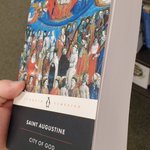
Father, I'm currently writing a graduate paper using that exact edition of The City of God.
I believe Augustine was writing for at least two distinct audiences, although his purpose ultimately became much larger.
First, he was addressing the pagan intellectuals and traditionalists who blamed the sack of Rome in 410 by Alaric and the Visigoths on the empire's abandonment of its ancient gods and its embrace of Christianity.
Augustine sought to demonstrate that Rome's misfortunes were not the consequence of Christianity. Indeed, Rome had experienced centuries of war, corruption, and suffering long before Christianity became the dominant religion of the empire.
Second, he was writing for Christians, particularly those struggling to understand how the supposedly Eternal City could fall after the Roman Empire had embraced Christianity.
Here Augustine makes an extraordinary theological argument.
Rome was never truly eternal. No earthly empire is.
He develops the distinction between the earthly city and the City of God, the heavenly Jerusalem. These are not simply Rome and the institutional Church, but two communities ultimately distinguished by what they love and where they place their highest allegiance.
The earthly city pursues temporal glory and power. The heavenly city seeks eternal communion with God.
And here's something particularly interesting about your question concerning the absence of the printing press.
Augustine corresponded with a man named Firmus, providing instructions for dividing the twenty-two books into volumes and making copies available to others.
So Augustine clearly anticipated that his work would circulate beyond its immediate recipients.
I suspect he was writing not merely to defend Christianity against the accusations of his contemporaries, but to establish a theological understanding of history that would survive the Roman Empire itself.
And sixteen centuries later, here we are, still discussing his arguments.
Perhaps that is the most remarkable answer to your question.
Fr. Timothy Matkin retweeted
Most Protestants are told relic veneration is a medieval corruption, something Constantine's era smuggled in from paganism.
But one of the earliest Christian documents outside the New Testament records the Church carefully collecting a martyr's bones and treasuring them.
The martyr was St. Ignatius of Antioch. Around 107 AD.
This kind of thing is the worst of A.I., taking someone's image and voice without authorization to basically push an editorial or sell a product.
I have no problem with fiction or satire, but this is outright deception.
@michiokaku
youtu.be/KYcGFTY04Ts?is=iYRx…
3
195
Fr. Timothy Matkin retweeted

Senator Rick Scott sent a letter to his colleagues laying out what he believes the Senate’s agenda should be for the remainder of the 119th Congress:
▪️Confirm every President Trump nominee
▪️Fund gov’t w/o massive omnibus bill
▪️Ban stock trading for Members of Congress
▪️Pass the Bipartisan American Affordability and Jobs Act
▪️Pass the NDAA
▪️Balance the budget
▪️Pass the SAVE America Act
“We ought to stay in session every day, 24 hours per day with a relentless focus on creating jobs, lowering prices, attacking government corruption, and holding Washington accountable until we achieve our goals.”
@SenRickScott


Fr. Timothy Matkin retweeted

🚨JUST FILED🚨
TX Representative Brian Harrison has filed a bill that would ELIMINATE ALL PROPERTY TAXES in the state.
Republicans need to make it a top priority to PASS this bill before Democrats take over.
@brianeharrison is again trying to live up to the promises made by Texas Republicans.


Fr. Timothy Matkin retweeted

On the left is how a Christian Anglo-Saxon woman would have dressed over a thousand years ago. On the right is how a many Muslim women currently dress.
The distinction between the Christian head covering and the Islamic hijab is not merely sartorial; it is foundational. While both involve a woman covering her head, they proceed from radically different views of the divine, the nature of humanity, and the relationship between the sexes.
The Theological Foundation
In Christianity, the head covering—as described in 1 Corinthians 11—is an act of voluntary participation in a created order, not a condition for avoiding divine punishment or a tool for social segregation. St. Paul writes that the woman covers her head because of the angels, signifying her recognition of God’s glory and the hierarchical order He established for the sake of harmony and peace within the Church. It is a sign of authority, yes, but it is an authority rooted in the context of the Body of Christ. It is an act of liturgical reverence performed by a daughter of God who is already redeemed. The covering acknowledges that while there are distinctions between male and female, both are image-bearers of God, equal in dignity and co-heirs of salvation.
In contrast, the Islamic hijab is fundamentally a requirement of Sharia (law) rooted in a theology of modesty necessitated by the perceived uncontrollability of male desire. The Quranic imperative (e.g., Surah 24:31) commands covering to distinguish believing women from others, effectively acting as a marker of group identity and submission to a legalistic code. In Islam, the hijab is often tied to the concept of fitna—social chaos—which women are seen as inherently prone to inciting. Consequently, the hijab serves as a protective barrier not just for the woman’s modesty, but as a mechanism to manage the social environment.
Differing Views on the Value and Nature of Women
These practices communicate divergent views on the value and status of women:
- Christianity: The Dignity of the Redeemed. In the Christian tradition, the head covering is not about hiding a woman’s face or body because she is a temptation, nor is it a means of restricting her movement in the public sphere. It is a sign that she is under the covering of her husband and, ultimately, under the covering of Christ. It reflects a theology where the woman is a daughter of the King, valued as a unique creation. The covering emphasizes her role within a family unit and the Church, focusing on her spiritual posture rather than her social containment. Even in traditional settings, Christian womanhood is honored; she is the "glory of man," a distinct and vital partner whose strength is celebrated (as in Proverbs 31).
- Islam: The Logic of Separation and Submission. The hijab communicates a different message: that the woman’s presence in public is a liability that must be mitigated. While some Muslim women frame the hijab as an empowering choice, the theological premise is rooted in a clear separation of spheres, often leaning toward the invisibility of women in public life. It serves as a visual boundary that separates the "clean" space of the household and the community of believers from the potentially corrupting influence of the outside world. The value placed on the woman is often tied to her ability to maintain this boundaries of purity, with the hijab acting as the physical wall ensuring she remains "protected"—a status that historically borders on possessiveness rather than the covenantal protection found in Christian marriage.
Ultimately, the Christian woman covers her head to acknowledge that she is part of a spiritual order that transcends the flesh, whereas the hijab is part of a system that places the burden of public morality upon the woman’s physical appearance. The Christian covering points upward to the relationship between the Church and Christ; the hijab points outward to the regulation of society.

