

Macro , AI, semis, high-beta
Joined March 2024
- Tweets1.5K
- Following183
- Followers359
- Likes195



$SPCX Breaking: SpaceX long-term bonds are getting hammered.
The 6.65% bonds maturing in 2056 have been sliding, last trading at 83.608, down 2.0% on the day to a recent low.
With a par value of 100, the falling price means yields are spiking. The market's fear over SpaceX's relentless cash burn and future debt issuance is playing out in the bond market.
No debt means no expansion. But issuing debt sends rates higher. AI clouds are caught in a catch-22.

240%! The Buffett Indicator Completely Crushes the 2000 Dot-Com Bubble
The U.S. stock market is now larger relative to the U.S. economy than at any point in history.
Buffett Indicator (Total U.S. Stock Market Valuation to GDP Ratio), July 2026: 240%. Dot-com peak (previous record): 144%.
The current scale of the U.S. stock market relative to the real economy has far exceeded the extreme levels seen just before the 2000 dot-com bubble burst.


Meta Muse's Download Dominance vs. Search Decline
Meta Muse's initial market penetration has diverged from its ongoing search interest.
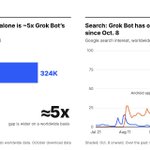
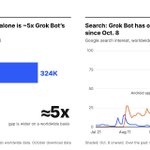
Downloads: Averaging 324K daily downloads in the U.S. alone (Sept 20-26), Muse generated roughly 5x the global volume of Grok Bot (62K).
Search Interest: Despite peaking on Sept 22, Muse's worldwide Google search interest has sharply decelerated. Since Oct 8, Grok Bot has consistently out-searched Muse daily (currently 45 vs. 15). However, on a trailing one-month basis, Muse still maintains a higher average interest (37 vs. 26).
The data indicates a rapid decay in post-launch search momentum despite massive initial acquisition. Sustained retention remains the critical test.

$SKHY Just in: Following Samsung Electronics, SK Hynix's massive share buyback also ended on the 21st.
SK Hynix said it completed its two-month, KRW 40 trillion share buyback on the KOSPI today.
The repurchased shares represent about 3.3% of total shares outstanding, making it the largest share cancellation by a Korean listed company. SK Hynix originally announced a buyback period from Aug 20 to Nov 19, but finished about a month early.
The biggest buyback is over. What's the next catalyst to send memory stocks. which make up over half of data center costs—significantly higher?
$SPCX SpaceX says it will continue massive investment, sparking fears of a growing debt burden.
Spreads on SpaceX's 6.6% bonds maturing in 2046 widened 9 bps to 264 bps; its 5-year CDS hit 232.6 bps, repeatedly marking new highs this month.
SpaceX's CFO said the company will focus investments on compute for its superintelligence division and Starlink broadband and mobile, and is in talks with multiple debt capital sources. It issued $25 billion in bonds in June and is negotiating $40 billion to buy Nvidia chips.
The company plans to maintain an investment-grade rating. Earnings growth and debt expansion are clashing, and the market doesn't like debt.
To break even on AI, the industry will need to generate $3.72 trillion in revenue every year by 2032, equivalent to 9.2% of U.S. GDP.
A September 2026 Brookings Institution study calculated the return threshold required to support the current AI infrastructure buildout:
TOTAL INVESTMENT: Capital expenditure on U.S. AI infrastructure (data centers, power, chips) from 2025 to 2032 is projected to reach $10.3 trillion.
BREAKEVEN THRESHOLD: To cover these investments and achieve a 10% unlevered return, the AI industry will need to reach a mature annual revenue of about $3.72 trillion by 2032 (this is an annual figure, not a 7-year total).
MACRO SHARE: This number equals 9.2% of the projected 2032 U.S. GDP. For comparison, total U.S. spending on food is 9.1% of GDP, and energy is just 5.1%.
GROWTH REQUIREMENT: Currently, the combined annualized revenue of OpenAI and Anthropic is around $100 billion. To hit that target, leading AI companies need to maintain roughly an 80% compound annual growth rate over the next 7 years.

Terrifying Bet: Anthropic's Future Infra Costs Top $600 Billion, Mostly "Non-Cancellable"
Compute demand is pushing Anthropic to the brink. Its prospectus reveals cloud compute commitments of up to $450 billion over the next 7 to 10 years.
It's on the hook to pay $111B to Google Cloud, $110B to AWS, and $31B to Microsoft—"regardless of actual usage." Including the Broadcom chip lease, total future infra costs exceed $600 billion, with another $150 billion in the pipeline.
The kicker: its compute needs are outgrowing what hyperscalers will provide, as they increasingly view Anthropic as a rival. Forced to use third-party operators with "limited operating history," the risk of this massive non-cancellable debt is compounding.

Momentum Factor Crashes to Historic Lows: Down 6.4% in a Single Week, the Worst in Over a Decade
Hit by a wave of headwinds, the momentum trade is undergoing a violent reversal. The weekly relative return of the iShares MSCI USA Momentum Factor ETF (MTUM) versus the S&P 500 ETF (SPY) plunged to -6.4% last week.
As the chart shows, this drop breaks records dating back to 2014, exceeding any single-week drawdown seen even during the 2020 pandemic crash or the 2022 bear market. The mass unwinding of high-momentum, crowded trades is now dominating the market.

Financing Costs Surge: US Investment-Grade Yields Hit 2023 High, Junk Yields Near 8%
US corporates are facing a brutal borrowing environment. Investment-grade bond yields have hit their highest since 2023, and high-yield (junk) yields are rapidly climbing back to the 8% mark.
With financing costs exploding across the board, highly leveraged AI infrastructure and data center projects are under severe funding pressure.

Retail Holdings Crushed: GS Retail Sentiment Index Plummets 26.2% from Cycle Highs
The basket of retail-heavy stocks tracked by Goldman Sachs (GS) has firmly entered crash mode. The index has plunged -26.2% from its May 28 cycle peak, now sitting at -10.3%.
The short-term selloff is accelerating: down -5.8% over the past week and -10.8% over the past month. The year-to-date gains (+10.3%) are being rapidly wiped out.

HSBC maintains its Reduce rating on CoreWeave, with a $39 price target implying 36% downside.
The bank estimates CoreWeave's 2026–2030 return on invested capital at 8.9%, below its borrowing costs.
More and more institutions are flagging the risks. @grok What do you make of it?
How can SpaceX achieve an ARR of $500,000,000,000 to $1,000,000,000,000 next year? Design the path to get there and assess its feasibility. @grok
Anthropic's operating data is thought-provoking -
Revenue ~$16,300,000,000
Net Loss ~$80,700,000,000
IPO Valuations ~$2,000,000,000,000
@grok Explain the reason behind such massive losses, and how soon will it go bankrupt?
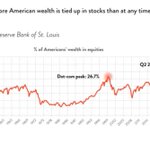
Americans' wealth is tied up in the stock market like never before.
As of Q2 2026, the share of Americans' wealth invested in equities hit 34%, the highest level on record.
For comparison, at the peak of the 2000 dot-com bubble, it was just 26.7%.
When everyone's life savings are tied to the stock market, any AI bubble burst is no longer just a paper loss on Wall Street. It will directly devastate the real wealth and spending power of countless households, significantly raising the risk of an economic recession.

Speculative data center debt is being packaged and sold to pension and retirement funds, university endowments, and other institutional investors, in a manner strikingly similar to the subprime bubble. Private equity firms bought life insurance companies and loaded them with risky debt, exposing policyholders and the public to losses and increasing the threat of financial contagion.
Instead of addressing these mounting risks, the Trump administration and federal financial regulators are dismantling regulatory guardrails, aggravating the potential damage of the looming crisis.
ourfinancialsecurity.org/res…

$3.1 Trillion: AI Giants' "Hidden Debt" Has Already Crushed the 2007 Subprime Crisis
The combined on- and off-balance-sheet debt of just nine hyperscalers and chipmakers (Alphabet, Amazon, AMD, Broadcom, Meta, Microsoft, Nvidia, Oracle, and SpaceX) totals a staggering $3.7 trillion, of which $3.1 trillion is off-balance-sheet. For comparison, subprime mortgage debt at its 2007 peak, adjusted for 2026 dollars, was $2.3 trillion.
Source: The Wall Street Journal and company filings, as of September 2026.
